Fastio API vs SharePoint API for AI Agents: A Technical Comparison
Choosing the right storage API is critical for building performant AI agents. While the SharePoint Graph API offers deep Microsoft ecosystem integration, it presents significant friction for automated workflows due to aggressive rate limiting and complex authentication. The Fastio API provides low latency, realtime event feeds, and native Model Context Protocol (MCP) support designed specifically for high-performance AI agents.

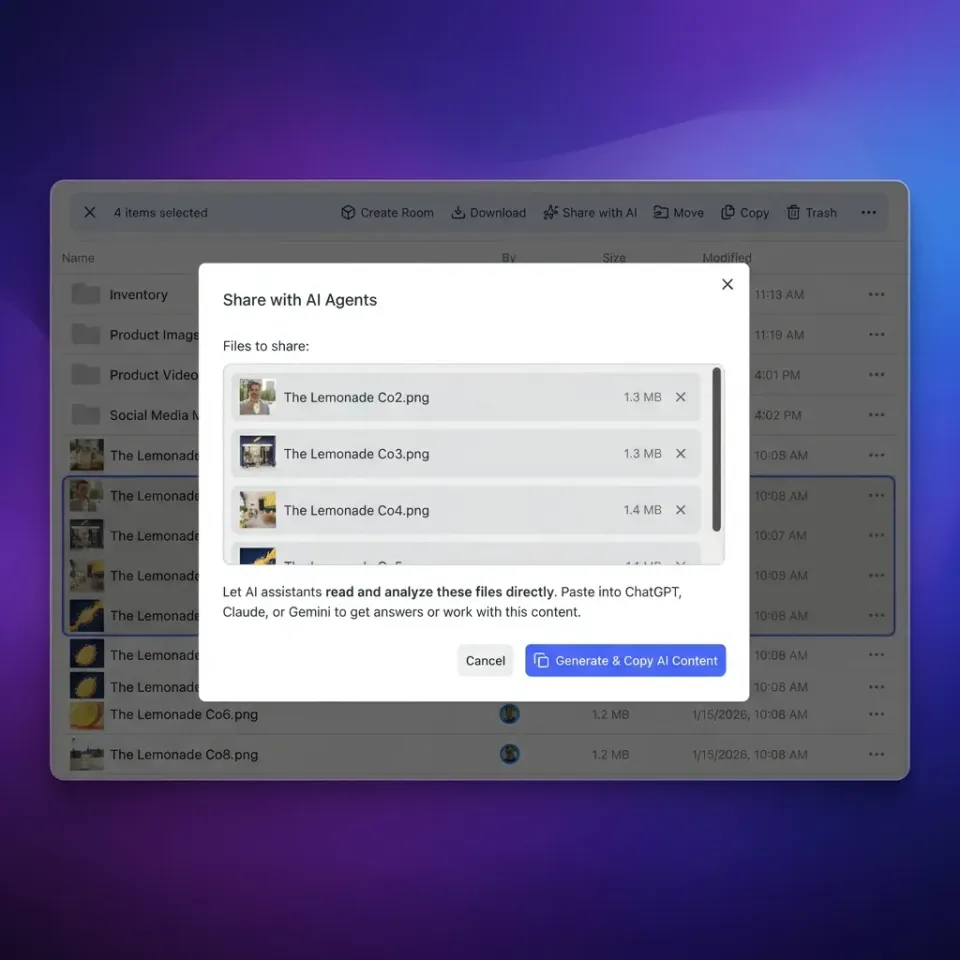
Storage APIs for the Agentic Era
As AI systems evolve from conversational chat interfaces into autonomous agents that read, write, and reason over enterprise data, the requirements for file storage APIs have fundamentally changed. Traditional platforms were built for human collaboration: optimizing for graphical interfaces, deep directory trees, and manual permission management.
AI agents require a different architecture. They need high-speed programmatic access, reliable event streams for reactive workflows, and standard protocols like MCP to interact with tools without writing custom integration code for every large language model (LLM).
While SharePoint API offers deep Microsoft ecosystem integration, Fastio API provides the low latency, realtime event feeds, and native MCP support required for high-performance AI agents. This technical comparison examines how both platforms handle the specific demands of automated, agentic file access.

SharePoint Graph API: Built for Humans, Adapted for AI
Microsoft's Graph API is the unified endpoint for accessing data across Microsoft 365, including SharePoint Online. It is a massive, comprehensive REST API that allows applications to interact with sites, lists, drives, and list items.
For enterprise teams heavily invested in the Microsoft ecosystem, SharePoint is often the default choice. However, when connecting AI agents to SharePoint, developers frequently encounter architectural friction. The Graph API was designed to support human users navigating applications, not autonomous agents processing thousands of files in parallel.
Authentication Complexity
Accessing SharePoint via the Graph API requires navigating the Microsoft identity platform (Entra ID/Azure AD). Developers must register applications, configure complex API permissions (delegated vs. application), and manage OAuth 2.0 token lifecycles. For an AI agent that needs to simply read a document or write an analysis report, this overhead can be prohibitive.
Rate Limiting and Throttling
SharePoint Graph API rate limits often throttle intensive agent data retrieval. Microsoft employs aggressive throttling to protect tenant performance. When an AI agent attempts to index a large repository or process multiple files concurrently, it frequently triggers multiple Too Many Requests responses. Developers must implement complex backoff and retry logic, slowing down agent execution significantly.
Fastio API: Native Infrastructure for AI Agents
Fastio is designed specifically for automated and agentic file access. Rather than bolting AI capabilities onto a legacy human-first platform, Fastio treats AI agents as first-class citizens. The platform provides an intelligent workspace where files are auto-indexed, searchable by meaning, and immediately accessible to LLMs.
Native Model Context Protocol (MCP) Support
The most significant advantage Fastio offers for AI development is its native support for the Model Context Protocol. Fastio exposes multiple MCP tools via Streamable HTTP or Server-Sent Events (SSE). This means developers can connect Claude, GPT-multiple, or local models to Fastio workspaces with zero custom integration code. Every capability available in the Fastio UI has a corresponding agent tool.
Built-in RAG and Intelligence
When you upload a file to Fastio, the workspace intelligence automatically indexes it. There is no need to build a separate vector database or configure chunking strategies. Agents can query the workspace directly, and Fastio provides semantic search results with citations. This eliminates the complexity of maintaining a parallel RAG pipeline.
Event Feed Reliability and Speed
Agentic workflows are often reactive. An agent needs to take action when a new file arrives or an existing file is modified. Fastio provides WebSocket events and a realtime activity feed, allowing developers to build responsive, event-driven systems without inefficient polling.


Ready to build smarter agents?
Connect your agents to intelligent workspaces with a consolidated MCP toolset and built-in RAG today.
Performance and Usability Comparison
When evaluating these APIs for AI agent integration, several key technical differences emerge.
- Setup Speed: Connecting an LLM to Fastio via the OpenClaw integration or standard MCP takes minutes. Configuring an Azure AD app, setting Graph permissions, and writing a custom retrieval layer for SharePoint takes days.
- Data Ingestion: Fastio supports URL Import, allowing agents to pull files directly from Google Drive, OneDrive, or Box via OAuth without requiring local I/O. SharePoint requires downloading and re-uploading files.
- Concurrency: Fastio provides advisory file locks and version history so agents can acquire a lease before writing and coordinate safely, whereas SharePoint relies on complex eTag versioning that is difficult for LLMs to manage reliably.
- Agent Isolation: Fastio allows agents to dynamically create workspaces, share them, and transfer ownership to human users while retaining administrative access. This makes it ideal for agents building client portals or delivering automated work products.
Which API Should You Choose?
If your organization has strict mandates to keep all data within the Microsoft multiple boundary and you have dedicated engineering resources to build and maintain custom RAG pipelines, Entra ID authentication, and robust throttling management, the SharePoint Graph API is necessary.
However, if your goal is to rapidly deploy performant AI agents, Fastio is the superior choice. Fastio is designed specifically for automated and agentic file access. Its native MCP support, built-in vectorization, and developer-friendly API eliminate the friction of building AI storage infrastructure. With transparent tiered plans (Starter $29/mo, Business $99/mo, Growth $299/mo) and a 14-day Business Trial (credit card required), developers can evaluate and scale agentic workflows immediately.
Frequently Asked Questions
Is SharePoint good for AI agents?
SharePoint can be used for AI agents, but it requires significant custom engineering. Its Graph API is built for human collaboration apps and often throttles the intensive data retrieval patterns typical of AI agents. You will need to build your own authentication, RAG pipeline, and retry logic.
How to connect AI agents to SharePoint?
To connect an AI agent to SharePoint, you must register an application in Entra ID (Azure AD), configure Graph API permissions, implement OAuth 2.0 token management, and write custom code to fetch documents, parse their contents, and feed them into your LLM's context window or a separate vector database.
What are the Fastio vs SharePoint API limitations?
SharePoint's main limitations for agents include aggressive API rate limiting, complex Entra ID authentication, and the lack of native LLM integration protocols. Fastio's limitations are primarily that it exists outside the native Microsoft multiple compliance boundary, though it offers URL import to pull data from OneDrive.
Does Fastio require a separate vector database?
No. When you enable Intelligence Mode on a Fastio workspace, files are automatically indexed. Agents can query the workspace using semantic search and receive answers with citations, eliminating the need to maintain a separate Pinecone or Milvus instance.
What is the Model Context Protocol (MCP)?
MCP is an open standard that allows AI models to securely connect to external tools and data sources. Fastio natively supports MCP, exposing multiple tools that allow agents to read, write, and manage files without developers needing to write custom API wrappers.
Related Resources

Ready to build smarter agents?
Connect your agents to intelligent workspaces with a consolidated MCP toolset and built-in RAG today.