Fastio API vs Pinecone: Best Context Storage for Agents
Guide to fastio api pinecone agent context: When building AI agents, your context storage architecture determines how well your models reason over enterprise data. Pinecone provides a vector database for similarity search. Fastio offers a file-based intelligent workspace. This comparison explores whether your agents need raw files or just embeddings to perform at their best.


What is Agent Context Storage?
Agent context storage is the infrastructure that provides AI models with the relevant information they need to answer questions and execute tasks. It also helps them maintain state over time. It acts as the persistent, long-term memory for Large Language Models (LLMs), allowing them to access proprietary enterprise data that was not included in their original training set.
For developers, the primary architectural decision is whether to store this context as raw files (such as PDF documents, code repositories, and spreadsheets) or as mathematical representations called vector embeddings. The storage architecture you choose directly impacts your agent's ability to cite sources accurately and understand broad document context. It also affects how well agents collaborate with human team members. If an agent only has access to isolated data chunks, it cannot easily understand the structural flow of a full report.
Helpful references: Fastio Workspaces, Fastio Collaboration, and Fastio AI.

Related guides
- Fastio API Presigned URLs Implementation GuideFastio API presigned URLs allow your applications to grant secure, time-limited, direct access to files without...
- How to Build a Fastio API Golang ImplementationBuilding a Fastio API Golang implementation allows developers to manage workspaces, upload files concurrently, and...
- How to Automate the Fastio API Ownership Transfer WorkflowOwnership transfer via the Fastio API enables autonomous agents to securely hand off completed workspaces and files to...
- How to Implement Semantic Search with Fastio APIHow to implement semantic search with Fastio API starts with enabling Intelligence Mode on a workspace. This...
- How to Integrate Fastio API with LangChain ToolsConnect Fastio's API to LangChain tools. AI agents then get lasting file storage, RAG across multiple files, and...
- How to Integrate Fastio API with Next.js ApplicationsGuide to integrating fast api with next applications: Integrate Fastio API with Next.js to manage agentic workspaces...
More on this subject: Agent Integrations and APIs (191 guides)
Pinecone: The Dedicated Vector Database Approach
Pinecone is a focused vector database designed to store, manage, and query high-dimensional vector embeddings at large scale. It has become a core component in standard Retrieval-Augmented Generation (RAG) pipelines, enabling fast semantic search across billions of data points.
While Pinecone does well at dense vector similarity search, it is strictly an embedding storage layer. It does not store the original source files. This means developers must build, host, and maintain separate infrastructure for document ingestion and parsing. You also have to manage chunking and raw file hosting, typically using an AWS S3 bucket.
Pros:
- Speed: Delivers millisecond latency for similarity search across large datasets.
- Large Scalability: Purpose-built for handling enterprise-grade embedding workloads.
- Ecosystem Integration: Well-supported across the AI developer ecosystem, including LangChain and LlamaIndex.
Cons:
- No Raw File Storage: You are responsible for hosting and managing the original documents elsewhere.
- High Pipeline Complexity: Requires you to build and maintain the chunking and embedding pipelines. You also have to write syncing logic to keep vectors up to date.
- Agent Isolation: Human team members cannot easily browse, read, or verify the raw data stored as mathematical vectors.
Fastio API: The Intelligent File Workspace
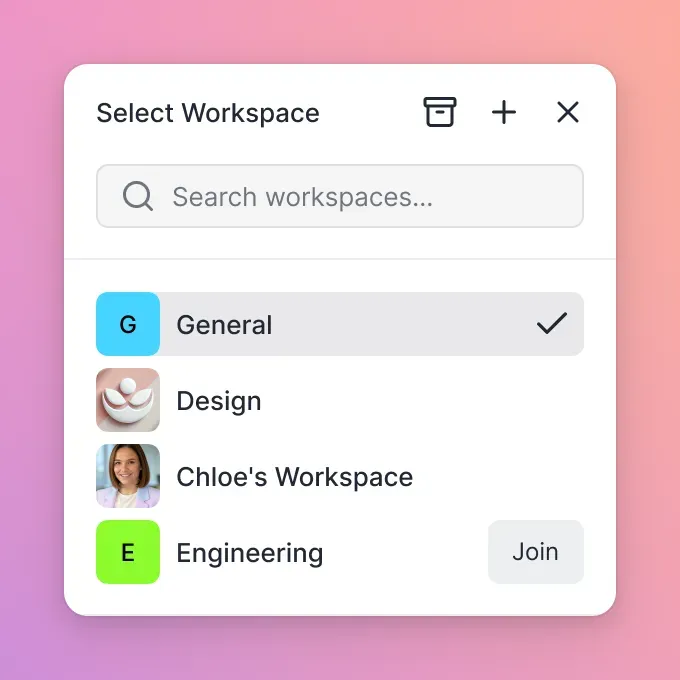
While Pinecone handles dense vector similarity search, Fastio provides a full file-based intelligent workspace that manages raw documents, metadata, and agent context. Instead of just storing mathematical embeddings, Fastio acts as a shared environment where both humans and AI agents interact with the actual source files.
When you upload a file to a Fastio workspace with Intelligence enabled, the platform automatically indexes it for semantic search. Your agents get the benefits of a vector database, including built-in RAG with citations, without requiring you to build or maintain the ingestion pipeline. With a consolidated MCP toolset available via Streamable HTTP, agents have detailed access to read, write, search, and organize their context on the fly.
Pros:
- Unified Workspace Storage: Agents and human users share the exact same files and collaborative workspaces.
- Zero-Config Built-In RAG: Files are automatically indexed upon upload; no manual chunking, parsing, or embedding pipelines are required.
- Plans and Trial: Transparent tiered plans (Starter, Business, Enterprise) with a 14-day Business Trial (credit card required).
Cons:
- File-Centric Architecture: Best suited for workflows that originate from distinct documents, media files, or structured folders rather than isolated database rows.
- General Purpose: Not designed solely for large-scale vector benchmarking scenarios.


Give your AI agents a real workspace
Stop building complex RAG pipelines. Get built-in Intelligence and a consolidated MCP toolset during your 14-day Business Trial.
Vector Embeddings vs Raw Files: The Architectural Choice
The choice between Pinecone and Fastio comes down to what your AI agent needs to accomplish in its daily operations. If you are building a system that analyzes millions of disconnected text snippets or application logs, a dedicated vector database is essential.
However, if your agent needs to read a specific legal PDF, modify a codebase, or organize a project folder, it needs direct access to the raw files.
For most agentic applications, having access to the raw files alongside built-in intelligence provides a better foundation than relying on embeddings alone.
Implementation Comparison: Building a Context Pipeline
Building a standard RAG pipeline with Pinecone requires managing different systems. First, you must extract text from your source documents using a parser. Next, you chunk the text into smaller segments to fit LLM token limits. Then, you pass those chunks to an embedding model to generate vectors. Finally, you upsert those vectors into Pinecone while saving the raw file to an S3 bucket at the same time and storing the metadata in a relational database to map the vector ID back to the file URL. This synchronization logic is prone to breaking and failure when files are updated or deleted.
Conversely, implementing context storage with the Fastio API is straightforward. You create a workspace and upload the file using standard HTTP endpoints. Fastio's Intelligence Mode automatically handles the parsing, chunking, and embedding in the background.
To retrieve context, your agent can connect to the Fastio Model Context Protocol (MCP) server. By connecting to the remote server at https://mcp.fast.io/mcp/tools, your agent can search the workspace in natural language, and the API returns the relevant text snippets along with citations and a direct link to the human source file.
Also, Fastio supports URL Import, allowing you to pull files directly from Google Drive, OneDrive, Box, or Dropbox via OAuth without any local I/O bottlenecks.
Using MCP and OpenClaw for Dynamic Context
Context is not static. AI agents often need to write new files and update existing documents. They also restructure folders based on their reasoning. Pinecone is read-heavy by design, focusing on retrieval rather than complex data manipulation.
Fastio supports the Model Context Protocol (MCP) to provide agents with a consolidated MCP toolset via Streamable HTTP. Agents can acquire advisory file locks before writing, heartbeat them while working, and release them when done to coordinate concurrent multi-agent workflows safely, alongside reading file ranges, tracking version history, or generating shareable links.
Connecting an agent to Fastio is zero-config. Point your agent to the remote MCP server at https://mcp.fast.io/mcp/tools (or https://mcp.fast.io/mcp/code for coding agents), signing in or sending a scoped API key as a Bearer header, to equip your LLM with a consolidated MCP toolset. Because Fastio works with any LLM, including Claude, GPT models, Gemini, and local models, you are never locked into a specific vendor's ecosystem.
Human-Agent Collaboration and Ownership Transfer
A major architectural gap in vector databases is the inability to hand off agent output to a human client. Humans cannot read vector embeddings.
Fastio solves this through its Ownership Transfer primitive. An AI agent can create an organization and build a workspace. It can then populate it with generated research or compiled code before transferring ownership of that workspace to a human user via email. The agent retains admin access to continue working, while the human receives a branded file interface they already know how to use. This makes Fastio not just a storage backend, but a true coordination layer where agent output becomes team output.
Fastio provides a WebSocket events feed and an activity feed to trigger reactive workflows. When a human uploads a new file to the workspace, the events feed notifies the agent to begin processing it, removing the need for blind polling.
Evidence and Benchmarks for Hybrid Approaches
Recent implementations of enterprise RAG systems indicate that relying only on dense vector embeddings can often limit an agent's contextual understanding. Semantic search might find the most relevant paragraph but lose the broader structural context of the entire document, leading to hallucinations or logically incomplete answers.
RAG pipelines using hybrid file and vector approaches show higher context retrieval accuracy compared to dense-only retrieval methods. By maintaining the raw file structure alongside the semantic index, Fastio allows agents to find the relevant semantic chunk. They can also read the surrounding pages, verify the source document's metadata, and cite the exact file for human review.
Best Practices for Context Architecture
When designing the context storage architecture for your AI agents, following established best practices ensures scalability and reliability.
First, always maintain a single source of truth. One of the primary causes of hallucination in enterprise agents is data drift between the S3 file bucket and the Pinecone vector index. If a user deletes a file but the vector embedding remains in Pinecone, the agent will generate answers based on deleted data. Fastio eliminates this risk; when a file is deleted from the workspace, its intelligent index is purged.
Second, implement strong access controls. Agents should only have access to the context necessary for their specific tasks. In a Pinecone setup, you must implement metadata filtering rules for every query to enforce multi-tenant security. In Fastio, security is handled at the workspace and folder level. You provision a specific API key scoped to a single workspace, ensuring that the agent cannot access sensitive files outside its designated boundary.
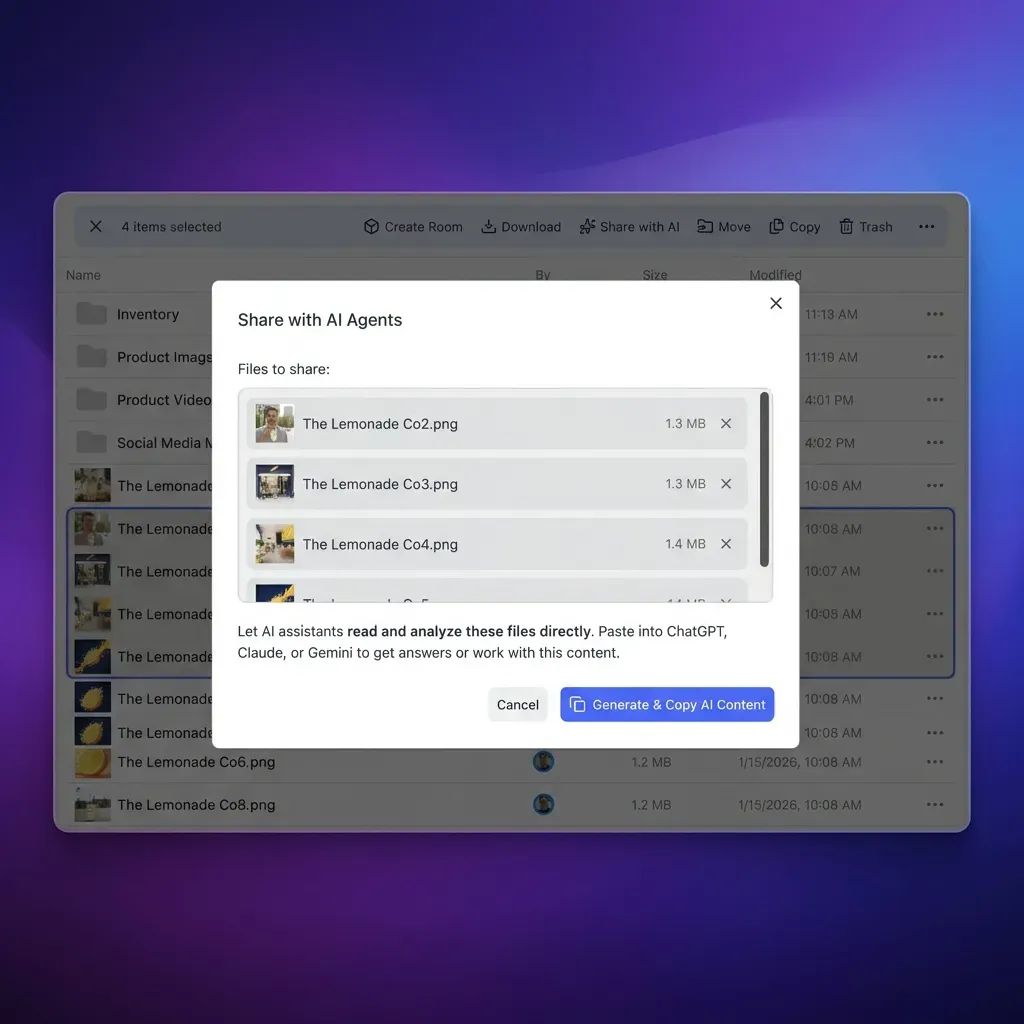
Third, plan for multimodal context. Modern agents are no longer restricted to text. They need to analyze images and transcribe video files. They also process complex diagrams. A standard vector database struggles with raw media unless you build custom preprocessing pipelines. Because Fastio is a file storage system, it supports uploading and organizing any file format, allowing agents to process raw image assets directly from the workspace.
Troubleshooting Common Context Retrieval Issues
Regardless of the storage architecture you choose, you will encounter context retrieval failures. Understanding how to debug these issues is important for maintaining agent reliability.
The "Lost in the Middle" Phenomenon LLMs often struggle to extract relevant information when it is buried in the middle of a large context window. When using Pinecone, developers often try to solve this by returning more vector chunks, which worsens the problem by flooding the LLM with disjointed text. With Fastio, you can use MCP tools to narrow the search scope. Instead of searching the entire vector database, the agent can inspect a specific folder in the workspace and analyze only the most relevant document, reducing context noise.
Handling Stale Embeddings If your agent is providing outdated answers, your vector embeddings are likely out of sync with your source documents. In a Pinecone architecture, you must write custom synchronization scripts to monitor your S3 bucket and re-parse updated documents. You also have to issue update and delete commands to the vector index. With Fastio, this synchronization is handled automatically. Updating a file via the Fastio API invalidates the old semantic index and generates a new one.
Debugging Citations When an agent hallucinates a fact, developers need to verify the source. In a vector setup, the agent often cannot provide a direct link to the source document because it only interacted with an abstract string of text. Because Fastio integrates the intelligent index directly with the file system, every semantic search result includes a permanent, clickable URL to the exact source file, allowing developers to verify whether the agent misinterpreted the text or if the source document itself contains an error.
How to Choose the Right Storage for Your Agents
If your core application requirement is querying billions of isolated data points with sub-millisecond latency for specialized data science workloads, Pinecone remains the industry standard vector database for the job. It provides the bare-metal infrastructure needed for large-scale semantic search.
However, if you are building autonomous AI agents that need to collaborate with human teams, Fastio is the better choice. It helps agents read full source documents and manage persistent state within a structured file environment. It removes the burden of building a multi-service RAG pipeline while providing agents with the MCP tools they need to operate on real enterprise files.
Frequently Asked Questions
Should I use vector storage or file storage for agents?
It depends on your workflow. Use vector storage if you only need semantic search across large, unstructured text datasets. Use file storage if your agents need to interact with complete documents or share outputs with humans. It also helps if they require built-in RAG without maintaining ingestion pipelines.
What is the difference between Pinecone and Fastio?
Pinecone is a specialized vector database that stores mathematical embeddings for fast similarity search. Fastio is an intelligent workspace that stores raw files and automatically indexes them for AI. It also provides agents with multiple MCP tools to manage and collaborate on that data.
Can I use Fastio as a vector database?
Fastio includes built-in Intelligence Mode that automatically provides RAG capabilities and semantic search for your files. While it handles the vector database complexities for the developer, it serves the same functional purpose for agent context retrieval.
How do MCP tools work alongside agent storage?
Fastio provides a consolidated Model Context Protocol (MCP) toolset via Streamable HTTP. These tools allow your AI agents to read, write, and search files within the workspace. They act as the interface between the LLM and its context storage.
Do I need to chunk files before uploading to Fastio?
No. When you upload a file to a Fastio workspace with Intelligence Mode enabled, the platform automatically handles document ingestion and chunking. It also manages embedding and indexing. Your agents can ask questions and get answers with citations.
Related Resources

Give your AI agents a real workspace
Stop building complex RAG pipelines. Get built-in Intelligence and a consolidated MCP toolset during your 14-day Business Trial.