How to Enable Edge AI Agent File Access: Patterns for Local Storage and Fast Inference
AI agents need fast access to data where it lives. Moving file storage to the edge reduces lag and makes autonomous workflows more reliable. This guide looks at patterns like local caching and peer-to-peer sync that power edge-first agent storage. See how to combine local speed with cloud coordination for your AI deployments.

What is Edge AI Agent File Access?
Edge AI agent file access refers to patterns for giving AI agents fast, reliable access to files by running storage on edge infrastructure close to users. In traditional architectures, an agent must send a request to a central data center, wait for the file, and then process it. This causes lag, especially for multi-gigabyte files or high-frequency operations.
Moving file access to the edge means the data stays on the same local network or device as the inference engine. This change improves how agents work in the real world. Instead of relying on a slow internet link and remote cloud storage, they can work at the speed of local hardware. This is essential for autonomous drones, industrial robotics, and real-time medical imaging where every millisecond counts.
By prioritizing edge-first storage, you ensure that your agents remain functional even when connectivity is patchy. The agent no longer needs a constant connection to the cloud just to read a local config file or a sensor log. This independence makes the entire system more resilient and reduces the bandwidth costs of moving massive amounts of data back and forth to the cloud.
Helpful references: Fastio Workspaces, Fastio Collaboration, and Fastio AI.
The Case for Edge: Latency, Reliability, and Privacy
Three things drive the move to edge-native AI: speed, reliability, and security. Cloud storage is great for coordinating global data, but it fails when you need a response in less than a second. For many enterprise workloads, the delay of sending data to a remote server and waiting for a response is a deal-breaker.
According to Cisco and Forrester Research, edge computing reduces AI inference latency by multiple-multiple% compared to cloud-only setups. This speed boost isn't just a minor tweak. It changes what AI agents can actually do. When an agent can access its training data or local context in multiple milliseconds instead of multiple, it can react to its environment in real-time.
Reliability is also key. If your AI agent depends on the cloud for every file read, a single network hiccup can stall the whole workflow. Edge deployment protects the final link in the chain. Even if the broader internet goes down, the agent can keep working using locally cached or synced data.
Finally, privacy and governance are major concerns for enterprise deployments. Many organizations don't want to send sensitive proprietary data to the cloud for processing. By keeping file access at the edge, you can process information locally and only sync the results or metadata to the cloud. This approach keeps data secure while still allowing for centralized reporting.
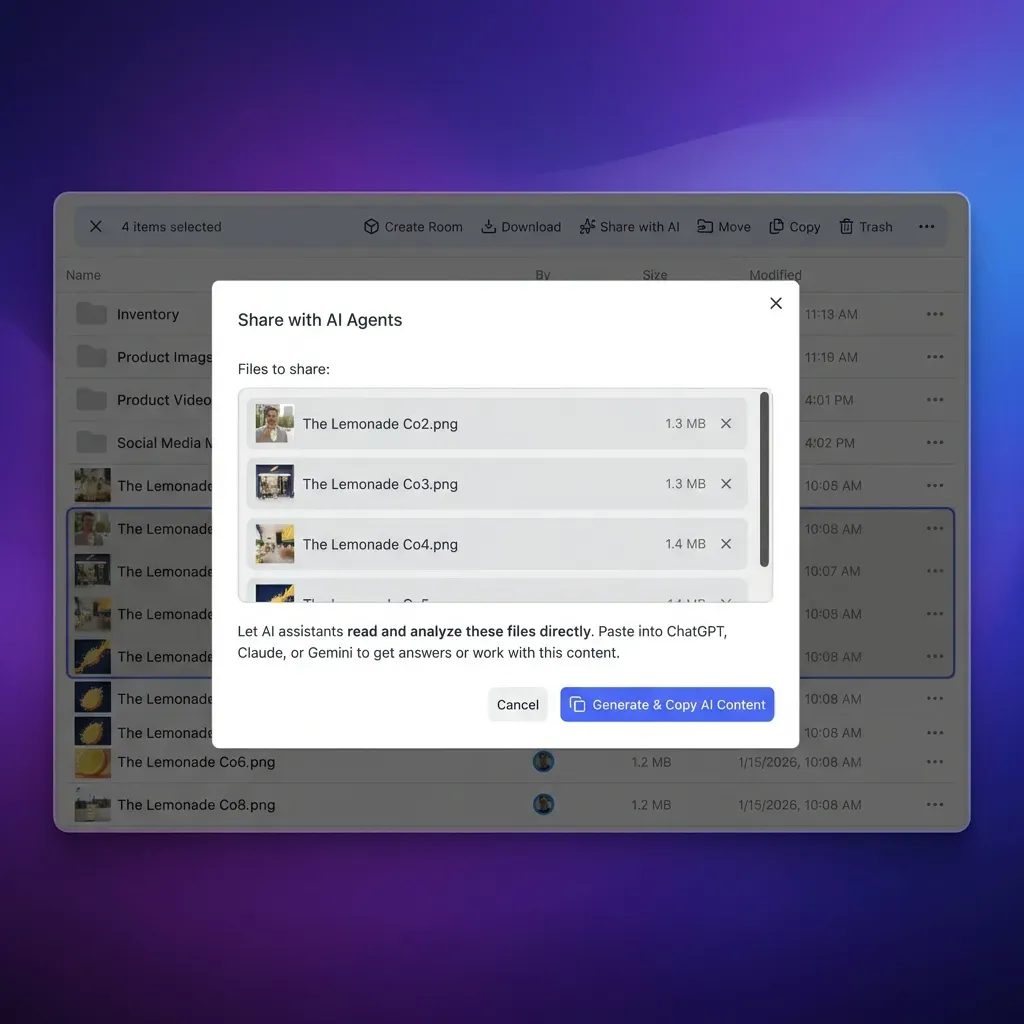


Give Your AI Agents Persistent Storage
Get 50GB of free agent storage and access to 19 consolidated tools. Start building the future of autonomous workflows today. Built for edge agent file access workflows.
Evidence and Benchmarks: Why the Edge Wins
The industry is quickly recognizing that the cloud cannot handle the scale of modern AI workloads alone. As models become more complex and data volumes grow, the bottleneck moves from the CPU to the network interface. The shift toward the edge is already well underway in most sectors.
Gartner predicts that by multiple, over multiple% of enterprise AI workloads will involve edge components. This represents a massive shift from just multiple% in multiple. The reason for this growth is clear when you look at the raw performance metrics. In a typical cloud-based agent setup, the network round-trip time (RTT) often accounts for more than multiple% of the total inference time. By moving the storage to the edge, you effectively eliminate that RTT.
In practice, this means an agent can process a multiple video file for object detection in seconds rather than minutes. It can query a local RAG index with thousands of documents and receive an answer almost instantly. These benchmarks prove that the edge is not just a "nice to have" feature but a core requirement for the next generation of autonomous systems.
Key Patterns for Edge AI Agent Storage
Architecting file access for edge agents means choosing the right pattern for your specific use case. There is no one-size-fits-all solution, but most successful deployments use one of these three approaches.
1. Local Caching
In this pattern, the agent keeps a high-speed local cache of the most common files. When the agent needs a file, it checks the local cache first. If the file is missing, it pulls it from the cloud and saves a copy for later. This is the simplest pattern to set up and makes repetitive tasks much faster.
2. Peer-to-Peer (P2P) Synchronization
For clusters of agents working together in one location, P2P sync lets them share files directly without hitting the cloud. If Agent A downloads a large dataset, Agent B can pull it directly from Agent A over the local network. This saves bandwidth and ensures the local cluster stays synced even if the external link is slow.
3. Hybrid Synchronization
This is the advanced pattern and the one we recommend for enterprise apps. It combines local speed with cloud governance. Files stay local for fast access, but all changes are synced back to a central workspace. This ensures a global "source of truth" always exists while allowing edge agents to work at full speed.
Implementing Edge-First Workflows with Fastio
Fastio provides the infrastructure to connect edge performance with cloud management. Our platform is an intelligent workspace where both humans and agents do their best work. Here is how you can set up an edge-first strategy using our tools.
The 19-tool MCP Server
Our Model Context
Protocol (MCP) server gives your agents multiple tools for managing, searching, and sharing files. You can run the MCP server on your edge infrastructure, letting your agents interact with local workspaces via Streamable HTTP or SSE. This gives them a standard interface for file operations while keeping data transfers local. For example, an agent can use the list_files or read_file tools to browse a local directory that is synced with a Fastio cloud workspace.
URL Import and Cloud Bridges
One of the biggest challenges of edge AI is getting data from legacy cloud systems like Google Drive, OneDrive, or Box into the edge environment. Fastio's URL Import lets you pull files directly into a workspace via OAuth without local I/O on your side. Once the file is in a workspace, your edge agents can access it using our APIs or MCP tools. This "pull" model is much more efficient than traditional upload-download cycles because it uses provider-to-provider transfer speeds.
Webhooks for Reactive Logic
To build autonomous systems, your agents need to know when files change without constant polling. Our webhooks notify your edge agents the moment a file is uploaded, modified, or moved. This lets you build reactive workflows where an agent starts processing a file as soon as it arrives at the edge. A developer can set up an endpoint that triggers an inference run the second a new sensor log appears in the workspace. This event-driven architecture ensures your agents are always working on the most current data without wasting cycles.
Security and Data Governance at the Edge
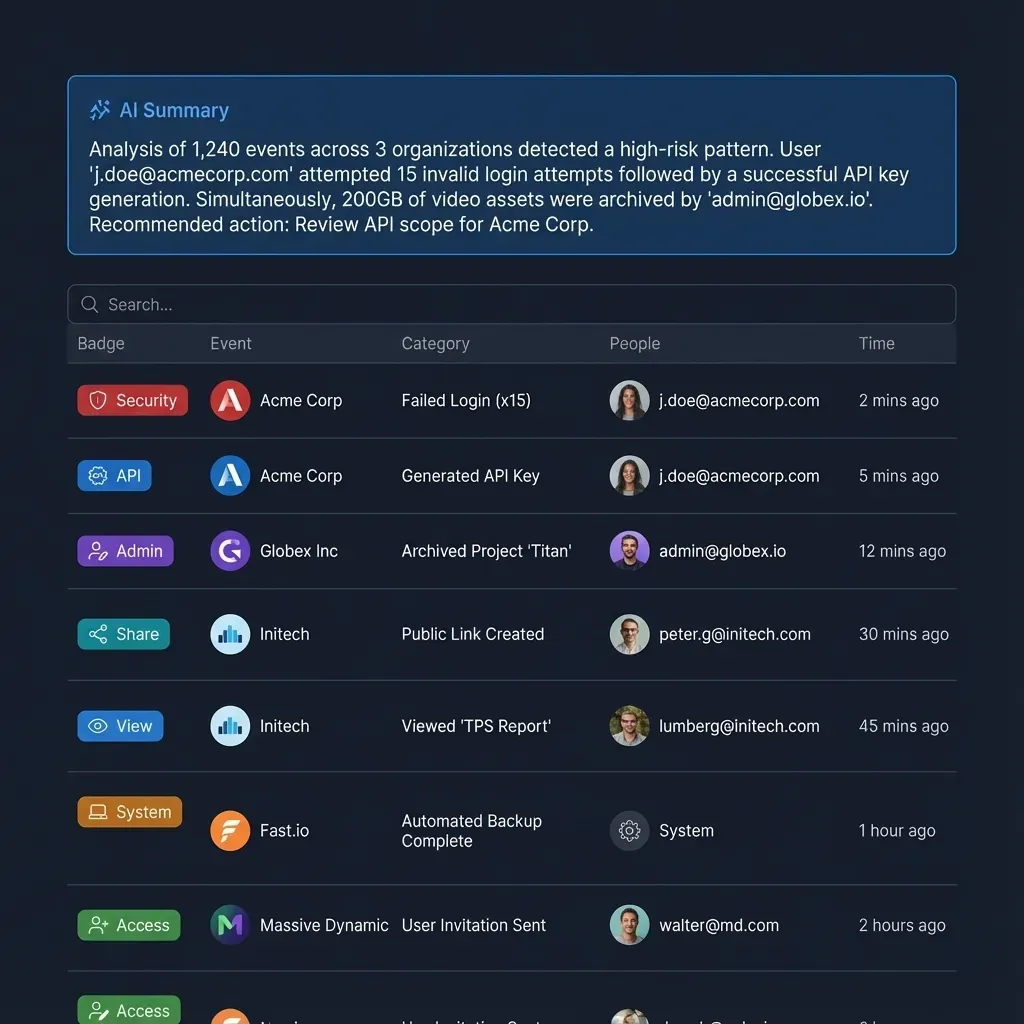
Security at the edge has its own set of challenges. Unlike a centralized data center, edge nodes are often physically accessible or located on less secure networks. Fastio handles this with granular access controls and end-to-end encryption for all file transfers. Our security model ensures that even if an edge device is compromised, your broader data stays protected through scoped tokens and workspace permissions.
You can define exactly which agents have access to which workspaces. Our "Intelligence Mode" also lets you index files for RAG (Retrieval-Augmented Generation) while keeping the actual content within the workspace boundaries. When an agent queries the index, it receives citations pointing back to the specific files, ensuring full transparency. This is important for legal or healthcare apps where tracking data sources is a requirement.
The ownership transfer feature in Fastio also lets an agent build a workspace and then hand it over to a human. This is perfect for when an edge agent processes data and then delivers the results to a client or supervisor. The human receives the workspace as a polished deliverable, but the agent can keep admin access to continue its work or perform maintenance if needed. This pattern connects automated production with human oversight, ensuring agent-generated content has a clear path to review.
Frequently Asked Questions
How do AI agents access files at the edge?
AI agents access files at the edge using local APIs or specialized protocols like the Model Context Protocol (MCP). Instead of calling a remote cloud server, the agent talks to a local storage node or a cached workspace on the same network. This removes network lag and ensures the agent can work even when the internet is patchy.
What is edge AI agent deployment?
Edge AI agent deployment involves running the AI model and its storage infrastructure on local servers or devices near the data source. This is common in industrial and medical apps where real-time response is critical. Fastio supports these deployments by providing a lightweight coordination layer that works with any LLM.
How do you sync agent files between edge and cloud?
Syncing between edge and cloud is usually done through a hybrid synchronization pattern. Files stay local for fast access, and a background process pushes updates to a central cloud workspace. Fastio automates this by providing a global source of truth that agents can access locally through our multiple-tool MCP server.
What storage works best for edge AI agents?
The best storage for edge AI agents is a workspace that supports high-speed local access, built-in indexing for RAG, and strong synchronization tools. Fastio is ideal for this because it combines multiple of free agent storage with a massive library of MCP tools, letting agents search, read, and write files with minimal overhead.
Can AI agents work offline at the edge?
Yes, AI agents can work offline at the edge if they have access to a local file store and a locally hosted LLM. By using a local cache or a persistent edge workspace, the agent can continue its tasks until a connection is restored. Once back online, Fastio can sync any local changes to the cloud for global visibility.
Related Resources

Give Your AI Agents Persistent Storage
Get 50GB of free agent storage and access to 19 consolidated tools. Start building the future of autonomous workflows today. Built for edge agent file access workflows.