How to Deploy Fastio MCP Server on Vercel
Deploying the Fastio MCP server on Vercel enables scalable, serverless access to your agent's file tools without managing infrastructure. While most documentation focuses heavily on Docker or local deployment for the Model Context Protocol, this guide specifically targets modern full-stack workflows.

Why Deploy Fastio MCP Server on Vercel?
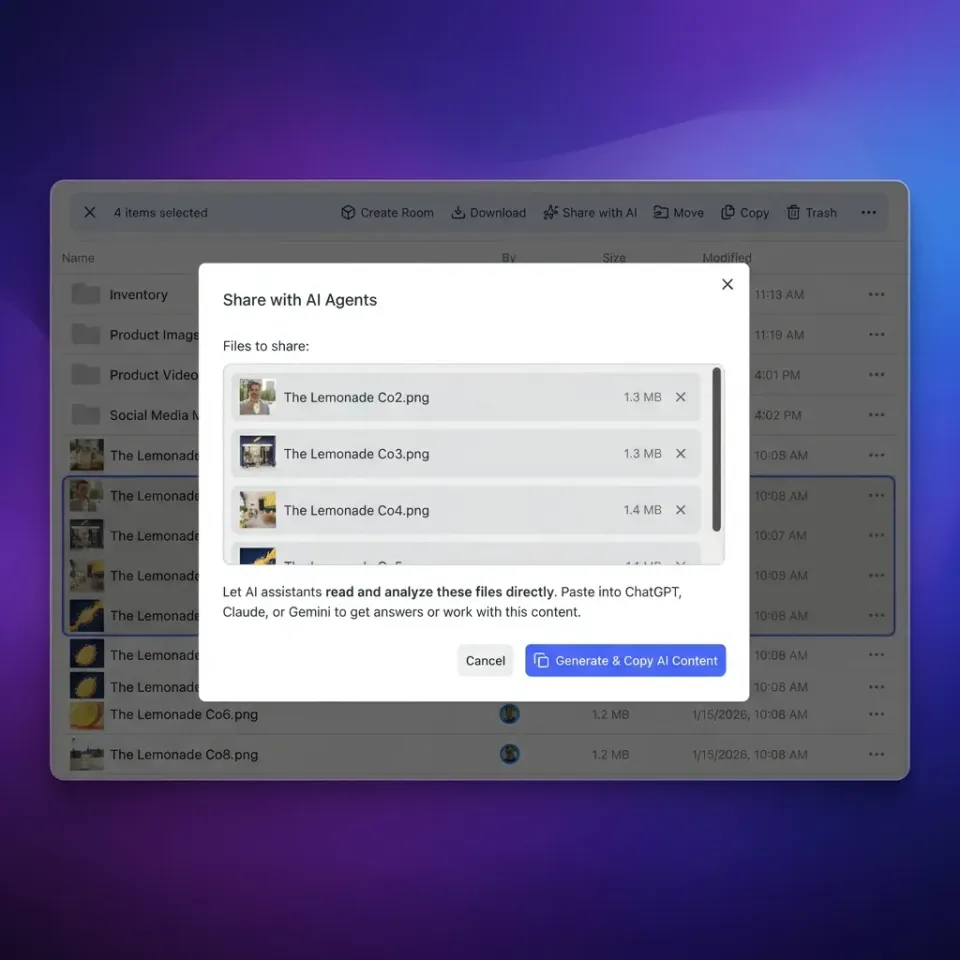
Deploying the Fastio MCP server on Vercel enables scalable, serverless access to your agent's file tools without managing infrastructure.
Historically, the Model Context Protocol (MCP) has been heavily associated with local desktop environments or containerized Docker deployments. While those approaches work well for local development or traditional server architectures, they introduce unnecessary friction for teams building modern, cloud-native AI applications. By choosing a serverless deployment model, you shift the operational burden away from your engineering team.
According to Amazon Web Services, "Serverless technologies feature automatic scaling, built-in high availability, and a pay-for-use billing model... eliminate infrastructure management tasks like capacity provisioning and patching." This architectural shift allows developers to focus entirely on building intelligent agent behaviors rather than maintaining persistent server connections or dealing with operating system updates. Vercel's edge network and serverless functions provide an ideal hosting environment for the streamable HTTP endpoints required by modern MCP implementations, ensuring low latency and high reliability across the globe.
Related guides
- How to Deploy Fastio MCP Server on AWS LambdaConnecting serverless agents on AWS Lambda to the Fastio remote MCP server gives your AI workflows persistent file...
- How to Connect Azure Container Apps to the Fastio MCP ServerConnecting agent runtimes on Azure Container Apps to the Fastio remote MCP server provides a secure, serverless...
- How to Run AI Agents on Google Cloud Run with FastioGoogle Cloud Run is a good home for an agent that runs on demand and then gets out of the way. This guide covers the...
- How to Deploy a Fastio MCP Server on RenderDeploying a Fastio MCP server on Render requires configuring environment variables and web services to expose tools....
- How to Deploy and Host an MCP ServerMoving an MCP server from localhost to a production environment gives remote access to AI agents across your...
- How to Deploy Your Agent on Kubernetes with Fastio MCPFastio hosts and operates its MCP server, so Kubernetes runs your agent rather than the Fastio server. This guide shows...
More on this subject: MCP and Model Context Protocol (238 guides)
The Fastio Intelligent Workspace Advantage
Before configuring your deployment, it is crucial to understand why Fastio serves as the optimal coordination layer for AI agents. Fastio is an intelligent workspace, not just a static storage bucket. Intelligence is native to the platform; files are indexed and searchable once Intelligence is enabled for the workspace.
Agents and humans share the exact same workspaces, the same toolsets, and the same underlying intelligence. While human collaborators interact through an intuitive visual interface, your deployed AI agents utilize the consolidated MCP toolset to perform matching actions programmatically. This ensures absolute parity between what a user can do and what an automated agent can achieve.
Also, Fastio offers a 14-day Business Trial requiring a credit card, allowing teams to evaluate shared workspaces, granular permissions, and agent access with usage-based credits before selecting a plan at /pricing/.
Prerequisites for Serverless Agent Deployment
To successfully deploy the Fastio MCP server to Vercel, you need to gather a few essential credentials and understand the underlying protocol requirements.
First, you must create a Fastio organization and generate your API keys. These keys will authenticate your Vercel serverless functions against the Fastio backend. Second, you need an active Vercel account and the Vercel CLI installed on your local machine for testing and deployment. Third, your application must be prepared to handle Server-Sent Events (SSE). Unlike traditional REST APIs that close the connection after a single response, MCP heavily relies on persistent, streamable HTTP connections to maintain context and stream large tool responses back to the language model.
When connecting an agent client, point your environment configuration to your deployed streamable endpoint URL to enable natural language file management and workspace operations.
How to Configure vercel.json for Fastio MCP
To successfully expose a streamable HTTP endpoint for MCP, you must override Vercel's default routing and caching behaviors. The exact configuration requires adjusting function execution times and setting specific HTTP headers.
Follow these steps to configure your Vercel project:
- Create the configuration file: Add a
vercel.jsonfile to the root of your project directory. - Set the maximum duration: For persistent agent connections, set
maxDurationas high as your Vercel plan allows. - Disable aggressive caching: Ensure that EventStream responses bypass the CDN cache to deliver real-time agent updates.
{
  "functions": {
    "api/**/*.ts": {
      "maxDuration": 300,
      "memory": 1024
    }
  },
  "headers": [
    {
      "source": "/api/(.*)",
      "headers": [
        {
          "key": "Cache-Control",
          "value": "no-cache, no-transform"
        },
        {
          "key": "Content-Type",
          "value": "text/event-stream"
        }
      ]
    }
  ]
}
This configuration ensures that your Vercel deployment correctly identifies the endpoint as a streaming connection and prevents intermediate proxy servers from buffering the AI agent's tool responses.
Implementing the Streamable HTTP Endpoint
With the infrastructure configuration in place, the next phase involves writing the serverless function that handles the Model Context Protocol communication. In a serverless architecture, session state cannot be stored in local memory because the compute instances are ephemeral. Instead, the MCP server utilizes Fastio's robust backend to maintain state across requests.
Your API route must be capable of processing incoming POST requests containing tool execution commands and returning an EventStream response. When an agent requests to read a large document or execute a complex search query, the streamable HTTP connection allows the server to send chunks of data back to the client as soon as they become available.
This asynchronous, streaming approach dramatically reduces time-to-first-byte (TTFB) and prevents the serverless function from exhausting its memory limits when handling massive datasets. By acting as a lightweight proxy, your Vercel deployment seamlessly bridges the gap between your preferred language model and the consolidated MCP toolset provided by Fastio.



Ready to deploy intelligent agents at scale?
Explore collaborative workspaces and the consolidated Fastio MCP toolset.
Handling Agent Collaboration and Concurrency
When deploying an MCP server globally via Vercel, you introduce the possibility of concurrent access. Multiple agents, or human-agent teams, might attempt to modify the same workspace simultaneously. Fastio coordinates concurrency through advisory file locks alongside granular permissions, automatic file version history with restore, and a detailed activity log tracking every action. An agent can acquire an advisory file lock before writing, heartbeat it while active, and release it when complete; concurrent writes without a lock land safely as distinct versions in version history.
When an agent updates a document, Fastio creates a new version automatically while preserving prior revisions. Connected clients can monitor changes via the activity feed, ensuring data integrity without blocking other collaborators.
Additionally, serverless environments lack persistent local file systems. To mitigate this, agents should utilize Fastio's cloud import capabilities to bring files directly from Google Drive, OneDrive, Box, Dropbox, or public URLs. This eliminates local input/output bottlenecks entirely, as file transfers happen directly between cloud providers rather than passing through your Vercel function's limited memory.
Activating Intelligence Mode and Built-in RAG
A significant advantage of deploying Fastio's MCP server is the immediate access to advanced Retrieval-Augmented Generation (RAG) capabilities without provisioning separate vector databases. Vercel acts simply as the scalable compute proxy, while Fastio handles the complex, compute-intensive processes of document chunking, embedding generation, and semantic retrieval.
Files are indexed and searchable once Intelligence is enabled for the workspace. Your agents can then utilize specific MCP tools to ask natural language questions and receive mathematically grounded answers with precise document citations.
This built-in RAG pipeline significantly reduces the architectural complexity of your application. You no longer need to manage Pinecone clusters, orchestrate document parsing pipelines, or write complex chunking algorithms. The entire intelligence lifecycle is managed seamlessly within the shared workspace, accessible immediately via the serverless Vercel deployment.
Ownership Transfer and Client Handoff
One of the most powerful workflows enabled by a serverless Fastio MCP deployment is the seamless handoff of digital assets. In a typical agency or consulting scenario, an AI agent operates autonomously to generate valuable deliverables.
Using the provided MCP tools, the agent creates an organization, builds customized workspaces, and populates them with processed files, research reports, or code artifacts. Once the automated work concludes, the agent initiates an ownership transfer, securely handing the workspace over to a human client or stakeholder.
The agent successfully transfers ownership while retaining specific administrative or read-only access roles. This allows the automated system to continue delivering updates, processing background tasks, or syncing external data, while the human client receives a fully branded, secure environment to review and access the final output. The serverless Vercel deployment ensures this orchestration layer remains highly available and responsive to event feeds.
Troubleshooting Vercel Deployment Issues
Even with a precise configuration, deploying streamable endpoints to serverless environments can present unique challenges. Understanding how to diagnose and resolve these edge cases ensures a robust agent integration.
First, address connection timeouts. If your AI model processes complex queries that exceed Vercel's maximum execution duration, the connection will drop unexpectedly. Implement aggressive chunking strategies or poll the realtime activity feed or subscribe to the WebSocket events feed to check task status asynchronously.
Second, manage Server-Sent Event (SSE) connection stability. Ephemeral network issues can interrupt streaming responses. Ensure your client-side MCP implementation includes robust retry logic and exponential backoff algorithms to automatically re-establish dropped connections without losing the conversational context.
Finally, monitor rate limits carefully. While Vercel scales horizontally to handle massive traffic spikes, your underlying Fastio API keys are subject to organizational rate limits. Implement intelligent request batching and rely on native search tools rather than aggressively pulling raw file data to optimize your operation quota.
Sources
References used to verify factual claims in this guide.
-
Serverless technologies feature automatic scaling, built-in high availability, and a pay-for-use billing model... eliminate infrastructure management tasks like capacity provisioning and patching
Frequently Asked Questions
Can I host an MCP server on Vercel?
Yes, you can host an MCP server on Vercel by utilizing serverless functions and streamable HTTP endpoints. By correctly configuring your `vercel.json` file to support Server-Sent Events (SSE) and disabling aggressive caching, Vercel provides a highly scalable and reliable environment for Model Context Protocol communications.
How to deploy Fastio MCP?
To deploy the Fastio MCP, you need to configure an API route in a hosting environment like Vercel that securely proxies requests to the Fastio backend using your organization's API keys. The deployment must support streaming responses to effectively handle the continuous, bidirectional communication required by AI agents accessing the consolidated MCP toolset.
What is included with the Fastio Business Trial?
The Fastio Business Trial provides up to 14 days of access on a monthly plan (credit card required) to evaluate collaborative workspaces, granular permissions, usage-based credits, and the consolidated MCP toolset. Details can be found at /pricing/.
Does Fastio support built-in RAG?
Yes, Fastio provides built-in Retrieval-Augmented Generation natively within its workspaces. Once Intelligence is enabled for the workspace, all uploaded files are automatically indexed, allowing agents to perform semantic searches and generate accurate answers with verifiable citations without requiring a separate vector database integration.
How do I test my serverless MCP endpoint?
You can test your serverless MCP endpoint using standard cURL commands configured to accept EventStream data, or by connecting an MCP-compatible agent client with your endpoint URL and API key to verify tool execution.
Related Resources

Ready to deploy intelligent agents at scale?
Explore collaborative workspaces and the consolidated Fastio MCP toolset.