How to Orchestrate Cross-Vendor AI Agent Teams in Shared Workspaces
Mixing models like GPT-4, Claude, and Gemini is often the best way to build a high-performance AI strategy. Each model has unique strengths, yet managing these diverse agent teams is difficult without a common ground for files. Shared workspaces provide a vendor-neutral coordination layer where agents collaborate on the same data without being locked into a single ecosystem.

The Shift Toward Multi-Model AI Strategies
The era of the single-model AI system is ending. Developers now realize that different Large Language Models (LLMs) excel at different tasks. While GPT-4 might be the best choice for complex reasoning and logic, Claude 3.5 Sonnet often wins for creative coding and long-context processing. To build high-performance agentic workflows, organizations are increasingly deploying teams that pull from multiple vendors simultaneously.
According to a 2025 McKinsey report, more than two-thirds of organizations now use AI in more than one business function, with half employing it in three or more. This shift is driven by the need for resilience and performance optimization. By using multiple models, teams can avoid vendor lock-in and choose the most cost-effective or capable model for every specific step in a workflow.
Related guides
- Building Shared Workspaces for LangGraph Multi-Agent TeamsA shared workspace for LangGraph teams gives agents a central spot to access shared files, state, and tools. We'll look...
- Implementing Collaborative Prompt Versioning for Shared Agent EnvironmentsTeams working on AI agents need a way to track changes to their instructions. When multiple people edit the same...
- How to Evaluate Collaborative RAG Performance in Shared Agent MemoryEvaluating collaborative RAG helps teams understand how multiple agents use a unified memory without creating noise or...
- How to Build a Partner Ecosystem Collaboration PlatformPartner ecosystems need a better way to share files across different networks. Research shows partners drive multiple%...
- How to Build a Sales Pipeline Collaboration WorkspaceSales pipeline collaboration lets teams share deal files and updates in real-time to close deals faster. By keeping...
- How to Set Up a Collaborative GeoJSON Review for AI Mapping AgentsValidating GeoJSON data is one of the most expensive parts of building autonomous systems. When mapping agents and...
More on this subject: Team Collaboration (125 guides)
The Primary Barrier: Interoperability and State
Despite the benefits, orchestrating agents from different vendors introduces a major technical hurdle: interoperability. Most AI platforms are designed to keep users within their own family of models. This creates silos where an OpenAI agent cannot easily see the work done by an Anthropic agent unless they share a persistent data layer.
Industry research from 2025 identifies interoperability as the primary barrier to scaling multi-model systems. Without a shared workspace, agents struggle to maintain a consistent state across different models. If a GPT-4 agent generates a report and a Claude agent needs to review it, they need a vendor-neutral environment where the file is stored, indexed, and accessible to both via standardized tools.
Shared Workspaces as a Coordination Layer
A shared workspace serves as the 'ground truth' for cross-vendor teams. Instead of passing massive amounts of text back and forth between API calls, agents use a persistent filesystem as their workspace. This approach allows agents to build upon each other's work asynchronously.
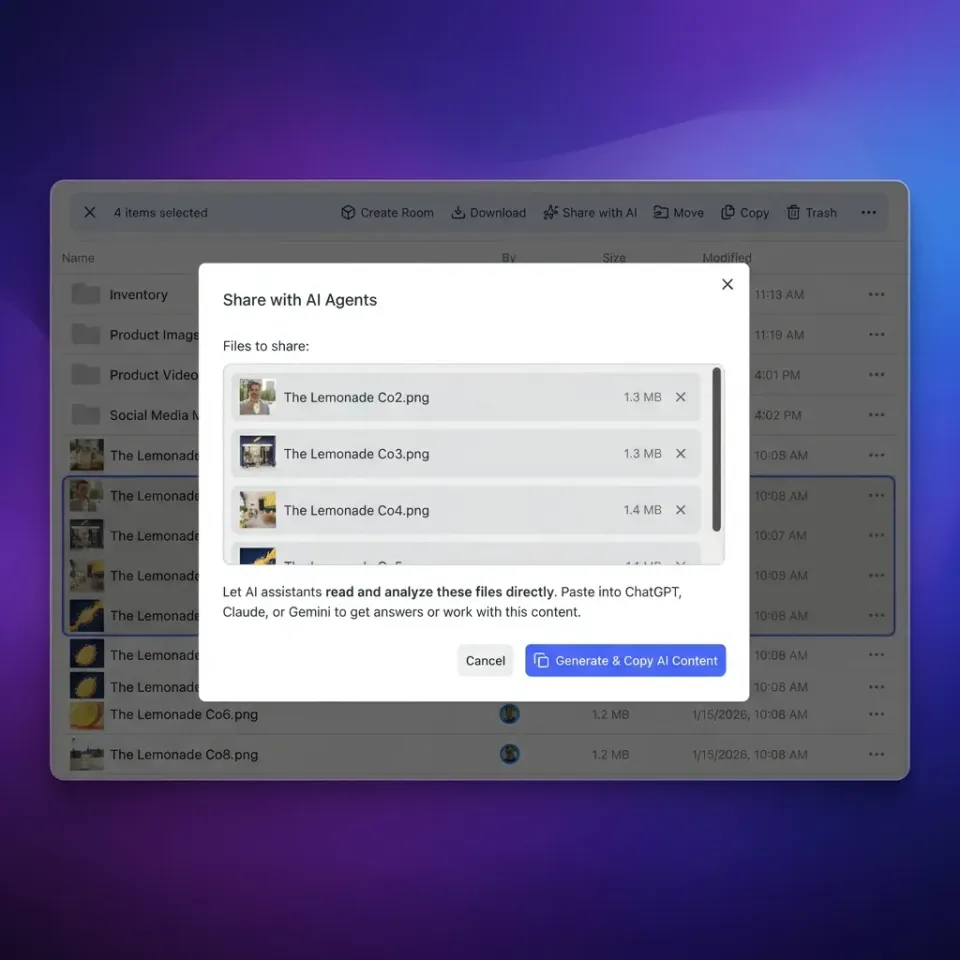
In this architecture, the workspace is not just storage; it is an intelligent hub. When one agent saves a file, it is automatically indexed and made available to all other agents in the team. This allows for complex handoffs where a research agent might gather data, a writer agent drafts the content, and an editor agent performs the final review, all using different LLMs but the same shared files.



Ready to Build Your Multi-Agent Team?
Orchestrate multi-vendor agents with persistent workspaces, version history, and a consolidated MCP toolset. Built for cross-vendor AI collaboration.
Implementing Cross-Vendor Teams with MCP
The Model Context Protocol (MCP) is the key to making cross-vendor orchestration practical. MCP provides a standardized way for agents to connect to tools and data sources regardless of which model is powering them. By using an MCP server, you can give a Claude agent and a GPT-4 agent the exact same consolidated toolset for file management, search, and collaboration.
Fastio's MCP implementation allows agents to coordinate safely using advisory file locks, version history, and a detailed activity log. Agents can acquire an advisory lease on a file before writing via the MCP storage tool, while other agents see the lock and wait. If concurrent writes land without a lock, Fastio preserves every revision in version history so work is never lost.
For developers, this means you can write one set of instructions that works across different LLMs. You do not need to build custom integrations for every model you add to the team. You simply connect the agents to the shared workspace via MCP, and they immediately gain the ability to read, write, and query the files in that environment.
Evidence and Benchmarks for Multi-Model Teams
Recent data points show that multi-vendor teams often outperform single-model teams in both accuracy and cost. A 2025 analysis by Andreessen Horowitz noted that deploying multiple highly capable LLMs has become the norm for enterprise production use cases.
Benchmarks for these teams often highlight three main metrics:
- Task Success Rate: Multi-model teams can achieve up to 30% higher success rates on heterogeneous tasks by routing sub-tasks to the best-fit model.
- Latency Optimization: Using smaller, specialized models for simple tasks while reserving larger models for complex logic reduces overall system latency.
- Reliability: If one vendor experiences an outage or API degradation, the system can automatically fail over to a secondary model without losing access to the underlying workspace data.

Practical Workflow: GPT-4 and Claude Collaboration
A common real-world example of cross-vendor orchestration involves using GPT-4 for data extraction and Claude for synthesis. In a shared workspace, the workflow looks like this:
- Extraction: A GPT-4 agent uses an MCP tool to scan a directory of raw PDF documents. It extracts key data points and saves them as JSON files in a subfolder.
- Indexing: The shared workspace automatically indexes these new JSON files, making them searchable by their meaning.
- Synthesis: A Claude 3.5 Sonnet agent is triggered by the new file creation. It reads the JSON files, queries the workspace for related historical data, and writes a detailed summary report.
- Human Review: A human team member receives a notification, opens the workspace, and reviews the final report alongside the source documents used by the agents.
This workflow demonstrates how a shared workspace bridges the gap between different vendors while keeping the human in the loop. The agents focus on what they do best, while the workspace handles the storage, indexing, and tool orchestration.
Sources
References used to verify factual claims in this guide.
-
More than two-thirds of organizations reported using AI in more than one business function
-
Over 80% of companies already using AI have implemented three or more use cases
-
It has become the norm for enterprises to deploy multiple highly capable Large Language Models in production
Frequently Asked Questions
Can ChatGPT and Claude work together on the same files?
Yes, they can collaborate if they both have access to a shared workspace. By using a vendor-neutral storage layer and tools like the Model Context Protocol (MCP), agents powered by different models can read, edit, and create files in the same environment.
How do you sync data between different AI models?
The most effective way to sync data is to use a central shared workspace rather than passing data between APIs. When one model saves a file to the workspace, the other model can immediately access it using standardized file management tools.
What are the benefits of using multiple AI vendors?
Using multiple vendors allows you to use the specific strengths of different models, such as GPT-4 for logic and Claude for creative writing. It also provides system resilience and helps you avoid being locked into a single provider's pricing and limitations.
Is it expensive to run cross-vendor agent teams?
It can actually be more cost-effective. By routing simpler tasks to smaller, cheaper models and using expensive models only for complex reasoning, you can optimize your total spend while maintaining high performance across the entire workflow.
Do I need a separate database for multi-agent collaboration?
No, a shared workspace with built-in intelligence can handle both the file storage and the indexing needed for agents to find information. Fastio workspaces include RAG (Retrieval-Augmented Generation) capabilities once Intelligence Mode is enabled for the workspace, working seamlessly for any connected agent.
Related Resources

Ready to Build Your Multi-Agent Team?
Orchestrate multi-vendor agents with persistent workspaces, version history, and a consolidated MCP toolset. Built for cross-vendor AI collaboration.