How to Set Up Construction Submittal Sharing and Approval Workflows
Construction submittals are contractor-submitted documents that architects and engineers must approve before installation begins. A typical commercial project generates over 500 submittals, and slow review cycles account for roughly 25% of schedule delays. This guide walks through how to structure submittal sharing workflows, set up approval chains, manage shop drawing reviews, and keep submittal logs accessible to every stakeholder who needs them.


What Construction Submittals Are and Why Sharing Matters
Submittals are contractor-submitted docs for architect approval. They verify that proposed materials, equipment, and fabrication methods match the contract documents before anything gets built.
Three categories cover most of what moves through a project:
Shop drawings make up about 20% of submittals. These are detailed fabrication drawings for items like structural steel connections, precast panels, and curtain wall systems. They require engineering review and often carry seal-stamp signatures.
Product data accounts for roughly 70% of the volume. Manufacturer cut sheets, spec compliance documents, fire ratings, load tables, and R-value certifications all fall here.
Samples and certificates round out the rest. Physical material samples for color and texture approval, mill certifications for steel grade, and third-party fire test reports all need sign-off before installation.
On a mid-sized commercial project, teams process 500 or more submittals. Each one passes through a review cycle: the contractor submits, the architect or engineer reviews, and the item comes back as approved, approved as noted, revise and resubmit, or rejected. Industry data shows a 30-40% first-pass rejection rate, with each rejection adding two to four weeks and averaging $805 in preventable costs.
The sharing piece is where most projects lose time. When submittals move through email attachments, version confusion is constant. A structural engineer reviews revision B while the contractor already uploaded revision C. Subs on the job site can't access the latest approved drawings because the files are buried in someone's inbox. Architects spend hours tracking down which items are still pending because the Excel log hasn't been updated since last Tuesday.
Centralizing submittal sharing in a cloud workspace fixes these problems by giving every stakeholder access to the same files, the same versions, and the same status information.
Helpful references: Fastio Workspaces, Fastio Collaboration, and Fastio AI.
Related guides
- How to Share Construction Blueprints SecurelyGuide to construction blueprint sharing: Construction teams send blueprints like CAD drawings, PDFs, BIM models to...
- How to Use Construction Photo Sharing Sites for Site ProgressConstruction photo sharing sites let field teams document site progress with timestamps and geotags. Field teams upload...
- How to Share As-Built Drawings for Construction Closeout**As-built drawings file sharing** helps with construction closeout. These drawings show final built conditions,...
- How to Choose the Best Construction CAD File Sharing SolutionsGuide to construction cad file sharing: Construction teams share .dwg and .dxf files with general contractors, subs,...
- How to Share Construction Daily Logs EfficientlyConstruction daily logs sharing keeps subs, owners, and inspectors up to date on site progress. Traditional PDF emails...
- How to Share Construction Progress Photos with Your TeamProgress photos keep everyone aligned on what happened on site. This guide walks through a practical workflow for...
More on this subject: Construction (16 guides)
How to Structure a Submittal Approval Workflow
A good submittal workflow has clear stages, assigned reviewers, and automatic notifications. Here's a practical structure that works for most commercial projects.
Step 1: Organize by spec section. Create a folder structure that mirrors the CSI MasterFormat divisions. Division 03 gets concrete submittals, Division 05 gets metals, Division 26 gets electrical. Inside each division folder, subcontractors upload their submittals with a naming convention like 05-12-StructuralSteel-ShopDwg-v1.pdf. Sortable names prevent the "which file is which" problem.
Step 2: Assign reviewers by trade before the project starts. Electrical submittals go to the electrical engineer. Structural steel goes to the structural engineer. Pre-assigning reviewers eliminates the forwarding chain where a general contractor sends a submittal to the architect, who forwards it to the right consultant, who doesn't see it for a week.
Step 3: Notify reviewers automatically when new submittals arrive. Activity feeds and automated alerts notify the right people immediately. No more "I didn't know it was submitted" delays.
Step 4: Review with context. Reviewers should be able to open shop drawings directly in the browser, add comments anchored to specific regions of the drawing, and mark the submittal with a status. Anchored comments eliminate ambiguity. Instead of "the connection detail on page 3 looks wrong," the reviewer pins a note directly on the detail.
Step 5: Route the response back. The contractor gets notified of the review status and can see exactly what needs to change. If revisions are needed, the contractor uploads a new version to the same location. The system preserves version history so both parties can compare what changed.
Step 6: Distribute approved submittals to the field. Once approved, the documents need to reach superintendents and foremen on site. Shared links or branded portals let field teams pull the latest approved drawings without needing full project access.
The standard review period runs 10 to 14 calendar days. Teams using digital workflows consistently cut this to 3 to 7 days because reviewers get instant access, comments are specific, and there's no time lost to email routing.
Handling Parallel Reviews
MEP coordination submittals often need review from three or more engineers simultaneously. The mechanical engineer checks duct routing, the electrical engineer verifies conduit clearances, and the plumbing engineer confirms pipe runs don't conflict.
Sequential reviews (one after another) can stretch a single submittal to six weeks. Parallel reviews let all three disciplines review at the same time, cutting the timeline to the longest single review period plus a coordination check.
Set up your workspace so that each reviewer can comment independently. After all reviews come in, the lead engineer or architect consolidates comments and issues a single response to the contractor. This prevents the contractor from getting three conflicting markups with no clear direction.
Managing Submittal Logs and Tracking at Scale
The submittal log is the project's scoreboard. It tracks every item's status, responsible party, submission date, review date, and disposition. On a 500-item project, keeping this accurate is a full-time job if you're doing it manually.
Ball-in-court visibility matters most. Project managers need to see, at a glance, which submittals are waiting on the architect, which are waiting on the contractor for revisions, and which are overdue. Color-coded status indicators help: green for approved, yellow for under review, red for overdue, gray for not yet submitted.
Standard CSI statuses work well:
- Pending Submission
- Submitted for Review
- Under Review
- Approved
- Approved as Noted
- Revise and Resubmit
- Rejected
Link submittals to the project schedule. When structural steel submittals lag, the critical path extends. If the steel fabricator needs 12 weeks of lead time after approval, a two-week review delay pushes the entire steel erection sequence. Making this connection visible helps teams prioritize reviews based on downstream schedule impact rather than first-in-first-out.
Weekly log reviews catch bottlenecks early. Every Monday, the PM scans for items that have been "under review" for more than seven days. Escalation emails go out for anything past 10 days. This simple ritual prevents submittals from silently stalling.
Semantic search saves time on large projects. Instead of scrolling through a 500-row spreadsheet, you can search for "pending HVAC submittals" or "approved electrical panel data" and find exactly what you need. Fastio's Intelligence feature indexes uploaded documents for meaning-based search, so queries work even when file names are cryptic.
Export for closeout. At project completion, owners and lenders want a complete submittal record. The ability to export logs as CSV files for Excel or as PDF summaries for formal submissions saves days of manual compilation.
For dispute resolution, audit trails showing who accessed which documents and when provide authoritative records. Timestamps on every action, from upload to comment to download, settle disagreements about notification and response times.



Centralize Your Submittal Sharing Workflow
Fastio workspaces give construction teams shared folders with granular permissions, version history, branded portals for external stakeholders, and audit trails for every document action. Built for construction submittal sharing workflows.
Secure Sharing with Subcontractors and External Stakeholders
Construction projects involve dozens of external parties who each need different levels of access. The electrical sub needs to upload to Division 26 but shouldn't see the owner's budget documents. The owner needs to review progress but shouldn't be able to modify contractor submittals. The lender's inspector needs read-only access to approved items for compliance checks.
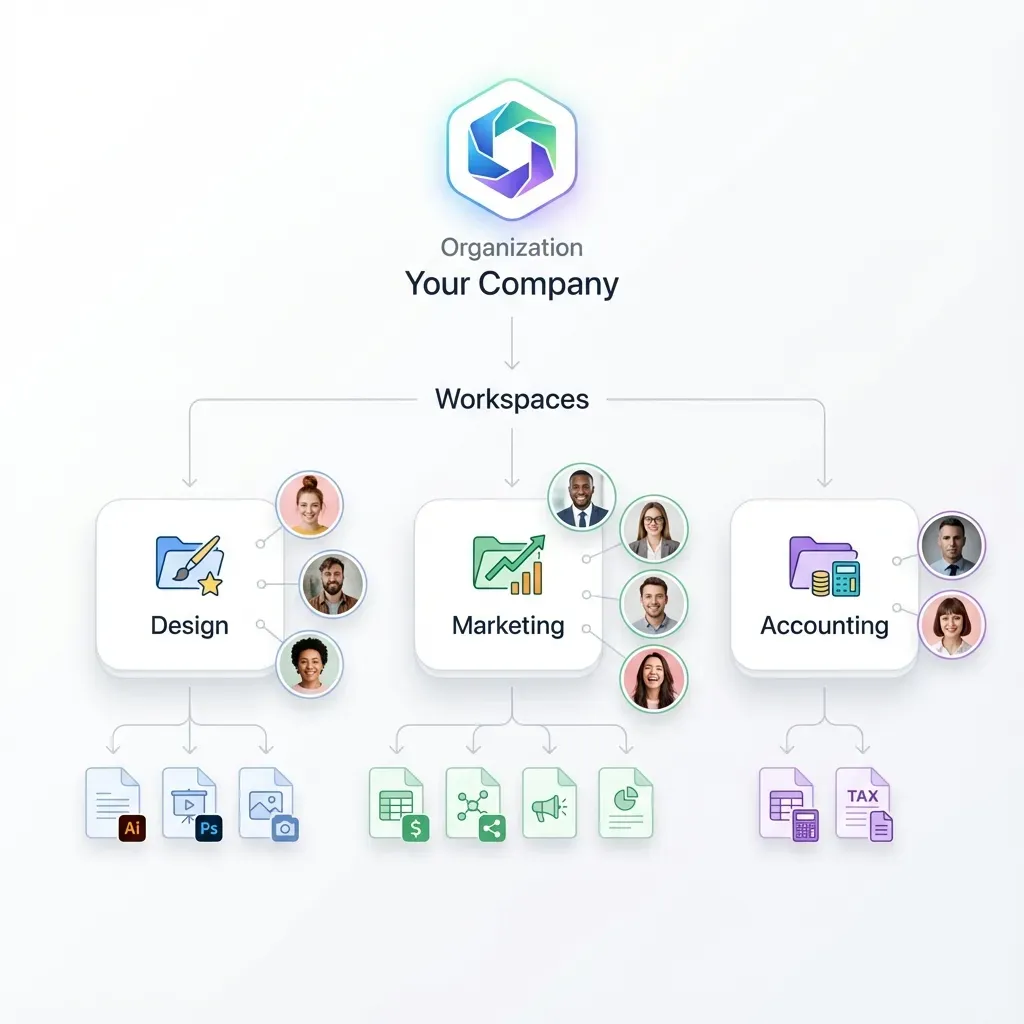
Granular permissions solve this. Set access at the organization, workspace, folder, or individual file level. A subcontractor gets upload and view rights to their spec section folder. The architect gets review access across all divisions. The owner gets a branded portal showing only approved items and status summaries.
Branded shares create professional experiences. When sharing submittals with owners or clients, a branded portal with your company logo looks better than a file dump. Receive shares let external parties upload documents directly into your workspace without needing a full account, which simplifies collecting submittals from subs who aren't tech-savvy.
Guest access without friction. Not every subcontractor needs a full account. Shared links with appropriate permissions let small subs upload their product data sheets and view approved markups without creating yet another login. For sensitive projects, add password protection and set expiration dates so access automatically revokes when the project completes.
Audit everything. Every view, download, upload, and comment gets logged. When a sub claims they never received the architect's markup, the audit trail shows exactly when the notification went out and when the file was first accessed. These logs export for compliance reporting on government and healthcare projects where documentation requirements are strict.
Compared to email-based workflows, centralized sharing eliminates version confusion, reduces the risk of sending documents to the wrong party, and creates a single source of truth that every stakeholder trusts.
Alternatives like Procore and Autodesk Construction Cloud handle submittals well within their broader PM ecosystems. For teams that need sharing-focused features without a full construction PM suite, Fastio offers workspace-based organization with granular permissions, branded shares, and built-in audit trails. Plans start at Starter ($9.99/mo) and include a 14-day Business Trial (credit card required; see /pricing/).

Reducing Rejection Rates and Resubmittal Cycles
A 35% first-pass rejection rate means roughly 175 submittals on a 500-item project come back for revision. Each rejection adds cost and time. Reducing that rate even by 10 percentage points saves weeks of cumulative delay.
Provide spec references with every submittal. When contractors include the specific specification section and paragraph their submittal addresses, reviewers can verify compliance faster. A product data sheet submitted with a note saying "per Section 09 29 00, paragraph 2.01.B" tells the architect exactly what to check.
Use checklists before submitting. A pre-submission checklist catches common rejection reasons: missing calculations, wrong scale on shop drawings, outdated product data, missing fire rating certificates. Five minutes of checking saves two weeks of resubmission.
Limit revision cycles to two rounds. If a submittal bounces back twice, escalate to a meeting. Endless revision loops burn time and signal a deeper misunderstanding that email markups won't fix. A 15-minute call between the contractor and the engineer resolves more issues than five rounds of written comments.
Track rejection reasons by trade. If the electrical sub's submittals get rejected 60% of the time while the mechanical sub runs at 20%, the electrical sub needs training or better specifications. Pattern data drives targeted improvements.
Post-mortem metrics close the loop. At project completion, review average review days per trade, rejection rates, and total resubmission cycles. These numbers become benchmarks for the next project. Teams that track and share these metrics see measurable improvement over successive projects.
Version control plays a critical role here. When a contractor uploads a revised submittal, the system should automatically preserve the previous version and make it easy to compare what changed. This prevents the costly mistake of installing materials based on a superseded revision, which according to industry estimates contributes to the roughly 10% of planned project time lost to rework.

Sources
References used to verify factual claims in this guide.
-
35% of submittals get rejected on first review, each rejection costing an average of $805
-
30-40% submittal rejection rate across the construction industry
-
Standard review period is 10-14 calendar days
-
Rework causes project delays of approximately 9.8% of planned project time
Frequently Asked Questions
What is digital submittal software?
Digital submittal software is a cloud platform where contractors upload shop drawings, product data, and samples for architect and engineer review. It replaces email-based workflows with centralized document sharing, automated notifications, version control, and status tracking. Popular options include Procore, Autodesk Construction Cloud, Bluebeam, and general-purpose workspace tools like Fastio.
What are submittal approval best practices?
Assign reviewers by trade before the project starts so submittals route directly to the right person. Standardize naming conventions using spec section numbers and revision markers. Use digital markups with comments anchored to specific drawing regions. Set a 10 to 14 day maximum review period with weekly status checks. Limit revision cycles to two rounds before escalating to a meeting. Track rejection rates by trade to identify subs who need support.
How many submittals does a typical construction project have?
A mid-sized commercial project typically processes around 500 submittals, though large or complex projects can exceed 2,000. Product data sheets make up about 70% of the volume, shop drawings account for roughly 20%, and samples and certificates cover the remaining 10%.
How long does the submittal review process take?
The standard review period is 10 to 14 calendar days per submittal. Teams using digital workflows with centralized sharing and parallel reviews consistently reduce this to 3 to 7 days. The savings compound when multiplied across hundreds of submittals per project.
How do you share submittals with external subcontractors?
Use a cloud workspace with granular folder-level permissions. Give each subcontractor upload access to their spec section folder and view access to approved markups. Shared links let small subs participate without creating full accounts. For owner reviews, branded portals present a professional interface with status summaries and approved documents.
Related Resources

Centralize Your Submittal Sharing Workflow
Fastio workspaces give construction teams shared folders with granular permissions, version history, branded portals for external stakeholders, and audit trails for every document action. Built for construction submittal sharing workflows.