How to Share Construction Progress Photos with Your Team
Progress photos keep everyone aligned on what happened on site. This guide walks through a practical workflow for capturing, organizing, and sharing construction photos with your team, clients, and subs, without email chains or lost files.


Why Progress Photos Matter on Construction Projects
Progress photos document what the site looks like at a given point in time. They show up in daily reports, change order justifications, punch lists, and client updates. When a dispute arises about whether a concrete pour met spec or a beam was installed correctly, dated photos settle the argument faster than any written description.
Most construction projects share progress photos on a weekly cadence. Fast-track jobs push that to daily. The photos serve different audiences at different times: the project manager checks framing completion, the owner verifies budget milestones, the sub confirms they can start their scope, and the inspector reviews concealed conditions before drywall covers them.
The Construction Industry Institute found that direct rework costs average 5% of total construction costs, with poor documentation of concealed elements contributing heavily to that figure. Photos taken before finishes go up are often the only record of what sits behind the walls.
Beyond dispute resolution, progress photos feed into practical processes. An RFI gets resolved faster when you attach a photo showing exactly where the beam misalignment is. Daily reports carry more weight with embedded images. Punch list items become unambiguous when you can point to a specific shot of the deficient work.
Over time, your photo archive becomes a resource for future bids and crew training. A library of past projects shows prospective clients your track record and helps estimators price similar scopes more accurately.
Helpful references: Fastio Workspaces, Fastio Collaboration, and Fastio AI.
Related guides
- How to Use Construction Photo Sharing Sites for Site ProgressConstruction photo sharing sites let field teams document site progress with timestamps and geotags. Field teams upload...
- How to Share As-Built Drawings for Construction Closeout**As-built drawings file sharing** helps with construction closeout. These drawings show final built conditions,...
- How to Share Construction Daily Logs EfficientlyConstruction daily logs sharing keeps subs, owners, and inspectors up to date on site progress. Traditional PDF emails...
- How to Choose the Best Construction CAD File Sharing SolutionsGuide to construction cad file sharing: Construction teams share .dwg and .dxf files with general contractors, subs,...
- How to Improve Construction RFI File Sharing and CollaborationConstruction RFI file sharing centralizes attachments for inquiries and responses. Large commercial projects generate...
- How to Set Up a Construction Subcontractor File PortalConstruction subcontractor file portals simplify document sharing between general contractors (GCs) and subs. They...
More on this subject: Construction (16 guides)
Common Problems with Construction Photo Sharing
The biggest issue is fragmentation. Photos end up scattered across email threads, personal phones, text messages, and random cloud folders. Six months into a project, nobody can find the foundation shots from week three.
Email makes things worse. Attachments hit size limits, so people compress images or split them across messages. Compressed photos lose the detail you need for inspection-quality documentation. And once a photo gets forwarded three times, nobody knows which version is current.
Field connectivity creates headaches too. Steel structures and remote sites drop cellular signal. Teams resort to SD cards or waiting until they get back to the trailer, which delays uploads by hours or days.
Clients add another layer of complexity. They want simple access without installing apps or creating accounts. But most project management platforms require logins and training. The result: clients stop checking updates, and approvals stall.
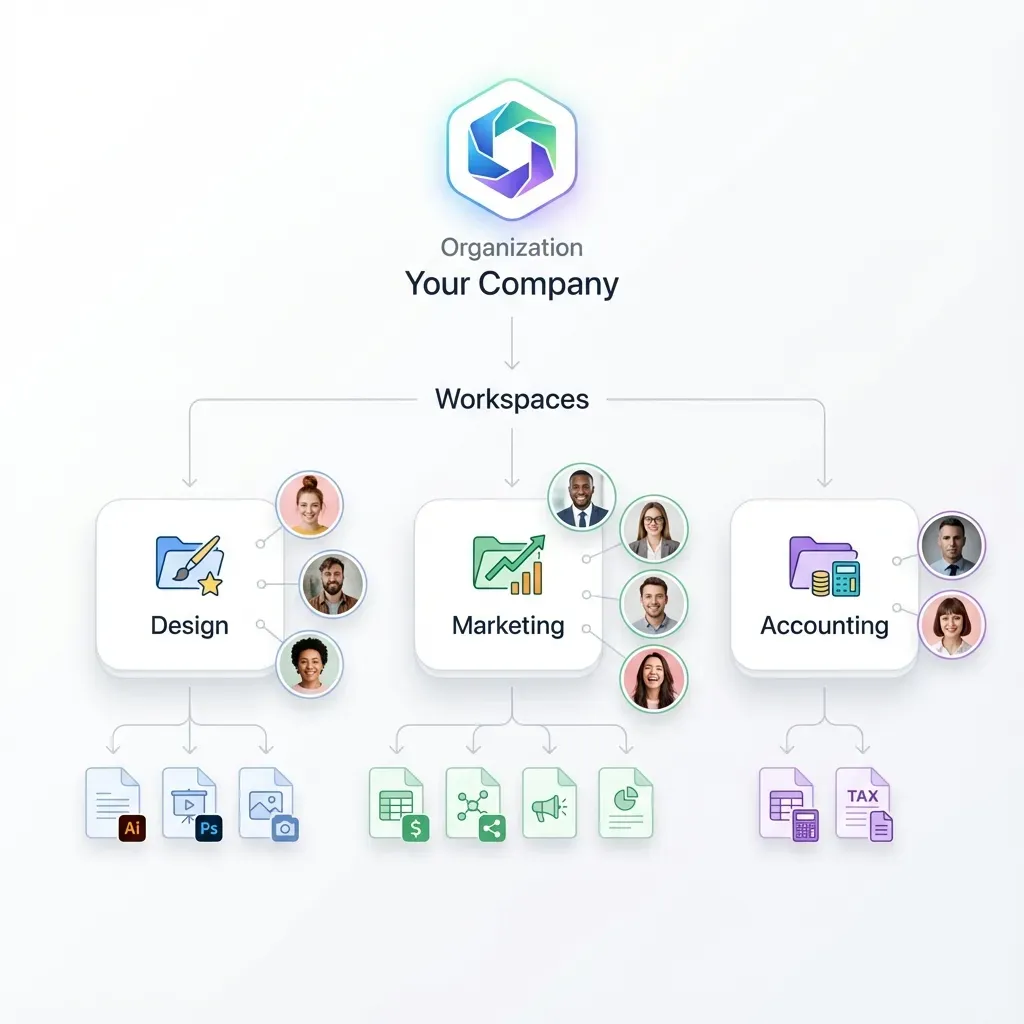
Permission management gets messy fast. A typical commercial project involves the GC, owner, architect, and a dozen subcontractors. Each needs different access levels. Subs should see their scope photos, not the owner's financial documents. Setting this up in email or a basic file share is nearly impossible to maintain.
Search is the final gap. Without consistent naming or tagging, finding a specific photo months later means scrolling through hundreds of files. "Where's that HVAC rough-in shot from before drywall?" can eat an hour of someone's day.


Organize Your Next Project's Photo Library
Fastio workspaces handle large construction photos without compression. Invite subs and clients with granular permissions, search photos by content, and keep audit trails on every view. Built for construction progress photos sharing workflows.
A Step-by-Step Workflow for Sharing Progress Photos
This workflow works whether you run a three-person crew or a multi-trade commercial project. Adjust the details to fit your team size and project complexity.
1. Set capture standards before the project starts.
Decide on photo frequency (daily vs. weekly), required angles, and minimum shots per area. Fixed-angle photos taken from the same spot each week make comparisons obvious. Require timestamps and GPS data on every image. Most smartphone cameras embed this metadata automatically.
2. Name files consistently.
Use a format like 2026-03-15_framing_level2_north.jpg. Date first, then phase, then location. This makes sorting and searching straightforward even without specialized software.
3. Organize folders by phase.
Create top-level folders for each major phase: site prep, foundation, framing, MEP rough-in, drywall, finishes, punch list. Inside each, add date-based subfolders as the project runs. This structure scales from small remodels to large commercial builds.
4. Upload to a central platform daily.
Pick a tool that handles large files without compression. Upload at the end of each shift. If field connectivity is poor, use an app that queues uploads and syncs when signal returns. Avoid tools that cap file sizes or compress images on upload.
5. Set permissions and share.
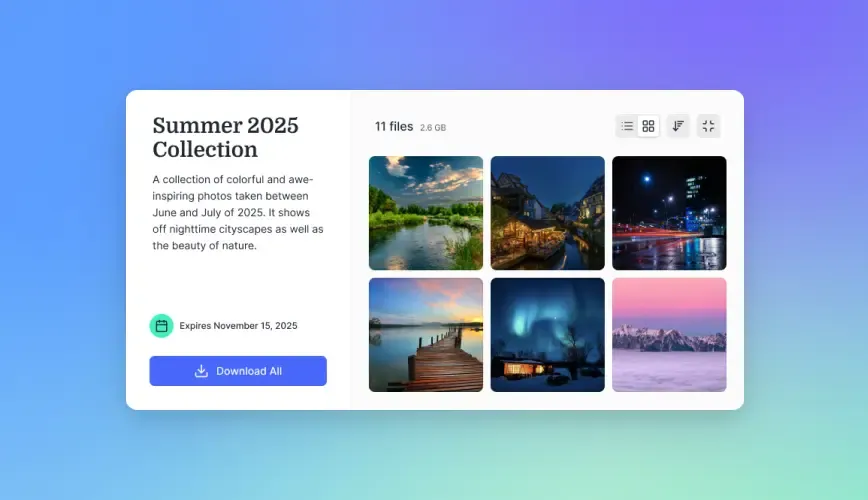
Give internal team members full access. Create view-only links for clients and subs with password protection. Set link expiration dates tied to project milestones or review periods.
6. Notify stakeholders.
Send a weekly digest or set up notifications so the team knows when new photos land. works alongside Slack, Microsoft Teams, or email alerts. Track whether clients have viewed shared links so you can follow up on stalled approvals.
7. Archive with version history.
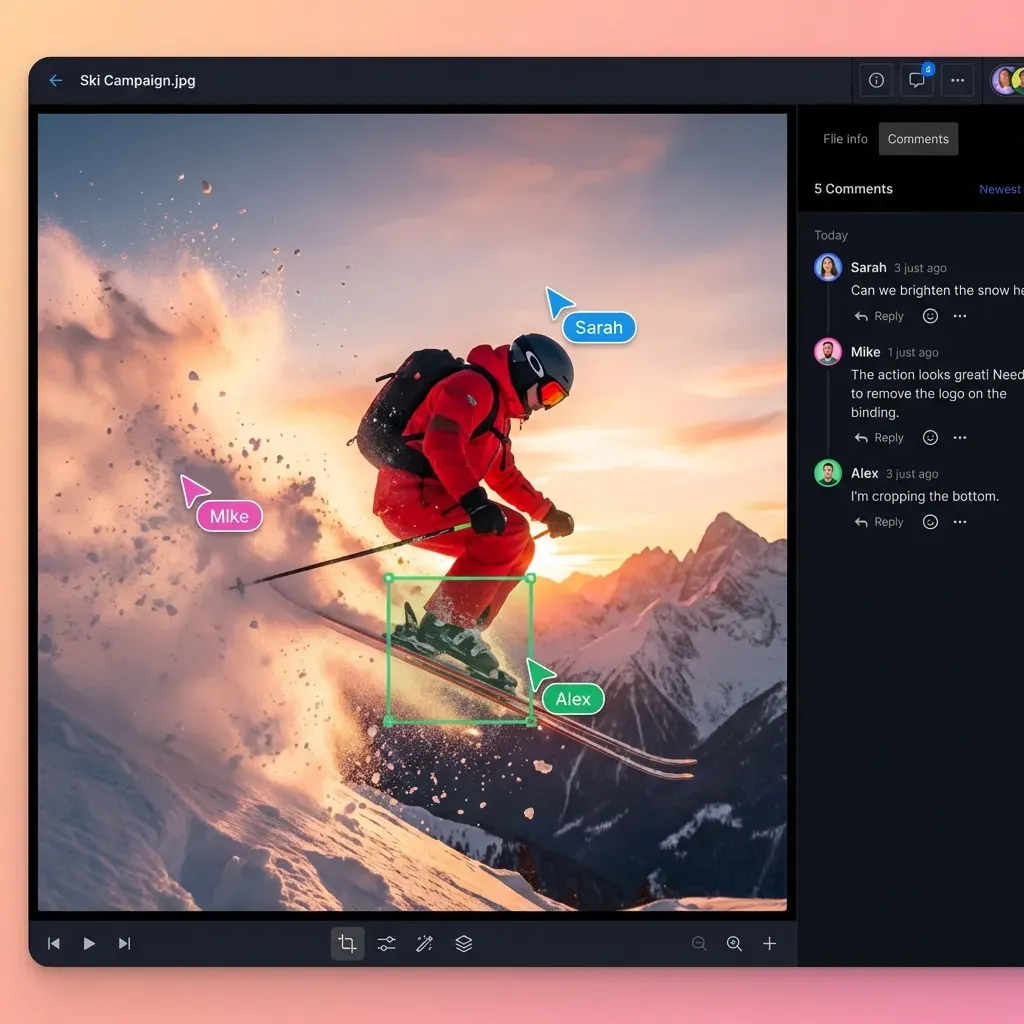
Keep originals intact. Never overwrite a photo with an edited version. Version history lets you go back to the raw capture if annotations or markups need correction later.
Tips for Mobile Uploads from the Field
Upload lower-resolution previews first for quick team review, then sync full-resolution originals when you hit Wi-Fi. Batch uploads at the end of the day rather than interrupting work mid-task. Test cellular speeds at different site locations early in the project so you know where the dead zones are. If your platform supports offline queuing, enable it on day one.
Tools for Construction Progress Photo Sharing
The right tool depends on your team size, budget, and how much you need photos tied to other project data.
Procore is the standard for large commercial projects. Its photo log connects directly to RFIs, daily logs, and punch lists. The markup tools are advanced, and the mobile app works well in the field. The downside is cost: Procore charges per project and targets enterprise budgets, which puts it out of reach for smaller contractors.
Fieldwire works well for field-first teams. It connects photos to tasks and blueprints on a mobile interface. Pricing is more accessible than Procore, but file handling for large images can be limited.
CompanyCam is built specifically for photo documentation. It auto-organizes by job site using GPS, and the capture experience is fast. It is focused on photos rather than full project management, so you may still need a separate PM tool.
OpenSpace handles 360-degree capture. Walk the site with a camera on your hard hat, and it maps photos to your floor plans automatically. Powerful for large projects, but the hardware and subscription cost add up.
Fastio takes a different approach. Instead of tying photos to a project management workflow, it focuses on the sharing and storage layer. Workspaces store files without compression, with uploads of up to 100 GB per file on the Enterprise plan, so inspection-quality images stay intact. Create a workspace per project, organize folders by phase, and invite subs as guests with folder-level permissions. Clients access photos through branded portals, no account required. Activity logs track every view and download.
When Intelligence is enabled for the workspace, Fastio auto-indexes uploaded photos for semantic search. You can search by description rather than filename, like "foundation pour north elevation" instead of scrolling through a folder of 200 images. Plans range from Starter (250 GB) to Enterprise (25 TB), and monthly plans start with a Business Trial of up to 14 days to evaluate the platform.
For teams that already use a PM tool like Procore, Fastio works alongside it. Upload photos to Fastio for storage and sharing, then link them into your RFIs and daily logs. This keeps your photo quality intact while still connecting images to the project record.
Securing Photos for Clients and Subcontractors
Construction photos often contain sensitive information: site layouts, proprietary designs, or conditions that could affect insurance claims. Sharing requires more than just dropping a link.
For clients, set up a branded portal. This gives them a clean view of project photos organized by date or phase, without exposing your internal dashboard. Password-protect the portal and restrict access by email domain if the client uses a corporate address. Set link expiration dates that align with review periods.
For subcontractors, use folder-level permissions. A plumbing sub needs access to MEP rough-in photos, not the owner's budget documents. Grant view-only access by default and upgrade to download permission only when needed. This prevents subs from redistributing photos without your knowledge.
For inspectors and regulators, generate time-limited share links. These provide access to specific folders during the inspection window, then expire automatically. Audit logs record exactly who viewed what and when, which is valuable if questions come up later.
Fastio supports all three scenarios through its sharing controls. Branded portals carry your company logo and colors. Granular permissions work at the workspace, folder, and file level. Audit trails capture view timestamps, IP addresses, and device information. For teams that need to prove a client reviewed photos on a specific date, these logs serve as documentation.
For photos that shouldn't be redistributed, disable file downloads on the share so recipients can view them without downloading the originals.
Advanced Photo Management Practices
Once the basics are covered, a few practices separate good photo documentation from great.
Fixed-angle comparison shots. Mark camera positions on your site plan. Photograph the same spots at the same time each week. Lined up side by side, these shots make progress obvious to anyone, and they are particularly useful in owner presentations and dispute situations.
Phase tagging from day one. Tag every photo with its construction phase, trade, and location as it gets uploaded. Front-loading this work saves hours of searching later. If your platform supports AI tagging, use it, but verify the tags are accurate for the first few weeks until you trust the automation.
Drone and 360-degree integration. Aerial shots from drones provide context that ground-level photos miss. Earthwork verification, site logistics planning, and progress overviews all benefit from a birds-eye view. Pair drone captures with ground-level detail shots for a complete record.
Connecting photos to project records. Link photos directly to RFIs, change orders, and daily logs. A photo attached to an RFI response resolves the question faster than a written description alone. If your PM tool supports deep links, reference specific photo URLs in your project documentation.
Building time-lapse sequences. Dated photos from the same vantage point compile into time-lapse videos that work well in bid presentations and client updates. Some tools generate these automatically from folder contents. Even a simple slideshow of weekly captures tells a compelling project story.
Semantic search for large libraries. On projects generating hundreds of photos per week, filename search breaks down fast. Platforms with AI indexing let you search by what is in the photo rather than what someone named it. Fastio's Intelligence Mode enables this kind of search across your workspace, returning results with citations to the source files.
Sources
References used to verify factual claims in this guide.
-
Direct rework costs average 5% of total construction costs
Frequently Asked Questions
What are the best apps for construction progress photos?
Procore and Fieldwire handle photo logs tied to project management. CompanyCam specializes in photo documentation with GPS tagging. OpenSpace captures 360-degree site walkthroughs. Fastio focuses on large-file sharing and client portals with no compression.
How do I share progress photos with clients remotely?
Use a branded portal or password-protected share link. Clients open the link in a browser without creating an account. Track views to confirm they reviewed the photos, and set expiration dates for time-sensitive shares.
What file format works best for progress photos?
JPEG works for most field documentation. PNG preserves more detail for close-up inspection shots. Keep RAW files as originals if your camera supports it. Avoid platforms that re-compress uploads, since that degrades the detail you need for inspections.
How often should teams share construction photo updates?
Weekly sharing works for most projects. Fast-track or high-activity phases warrant daily uploads. Set a consistent schedule so stakeholders know when to expect updates and can plan their reviews around it.
How do I organize progress photos by construction phase?
Create top-level folders for each major phase (foundation, framing, MEP, drywall, finishes). Inside each, add date-stamped subfolders. Name files with a consistent format like YYYY-MM-DD_location_description.jpg so they sort chronologically.
What security measures protect sensitive construction photos?
Use view-only links to prevent downloads, password protection for external shares, domain restrictions for corporate clients, and expiration dates for time-limited access. Audit logs track every view and download for accountability.
Can field teams upload photos with poor site connectivity?
Use a platform that supports offline queuing. Photos stage locally on the device and sync automatically when cellular or Wi-Fi signal returns. Batch uploads at end of shift to avoid interrupting fieldwork.
Related Resources

Organize Your Next Project's Photo Library
Fastio workspaces handle large construction photos without compression. Invite subs and clients with granular permissions, search photos by content, and keep audit trails on every view. Built for construction progress photos sharing workflows.