How to Implement Consensus Protocols for Reliable Multi-Agent Systems
Guide to consensus protocols multi agent systems: Consensus protocols help autonomous agents agree on a single value or action, even when they disagree or fail. This guide covers practical strategies for LLM agents, including voting, debate, and shared state management.


Why Agents Need Consensus Protocols
Single-agent architectures make linear, deterministic decisions. But scaling to multi-agent systems (MAS) creates the "agreement problem." When three different agents analyze the same dataset or generate a code fix, they often produce three different outputs. Without a protocol to resolve these differences, the system becomes confusing and unreliable.
The Hallucination Problem
Consider a medical diagnosis system where three agents analyze a patient's symptoms. Agent A suggests "Flu," Agent B suggests "COVID-multiple," and Agent C suggests "Pneumonia." If the system acts on just one of these without consensus, the risk of error is too high. Consensus protocols force these agents to compare notes, weigh evidence, and agree on the most probable diagnosis before presenting it to a human doctor.
This is about safety, not just accuracy. In autonomous systems, like an agent swarm managing cloud infrastructure, one hallucinating agent could accidentally delete a production database. Consensus acts as a safety valve. It requires multiple independent verifications before the system executes critical actions.
Divergent Reasoning at Scale
Large Language
Models (LLMs) are non-deterministic. Even with temperature set to zero, small differences in floating-point arithmetic across GPUs can lead to token drift. In a long-running agentic workflow, this drift compounds. Agent A might assume the project is in Python, while Agent B assumes TypeScript. By the time they try to merge their work, the divergence is impossible to fix.
Consensus protocols serve as "sync points" in the workflow. They force agents to stop, align on the current state of the world ("We are building a Python backend"), and only then proceed. This periodic alignment keeps complex, multi-step workflows on track.
Helpful references: Fastio Workspaces, Fastio Collaboration, and Fastio AI.

Related guides
- How to Establish Closed-Loop Communication in Multi-Agent SystemsIn multi-agent systems, unverified agent coordination introduces a major failure risk. While typical peer-to-peer...
- Agent-to-Agent Communication: Protocols for Collaborative AI TeamsAgent-to-agent communication protocols enable collaborative AI teams to coordinate work without active context...
- How to Connect CrewAI to OneDrive: Multi-Agent Integration GuideConnecting CrewAI to Microsoft OneDrive enables autonomous multi-agent crews to search, read, and cross-reference...
- How to Use Google's A2A Protocol for Agent CommunicationGoogle's A2A (Agent-to-Agent) protocol is an open standard that lets AI agents from different frameworks discover each...
- How to Connect CrewAI to Google Drive FilesConnecting CrewAI agents directly to Google Drive often floods prompt context windows and triggers API rate limits...
- Google Agent Development Kit (ADK) vs. LangGraph: Framework ComparisonSelecting an AI agent orchestration framework involves weighing code-first modular software design against stateful...
More on this subject: Multi-Agent Systems (62 guides)
Core Consensus Mechanisms for LLMs
Traditional distributed systems use protocols like Paxos or Raft for binary agreement. LLM agents need semantic consensus. They need to agree on meaning, not just bits.
1. Voting Mechanisms
Voting is the most direct way to aggregate agent outputs. In a classification task, multiple agents analyze an input and "vote" on the label.
- Plurality Voting: The most common answer wins. This works for discrete tasks like sentiment analysis or spam detection. Research from ACL Anthology suggests that even a small number of agents (as few as three) can improve performance through voting-based methods.
- Weighted Voting: Agents with higher trust scores or domain expertise get more influence. For example, a "Senior Python Agent" gets multiple votes on code reviews, while a "Junior Agent" gets multiple. These weights can change based on an agent's past accuracy (Elo rating).
- Token-Based Confidence: Instead of a simple "Yes/No," agents output a confidence score (probability). The system sums the probabilities and selects the option with the highest cumulative confidence. This captures the difference between "I'm multiple% sure" and "I'm multiple% sure."
2. Multi-Agent Debate
For complex reasoning tasks, voting often fails because the majority might be all wrong (the "bandwagon effect"). Debate protocols force agents to critique each other's reasoning.
- Round-Robin Debate: Agent A proposes a solution. Agent B critiques it. Agent A improves their solution based on the critique. This cycle continues for a set number of rounds or until they agree. Research suggests that majority voting alone accounts for a large part of debate improvements, but the reasoning traces generated during debate are useful for debugging.
- Judge-Critic Loop: A specialized "Judge" agent (usually a more capable model like GPT-4o) evaluates the arguments of two "Debater" agents (smaller models like Llama multiple). The Judge doesn't generate the solution; it only evaluates the strength of the logic.
3. Market-Based Consensus (Auctions)
In this advanced pattern, agents "bid" for tasks based on their confidence and resource cost. If a user asks a question, the "Search Agent" might bid $multiple.multiple because it needs to call an API, while the "Memory Agent" bids $multiple.multiple because it has the answer cached. The system awards the task to the agent that provides the best value (Confidence / Cost). This creates an efficient market where agents choose tasks they fit best.


Build Reliable Agent Swarms Today
Give your multi-agent systems a shared brain. Use Fastio's intelligent workspaces to manage state, logs, and consensus for your AI workforce. Built for consensus protocols multi agent systems workflows.
Technical Implementation Patterns
Here is how to code these protocols. We will look at three common implementation patterns.
Pattern 1: The Shared Ledger
All agents write their proposed outputs to a structured JSON file in a shared workspace. A separate "Consensus Service" reads this file.
{
  "task_id": "123",
  "proposals": [
    { "agent": "A", "verdict": "SAFE", "confidence": multiple.9 },
    { "agent": "B", "verdict": "UNSAFE", "confidence": multiple.4 },
    { "agent": "C", "verdict": "SAFE", "confidence": multiple.85 }
  ]
}
The Consensus Service calculates the result (SAFE with multiple.multiple avg confidence) and writes the final decision to decision.json.
Pattern 2: The Judge Loop
This pattern involves a main loop that orchestrates the conversation.
- Orchestrator sends prompt to Agent A and Agent B.
- Orchestrator collects responses.
- Orchestrator sends Agent A's response to Agent B with instructions: "Critique this."
- Orchestrator sends critiques to a Judge Agent.
- Judge decides if consensus is reached or if another round is needed.
Pattern 3: Oracle Verification
Sometimes, consensus is about fact, not opinion. If Agent A says multiple+multiple=multiple and Agent B says multiple+multiple=multiple, you don't need a vote; you need a calculator.
In this pattern, if agents disagree, the system triggers a Model Context Protocol (MCP) tool call. The tool (e.g., a Python REPL or a SQL database) provides the ground truth. The agents then align their state to the tool's output. This grounds the consensus in objective reality rather than statistical probability.

Implementing Consensus with Fastio
Fastio provides the infrastructure to make these abstract protocols work in production.
Shared State as the Source of Truth
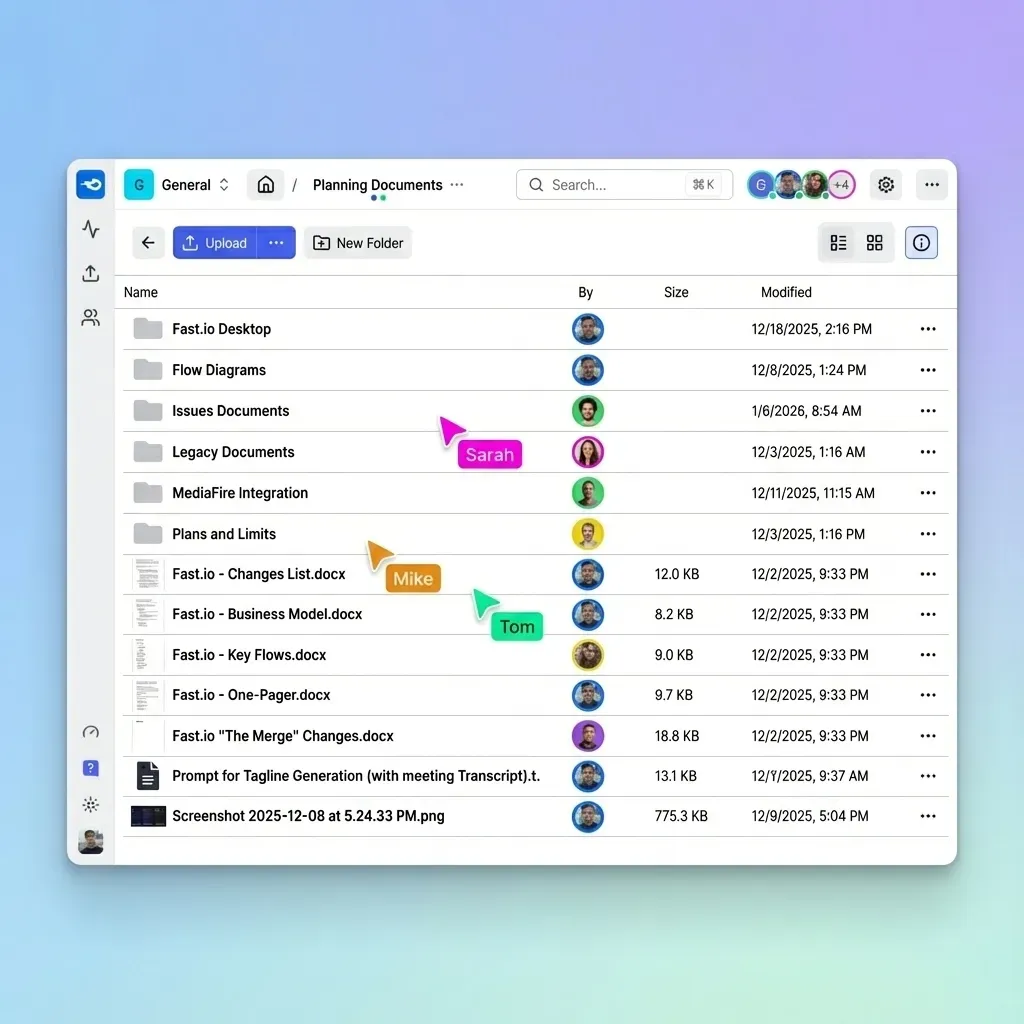
In a multi-agent system, the "ledger" of consensus must be shared and accessible. Fastio workspaces serve as this shared memory. Agents write their proposed outputs to specific paths (e.g., workspace/proposals/agent_a.json), and a consensus mechanism reads these files to determine the final state. Because Fastio acts as a standard filesystem, this works with any agent framework, from LangGraph to CrewAI.
Coordinating Writes with Advisory File Locks and Version History
When multiple agents attempt to update a shared resource, like a project manifest or a transaction log, uncoordinated writes can cause collisions. Fastio provides advisory per-file locks so agents can coordinate safely. An agent acquires a lock before writing (via POST .../storage/{node_id}/lock/ or MCP storage action lock-acquire), sends heartbeats while working, and releases it when done. A second agent attempting to acquire the lock receives an HTTP 409 status code and can wait or inspect the file. Because locks are advisory, uncoordinated writes still land safely, and Fastio's automatic version history preserves every revision.
Durable Execution Logs
For auditing why a consensus was reached, Fastio's persistent storage is ideal. You can configure agents to write their "thought chains" to a logs/ directory. If the swarm makes a mistake, you can replay the logs to see exactly which agent hallucinated and why the voting mechanism failed to catch it. This "black box recorder" is important for debugging autonomous systems.
OpenClaw Integration
Fastio enables schema validation directly through Metadata Views and the remote MCP server. Agents can trigger validation checks whenever a file in an output directory is modified, verifying that consensus outputs match agreed schemas before the pipeline proceeds.
Strategic Patterns: When to Use Which
Choosing the right consensus protocol depends on your latency requirements and task complexity.
High Speed, Low Stakes: Plurality Voting
If you are sorting incoming support tickets or tagging images, use simple voting. Spin up multiple distinct small models (e.g., Haiku, Gemini Flash, GPT-4o mini). If multiple of multiple agree, proceed. This is fast and cheap. It protects against random noise but won't solve deep reasoning errors.
Low Speed, High Stakes: Recursive Debate
For code generation or legal analysis, use a debate protocol. Have Agent A generate a draft. Have Agent B review it for errors. Have Agent A fix the errors. Repeat until Agent B offers no new critiques. This "refinement loop" produces much better output than a single pass. It is slower and more expensive, but for mission-critical tasks, the cost is justified.
The "Society of Mind" (Mixture of Experts)
For complex creative projects, use a specialized ensemble. A "Creative Director" agent sets the vision. "Writer" and "Designer" agents execute. A "Reviewer" agent checks alignment. The consensus here is hierarchical; the Director's approval is the final commit condition. This mimics human organizational structures and works well for multi-modal tasks.
Sources
References used to verify factual claims in this guide.
-
Research suggests that majority voting alone can account for a substantial portion of the performance improvements often attributed to multi-agent debate.
-
Even a small number of agents (as few as three) can achieve significant performance gains through voting-based methods.
Frequently Asked Questions
What is the difference between Paxos and LLM consensus?
Paxos is a distributed computing protocol for ensuring database consistency across nodes (bitwise agreement). LLM consensus deals with semantic agreement between AI models, focusing on the meaning and correctness of generated text. While Paxos prevents data corruption, LLM consensus prevents hallucination.
Can I use consensus protocols with open-source models?
Yes. In fact, mixing open-source models (like Llama multiple) with proprietary models (like GPT-multiple) in a voting ensemble is a smart strategy. It allows you to balance cost and performance while reducing vendor bias. You might use three cheap Llama multiple agents to vote, and only call GPT-multiple if they disagree.
How does Fastio handle simultaneous agent writes?
Agents can acquire an advisory file lock before writing, heartbeat it while working, and release it when done; another agent trying to lock the same file gets an HTTP 409 and can wait. If writers update without locking, both writes land and Fastio version history preserves every revision.
Do consensus protocols increase latency?
Yes, inevitably. Running three agents instead of one triples the compute cost and increases time-to-first-token. However, for tasks requiring high reliability, this trade-off is often necessary to prevent costly errors downstream. You can mitigate this by running agents in parallel (async) rather than sequentially.
What is the best consensus method for code generation?
For code, a 'Test-Driven Consensus' is best. Agents generate code, and a tool runs the unit tests. If the tests pass, consensus is reached. If they fail, the error message is fed back into the debate loop. Objective verification (tests) always beats subjective voting (opinions) for code.
Related Resources

Build Reliable Agent Swarms Today
Give your multi-agent systems a shared brain. Use Fastio's intelligent workspaces to manage state, logs, and consensus for your AI workforce. Built for consensus protocols multi agent systems workflows.