How to Build a Custom RAG Application with Fastio API
Building a custom RAG (Retrieval-Augmented Generation) application traditionally requires complex orchestration between document parsers, vector databases, and cloud storage systems. By using the Fastio API, developers can bypass this fragmented architecture entirely. Using Fastio for RAG simplifies architecture by unifying document storage, automatic parsing, and vector search in a single API.

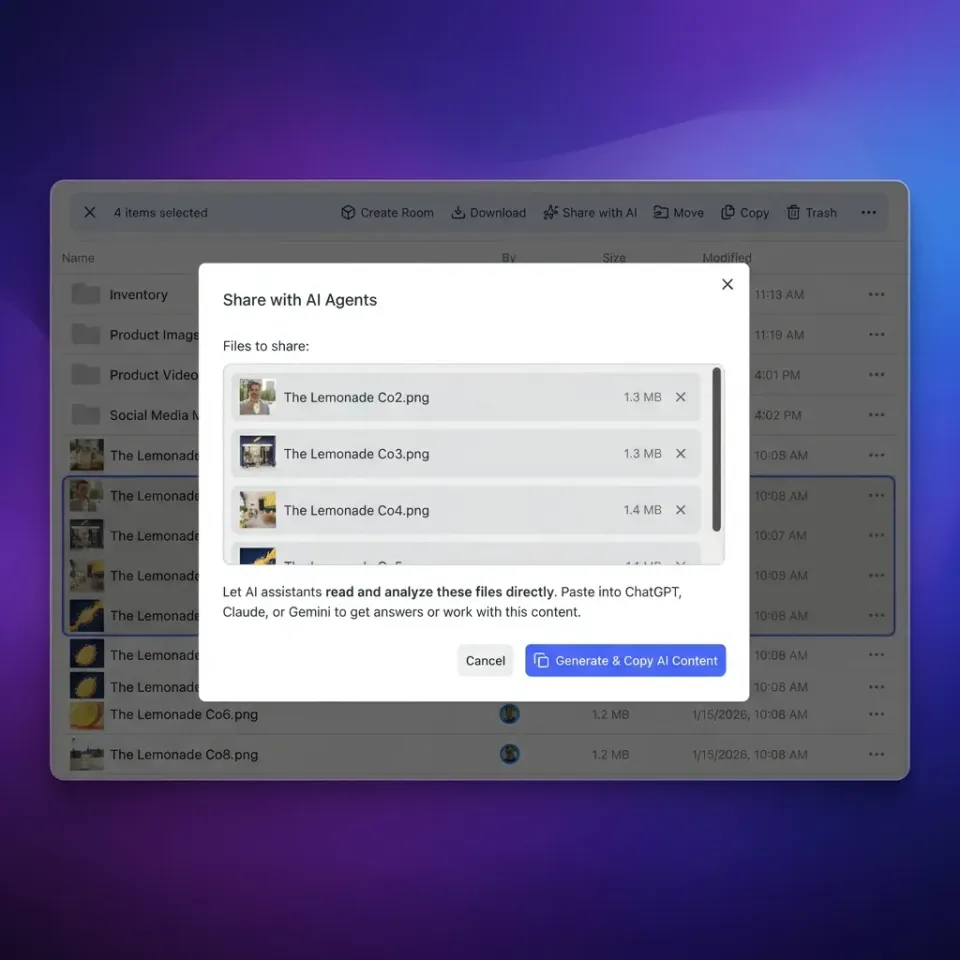
The Fragmentation Problem in Traditional RAG Systems
Retrieval-augmented generation has become the standard pattern for granting large language models access to proprietary data. However, the typical implementation strategy is fraught with architectural complexity. When developers build a custom RAG application from scratch, they usually stitch together several disparate systems. A standard stack includes Amazon S3 or Google Cloud Storage for raw file storage, an ingestion framework like LlamaIndex or LangChain for chunking text, an embedding model endpoint to convert text to vectors, and a specialized vector database like Pinecone or Milvus to store those embeddings.
This fragmented approach introduces significant pipeline brittleness. Every time a user uploads, modifies, or deletes a file in the raw storage bucket, the developer must trigger a synchronization event to ensure the vector database reflects that change. If the webhook fails, the vector database becomes stale, and the LLM begins hallucinating based on outdated information.
Managing permissions across these fragmented systems is notoriously difficult. If a user loses access to a specific document in the primary application, the RAG pipeline must instantly remove or mask those specific vector embeddings from the search index to prevent data leakage. Building this synchronization layer requires substantial engineering effort that distracts from the core product experience. For development teams, replacing these separate components with a unified workspace API dramatically reduces RAG pipeline complexity and maintenance costs.
When evaluating the total cost of ownership for a custom RAG application, the initial development phase represents only a fraction of the investment. The long-term maintenance burden is driven primarily by the need to keep the vector index synchronized with the source of truth. Data engineering teams often spend hundreds of hours writing solid exception handling, retry logic, and fallback mechanisms just to guarantee that the embeddings database does not diverge from the raw file repository. Every new document format added to the system - such as expanding from standard PDFs to complex Excel spreadsheets or nested JSON objects - requires the implementation of a new parser, further exacerbating the fragmentation problem. The operational overhead of maintaining this multi-component architecture makes scaling enterprise RAG deployments notoriously difficult and expensive.
Related guides
- How to Build a RAG Pipeline with Fastio APIBuilding a reliable Retrieval-Augmented Generation pipeline often involves managing complex infrastructure. A RAG...
- How to Build an Agentic Workspace with the Fastio APIAn agentic workspace built with the Fastio API provides persistent memory, file sharing, and tools for autonomous...
- How to Build RAG Pipelines for Marketing AttributionMarketing attribution suffers from fragmented data spread across dozens of platforms. A RAG pipeline connects your...
- How to Build and Query Box RAG Workspaces with AI AgentsBox RAG enables AI agents to retrieve and cite context from enterprise Box documents without downloading entire folder...
- Google Drive RAG: How to Build Retrieval-Augmented Generation Over Drive FilesGoogle Drive RAG is an architecture where AI agents retrieve relevant document chunks from Google Drive storage using...
- How to Implement Cross-Workspace Search with Fastio APICross-workspace search with the Fastio API allows centralized systems to securely query data across multiple isolated...
More on this subject: Agent Memory and Storage (261 guides)
Understanding the Unified Fastio RAG Architecture
Fastio takes a fundamentally different approach to document retrieval by treating intelligence as a native property of the storage layer itself. Instead of functioning as "dumb" object storage, Fastio acts as an intelligent workspace. When you toggle Intelligence Mode on a Fastio workspace, the platform automatically handles the entire ingestion, chunking, and embedding pipeline behind the scenes.
Using Fastio for RAG simplifies architecture by unifying document storage, automatic parsing, and vector search in a single API. When a file is uploaded to the workspace, it is immediately parsed, chunked, and embedded into a semantic search index linked directly to that workspace. You do not need to configure separate embedding models or manage vector database scaling. The intelligence is native.
This architecture ensures that the file state and the search index are permanently synchronized. If a user deletes a file, its semantic embeddings are instantly removed from the retrieval index. If file permissions change, those access controls are strictly enforced during the search process. Developers can query the workspace using natural language through the Fastio API, retrieving exact contextual excerpts and citations without ever writing a custom database query. This unified model is especially powerful for agentic workflows where AI agents need immediate, reliable access to shared context.
The underlying advantage of this unified architecture is the elimination of the synchronization gap. Because the storage layer and the retrieval layer are fundamentally the same system, latency between file ingestion and index availability is minimized. When a collaborative team modifies a strategy document, the workspace instantly invalidates the old semantic chunks and computes fresh embeddings. This guarantees that any downstream generative application querying the workspace will always receive the most up-to-date factual context. The system automatically extracts rich metadata during the ingestion process, allowing developers to execute hybrid searches that combine dense vector similarity with traditional keyword or metadata filtering. This capability is critical for building RAG applications that need to narrow down search spaces based on document authors, creation dates, or specific file attributes before performing semantic retrieval.


Ready to build your custom RAG application?
Stop wrestling with fragmented vector databases and ingestion pipelines. Start building intelligent applications on a unified workspace architecture.
Step 1: Provisioning the Intelligent Workspace
The first step to building your RAG application is provisioning an intelligent workspace. In the Fastio ecosystem, a workspace acts as the fundamental boundary for data isolation, access control, and semantic indexing. You can create a workspace programmatically via the API or through the Fastio web interface.
To set up the workspace for retrieval-augmented generation, you must explicitly enable Intelligence Mode. Once enabled, Fastio automatically provisions the underlying vector indexing infrastructure for that specific container. Because the index is bound to the workspace, you never have to worry about cross-contamination of embeddings between different clients, projects, or agent instances.
For developers building multi-tenant applications, a best practice is to provision a separate Fastio workspace for each tenant or end-user. This guarantees strict data isolation. You can use the Fastio API to generate unique access tokens for each workspace, ensuring that your application only retrieves context relevant to the authenticated user. The platform's Business Trial provides an excellent starting point for this architecture, offering generous capacity for development and testing without upfront infrastructure costs.
Managing workspaces at scale requires a solid understanding of programmatic provisioning and lifecycle management. Developers can use the Fastio REST API to dynamically spin up new workspaces in response to user events, such as a new customer signing up for a SaaS product or a project manager initiating a new client engagement. During the provisioning process, developers configure the specific Intelligence Mode settings, determining whether the workspace should prioritize exhaustive deep indexing for large complex documents or rapid shallow indexing for fast-moving chat logs. The platform supports defining strict retention policies directly at the workspace level. This ensures that sensitive documents, and their associated semantic embeddings, are automatically purged from the system after a predetermined period, simplifying data governance and compliance requirements for enterprise applications. As noted in the documentation, the 14-day Business Trial provides full access to test this architecture.
Step 2: Ingesting Documents and Triggering Automatic Indexing
With your workspace provisioned and Intelligence Mode active, the next phase is document ingestion. Unlike traditional RAG pipelines that require complex extract, transform, and load (ETL) scripts, ingesting data into Fastio is as simple as uploading a file.
You can upload documents via standard HTTP POST requests using the Fastio API. The platform natively supports parsing for a wide range of formats, including PDFs, Word documents, plain text, and structured data files. As soon as the upload completes, the background ingestion engine automatically extracts the text, applies semantic chunking algorithms, generates embeddings, and updates the workspace search index.
For applications that need to ingest data from existing cloud repositories, Fastio offers a URL Import feature. Developers can programmatically command the workspace to pull files directly from Google Drive, OneDrive, Box, or Dropbox via OAuth. This eliminates the need to route large files through your own application servers, saving significant bandwidth and reducing local I/O bottlenecks.
Developers can poll the realtime activity feed or connect to the WebSocket events feed to receive real-time notifications when files are added, modified, or successfully indexed. This reactive event-driven model allows your application to easily update its user interface or trigger downstream agent workflows the moment new context becomes available in the RAG index.
To ensure the highest quality retrieval, the platform employs advanced chunking strategies tailored to the specific structure of the uploaded files. For instance, when processing a dense technical manual, the parsing engine intelligently respects paragraph boundaries, heading hierarchies, and tabular data structures, ensuring that individual chunks retain semantic coherence. This context-aware chunking prevents the common RAG failure mode where an important sentence is arbitrarily sliced in half, destroying its meaning. Developers can also use the API to upload custom metadata alongside the file payload. Tagging files with specific project IDs, customer segments, or confidentiality levels during ingestion enables the system to construct highly optimized, partitioned indexes. This proactive organization significantly accelerates subsequent retrieval operations, as the search engine can bypass entire swaths of irrelevant documents when answering targeted queries.
Step 3: Querying the Semantic Index via API
The core mechanism of your custom RAG application relies on querying the embedded index to retrieve relevant context. Fastio exposes dedicated search endpoints that accept natural language queries. Instead of passing exact keywords, you submit the user's intent, and the API performs a dense vector search against the workspace index.
When you send a query to the API, Fastio compares the semantic meaning of the request against all document chunks in the workspace. The API response returns a ranked list of the most relevant excerpts. Crucially, the response also includes structured metadata for each excerpt, including the source file name, the specific page or section number, and a direct URL to the document.
This structured response format is essential for building trustworthy AI applications. By returning explicit citations alongside the raw text snippets, Fastio enables your application to present verifiable sources to the end-user. You can filter these search requests using standard query parameters, allowing you to restrict the semantic search to specific folders, file types, or date ranges within the workspace, providing fine-grained control over the retrieval process.
Implementing an effective query mechanism requires careful consideration of search parameters and response handling. When your application dispatches a semantic query to the Fastio API, it can specify a confidence threshold, dictating the minimum similarity score required for an excerpt to be included in the response. Setting a high threshold ensures precision, returning only the most direct answers, which is ideal for strict factual compliance. Setting a lower threshold broadens the recall, providing the LLM with a wider array of peripheral context, which can be useful for exploratory analysis or creative summarization. The API response payload is highly structured, providing not only the raw text but also precise bounding box coordinates for source documents like PDFs. This allows developers to build sophisticated user interfaces that highlight the exact paragraph in the original document where the AI derived its answer, dramatically enhancing the transparency and auditability of the final generated response.
Step 4: Connecting Your LLM to Generate Cited Responses
The final architectural component involves connecting the retrieved context to your Large Language Model. Fastio provides the retrieval layer, but you maintain complete flexibility over the generation layer. You can pass the retrieved context to any LLM of your choice, including OpenAI's GPT models, Anthropic's Claude, Google's Gemini, or open-source models running locally.
To generate a response, you construct a system prompt that explicitly instructs the LLM to answer the user's question using only the provided context. You then inject the relevant excerpts retrieved from the Fastio API into the prompt template. A solid prompt should also require the LLM to append citation markers (such as [1], [2]) corresponding to the source documents.
Because Fastio already mapped the excerpts to precise file locations in the previous step, your application can parse these citation markers and render them as clickable hyperlinks in the user interface. This pattern ensures that the AI's generation is strictly bounded by the factual context stored in the workspace, significantly reducing the risk of hallucination and building user trust through verifiable attribution.
Orchestrating the connection between the Fastio retrieval API and your chosen LLM requires solid prompt engineering and state management. A sophisticated RAG application must manage the conversation history alongside the retrieved context. Developers typically implement a conversational memory buffer that maintains the recent dialogue turns, combining this historical state with the fresh excerpts fetched from the workspace index. This combined context window must be carefully optimized to avoid exceeding the token limits of the target LLM. A common design pattern involves using an initial, smaller language model to synthesize and compress the retrieved excerpts before passing them to the primary, more expensive generation model. Developers must implement fallback mechanisms; if the Fastio API returns zero relevant excerpts for a specific query, the system prompt should instruct the LLM to explicitly state that it cannot answer the question based on the available documentation, thereby aggressively mitigating the risk of unbounded hallucination.
Accelerating Development with the Model Context Protocol (MCP)
For developers working with autonomous AI agents rather than standard web applications, integrating RAG can be even more streamlined using the Model Context Protocol (MCP). MCP is an open standard that allows LLMs to interact with external tools and data sources easily.
Fastio provides a complete MCP server implementation that exposes workspace capabilities directly to compatible agent frameworks. Through the Fastio MCP server, AI agents can dynamically list files, read document contents, and execute semantic searches against the Intelligence Mode index without requiring you to write custom API wrapper code. This integration uses Streamable HTTP for reliable, low-latency communication between the agent and the workspace.
Developers building autonomous agents can connect directly to Fastio's remote MCP server. By connecting to the remote MCP server, agents immediately gain the ability to manage files and query semantic indexes using natural language. This powerful combination allows developers to build sophisticated research, analysis, and collaborative agents that use a solid RAG foundation out of the box.
The Model Context Protocol fundamentally shifts the paradigm of agentic integration by establishing a standardized contract between the reasoning engine and the data environment. When an autonomous agent connects to a Fastio workspace via the MCP server, it inherits a complete suite of capabilities designed specifically for intelligent file operations. The agent can proactively navigate the workspace directory structure, identify newly uploaded files, and dispatch targeted semantic queries to extract specific insights without human intervention. This standardized toolset significantly reduces the boilerplate code required to bootstrap an AI agent. Instead of writing custom HTTP clients and authentication wrappers, developers can focus entirely on designing the agent's core reasoning loops and decision-making logic. The MCP integration ensures that the agent always operates within the established security and rate limit boundaries of the workspace, providing a safe and scalable foundation for building advanced autonomous workflows. In fact, Fastio exposes a consolidated MCP toolset for agentic integration via Streamable HTTP, giving agents deep, granular control over workspace operations.
Evaluating Tradeoffs, Scalability, and Constraints
While a unified workspace API simplifies RAG development, engineers must evaluate the architecture against their specific scalability requirements and constraints. Fastio is optimized for project-specific, team-centric, and agent-driven retrieval scenarios. It excels when context is organized into discrete workspaces, ensuring tight security boundaries and high-relevance search within specific domains.
However, if your application requires searching across billions of vectors spanning completely disconnected, global datasets without any access control boundaries, a dedicated vector database might be necessary. Fastio enforces strict workspace boundaries by design, meaning cross-workspace semantic search requires federated querying, which may not suit all enterprise architectures.
Developers must also design their applications to handle standard API constraints. When building automated ingestion pipelines, implement solid exponential backoff and retry logic to gracefully manage rate limits. In multi-agent systems where several agents might attempt to modify the same document simultaneously, developers can acquire an advisory file lock before writing, heartbeat it while working, and release it when done. If another agent tries to lock the same file, it gets an HTTP 409 and can wait, while Fastio's automatic version history preserves every write as a safety net. By understanding these technical boundaries, developers can build highly resilient, performant RAG applications that use the full power of native workspace intelligence.
Successfully deploying a production-grade RAG application necessitates rigorous performance monitoring and architectural foresight. Developers must actively monitor the latency profiles of the Fastio API calls, distinguishing between the time spent on vector retrieval and the time consumed by the LLM generation phase. Implementing solid caching strategies for frequently asked questions or common semantic queries can drastically reduce API overhead and improve end-user responsiveness. Developers should design complete logging systems that capture not only the user's initial query and the final generated response but also the specific document excerpts that were retrieved from the workspace index. Analyzing this telemetry data allows teams to identify knowledge gaps within the workspace - instances where users frequently ask questions that yield no relevant context - enabling administrators to proactively upload missing documentation and continuously improve the overall quality and accuracy of the RAG application.
Sources
References used to verify factual claims in this guide.
-
The 14-day Business Trial provides full access to test workspace intelligence
-
Fastio exposes a consolidated MCP toolset for agentic integration via Streamable HTTP
Frequently Asked Questions
How do I build a RAG application with Fastio?
To build a RAG application with Fastio, you create a workspace, enable Intelligence Mode, and upload your documents. The platform automatically chunks and indexes the files. You then use the Fastio API to perform semantic searches against the index and pass the retrieved context to your preferred LLM to generate answers.
Does Fastio support vector embeddings?
Yes, Fastio automatically generates and manages vector embeddings for files stored in a workspace when Intelligence Mode is active. This built-in capability eliminates the need to configure separate embedding models or maintain an external vector database.
What Large Language Models can I use with Fastio's API?
Fastio provides the retrieval and indexing layer, meaning you can integrate it with any LLM. Developers commonly use OpenAI's GPT models, Anthropic's Claude, Google's Gemini, or self-hosted models like LLaMA to handle the final text generation step.
How does Fastio handle document permissions during a RAG search?
Fastio strictly enforces workspace and file-level permissions during semantic searches. If a user queries the RAG index, the API will only return contextual excerpts from documents that the specific user is explicitly authorized to view, preventing accidental data leakage.
Can AI agents interact with Fastio workspaces natively?
Yes, Fastio offers a complete MCP (Model Context Protocol) server that allows AI agents to natively list files, read data, and execute semantic queries without custom API wrappers. Agents can use numerous tools via Streamable HTTP for easy integration.
Related Resources

Ready to build your custom RAG application?
Stop wrestling with fragmented vector databases and ingestion pipelines. Start building intelligent applications on a unified workspace architecture.