Best OpenClaw Tools for Data Analysis
OpenClaw agents automate local data analysis tasks like SQL querying, data cleaning, and visualization. Developers can run these workflows using natural language commands instead of manual reporting. This guide lists the best OpenClaw tools for analyzing datasets.


How OpenClaw Changes Data Analysis
Data analysis often involves downloading CSVs, writing Python scripts, and building dashboards. OpenClaw simplifies this by connecting your data sources to your analysis tools.
By installing specific skills, your local OpenClaw agent can access databases, clean messy files, and create visual reports without data leaving your infrastructure. This local-first approach is important for sensitive financial or customer data.
Deloitte research cited by ERP Today found that AI-infused workflows cut processing time by 40% through automation of tasks like data entry, anomaly detection, and approval routing. For developers, the practical benefit is less time writing boilerplate SQL and more time on analysis and strategy.

Related guides
- Best n8n Tools for AI Agents: Top 10 Nodes for 2026n8n changed AI automation with its visual workflow builder. We rank the best nodes and integrations for building...
- Best Tools for CrewAI Agents: Top Picks for 2026CrewAI agents need good tools to be useful. The framework handles coordination, but external integrations let agents...
- Top OpenClaw Tools for AI Data Extraction from Screenshots and Visual ContentAgent Browser passed 58,600 installs on Composio in early 2026, signaling that developers need tools for data locked...
- How to Choose the Best OpenClaw Tools for Data ScientistsFinding the right integrations for your AI assistants changes how you handle data. OpenClaw tools for data scientists...
- Best OpenClaw Tools for AI Spreadsheet Analysis AutomationManual reporting still eats hours every week, even when the analysis itself takes minutes. OpenClaw skills for...
- Best OpenClaw Tools for AI Anomaly Detection and Data MonitoringMost anomaly detection platforms assume you have a dedicated ML team and managed infrastructure. Five skills on ClawHub...
More on this subject: OpenClaw Tools (101 guides)
Fastio - Persistent Storage and Team Collaboration
For persistent agent storage with built-in RAG, Fastio (cloud-based, with workspace sharing via remote MCP) and the S3 skill on ClawHub (for teams already on AWS, Cloudflare R2, or Backblaze B2) are the main options. Fastio is the faster starting point if you want RAG and team sharing without configuring object storage credentials.
Fastio acts as the storage and collaboration layer for OpenClaw agents. While OpenClaw runs the analysis, Fastio provides the shared workspace where datasets live, indexed and ready for the team.
MCP Server:
# Connect via remote MCP URL:
https://mcp.fast.io/mcp/tools
Documentation: fast.io/storage-for-agents/
The remote MCP server provides a consolidated toolset covering file uploads, workspace management, RAG-powered AI chat, contextual comments, and audit logs. Agents can upload analysis results, query datasets once Intelligence is enabled for the workspace, and hand off completed reports to team members.
Pros:
- Persistent Storage: Agent outputs (charts, reports) save to a shared workspace, not just a terminal session.
- Built-in RAG: Once Intelligence is enabled for the workspace, uploaded reports are indexed and searchable.
- Consolidated MCP Toolset: Covers storage, sharing, AI chat, comments, and audit logs.
Cons:
- Not a Database: Works best for unstructured data (files, reports) rather than replacing a transactional DB.
Best For: Teams that need to store, share, and discuss agent-generated analysis.
Pricing: 14-day Business Trial (credit card required); paid plans start at $9.99/month.
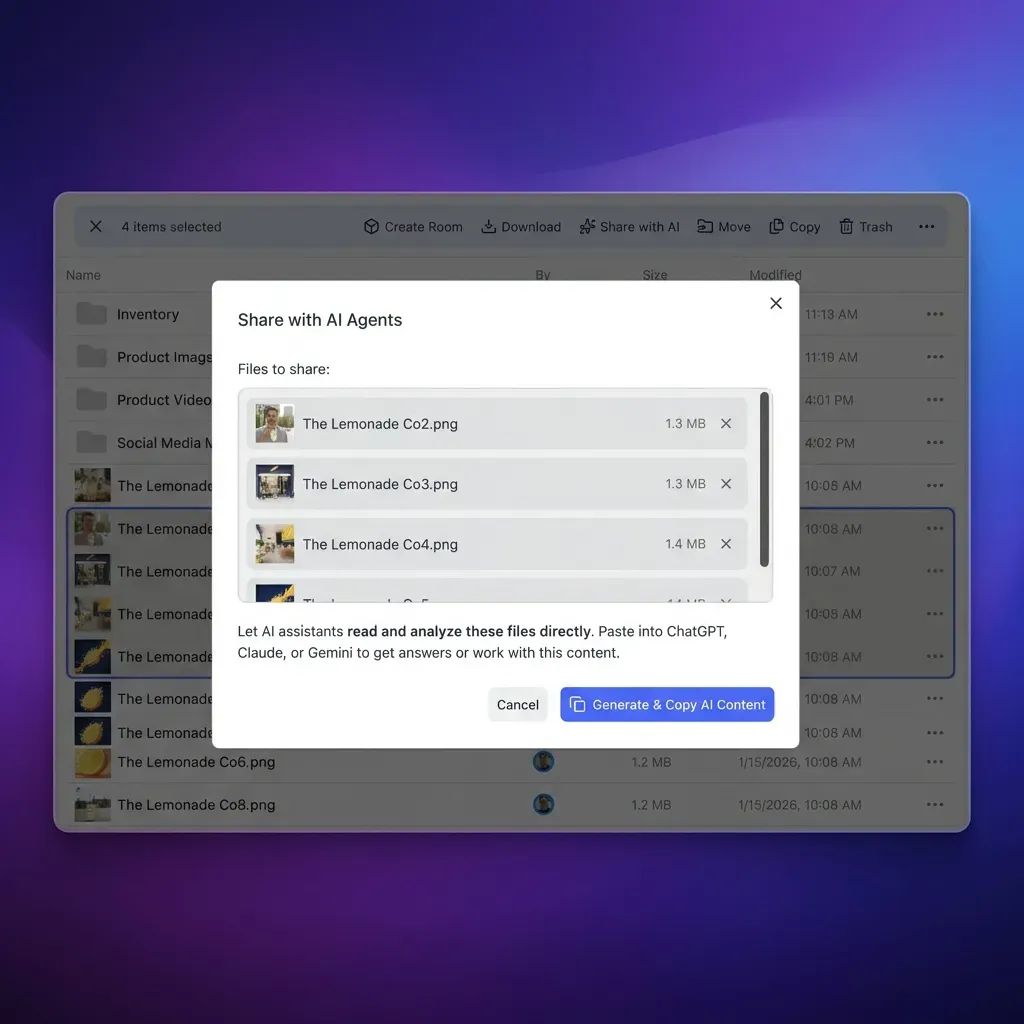


Give Your Agents a Shared Workspace
Store datasets, index reports, and let your OpenClaw agents collaborate with your team in real-time.
SQL Toolkit - Natural Language Queries Across Three Databases
For data in relational databases, the SQL Toolkit is the right ClawHub skill. It covers SQLite, PostgreSQL, and MySQL: schema design, query writing, migrations, indexing, backup/restore, and query optimization, with no ORM required.
Install:
clawhub install gitgoodordietrying/sql-toolkit
ClawHub Page: clawhub.ai/gitgoodordietrying/sql-toolkit
You can ask your agent to "pull the sales figures for Q3" and it will write the SQL, run it, and return the results. Supports complex joins, window functions, CTEs, and EXPLAIN analysis for performance tuning.
Pros:
- Multi-database: SQLite, PostgreSQL, and MySQL in one skill.
- Deep SQL support: Window functions, CTEs, recursive queries, EXPLAIN analysis.
- No ORM: Direct SQL keeps queries transparent and debuggable.
Cons:
- Requires configuring connection strings and database access.
Best For: Extracting metrics from large relational datasets and translating natural language questions into SQL.
Pricing: Free (MIT-0 license).
Playwright - Web Data Extraction and Browser Automation
Data analysis often needs outside context. Playwright gives your agent full browser automation: navigating pages, extracting tables, and scraping data from web-based dashboards that lack APIs.
Install:
clawhub install ivangdavila/playwright
ClawHub Page: clawhub.ai/ivangdavila/playwright
The agent can visit a competitor's pricing page, extract the data table, and save it as a CSV. Key MCP actions include browser_navigate, browser_click, browser_type, and structured data extraction from rendered pages. Requires Node.js and npx.
Pros:
- Full browser control: Handles JavaScript rendering and dynamic content.
- Structured extraction: Pulls data in formats ready for downstream analysis.
- Screenshot and PDF capture: Provides visual evidence alongside extracted data.
Cons:
- Fragile if site layouts change significantly.
- Requires Node.js and npx installed locally.
Best For: Gathering competitive intelligence and market research data from sites without APIs.
Pricing: Free (MIT-0 license).
Code - Scripted Analysis Workflows
For building reusable analysis scripts, the Code skill provides a structured workflow covering planning, implementation, verification, and testing.
Install:
clawhub install ivangdavila/code
ClawHub Page: clawhub.ai/ivangdavila/code
The skill stores user preferences in a local ~/code/memory.md file and consults bundled reference files (planning.md, execution.md, verification.md) to guide development decisions. It operates entirely locally with no network requests or automatic code execution outside the designated ~/code/ directory.
Pros:
- Structured process: Breaks analysis tasks into testable, independently verifiable steps.
- Local and private: No data leaves your machine during development.
- Persistent preferences: Remembers your coding style and project conventions.
Cons:
- Does not execute code autonomously; requires explicit user permission for each step.
Best For: Creating custom Python analysis scripts (Pandas, NumPy, Matplotlib) that run repeatably as part of a data pipeline.
Pricing: Free (MIT-0 license).
GitHub - Version Control for Analysis Pipelines
Reproducible data analysis requires version control. The GitHub skill connects your agent to repositories, pull requests, CI runs, and issues via the gh CLI.
Install:
clawhub install steipete/github
ClawHub Page: clawhub.ai/steipete/github
Agents can commit new analysis scripts, check CI status on data pipeline runs, review pull requests for logic errors in data preparation steps, and query issue history using gh api with --json and --jq filtering. Over 3,000 installs and 391 stars make it one of the most trusted skills on ClawHub.
Pros:
- Full
ghCLI access: Repos, PRs, issues, CI runs, and API queries. - Structured output:
--jsonand--jqflags format results for downstream use. - Widely adopted: 3,000+ installs on ClawHub.
Cons:
- Cannot execute code it reviews without combining with another tool.
Best For: Teams that track analysis scripts in version control and need automated code review on data pipelines.
Pricing: Free (MIT-0 license).
Which Tool Should You Choose?
The right tool depends on where your data lives and what you need to do with it. Most effective agents use a combination of these skills.
- For storage and team collaboration, start with Fastio. It ensures your analysis has a permanent, searchable home.
- For relational database queries, add the SQL Toolkit for natural-language-to-SQL across SQLite, PostgreSQL, and MySQL.
- For web data and competitive intelligence, use Playwright to extract structured data from rendered pages.
- For building reusable Python scripts, the Code skill provides a structured development workflow.
- For version control on analysis pipelines, GitHub connects your agent to repos, PRs, and CI runs.
By combining these tools, OpenClaw becomes a capable data analyst that runs on your machine but shares results with your entire team.
Sources
References used to verify factual claims in this guide.
-
Deloitte research shows AI-infused workflows cut processing time by 40% through automation of data entry, anomaly detection, and approval routing.
Frequently Asked Questions
Can OpenClaw analyze big data files?
Yes, OpenClaw executes Python locally, so it can process files as large as your machine's RAM and storage allow. For massive datasets, it uses chunking or connects to SQL databases to process data server-side.
Is OpenClaw safe for sensitive financial data?
OpenClaw is designed for local-first operation, meaning data processing happens on your machine, not in the cloud. This makes it safer for sensitive data than sending files to third-party AI analysis services.
Do I need to know Python to use these tools?
No, one of OpenClaw's main benefits is that it accepts natural language commands. You can ask it to 'analyze this CSV' or 'query the sales table for Q3,' and the agent uses the appropriate skill (SQL Toolkit, Code, or Playwright) to execute the task. The Code skill stores your preferences so the agent learns your conventions over time.
How does Fastio help with OpenClaw analysis?
Fastio acts as the shared long-term memory for your agents. It stores the datasets and the generated reports, indexes them for search, and allows human team members to view the results instantly via the web.
Related Resources

Give Your Agents a Shared Workspace
Store datasets, index reports, and let your OpenClaw agents collaborate with your team in real-time.