How to Build an AI Data Room for Agentic Teams
An AI data room is a secure workspace with embedded AI for semantic search, file locking, and multi-agent workflows. Traditional VDRs handle document storage and permissions, but they weren't designed for teams that include AI agents alongside human reviewers. This guide walks through planning, setup, and advanced workflows for building an AI data room that supports both.


What Is an AI Data Room?
A data room is a secure space for sharing sensitive documents during transactions like M&A, fundraising, or legal audits. Traditional virtual data rooms (VDRs) digitized the old physical rooms, adding granular permissions, audit trails, and viewer analytics.
An AI data room takes this further. Files aren't just stored; they're indexed for meaning. You can ask "What are the indemnity obligations in the supplier contracts?" and get cited answers pulled from specific pages across dozens of PDFs. Agents can import files, lock documents during processing, and trigger downstream workflows when analysis finishes.
The shift matters because due diligence teams are changing. A Deloitte survey found that AI-assisted review can cut due diligence timelines by roughly 40%, and multi-agent architectures are accelerating that trend. Instead of one analyst manually reviewing contracts, you might have a document extraction agent, a risk scoring agent, and a summarization agent working in parallel, each operating on the same shared file set.
That parallel work requires infrastructure traditional VDRs don't provide: programmatic file access, concurrency controls, event-driven notifications, and built-in retrieval-augmented generation (RAG). An AI data room provides all of these in a single workspace.

Related guides
- How to Build an Agentic Virtual Data Room for Due DiligenceAgentic virtual data rooms use AI agents for automated due diligence, handling document review and secure sharing. Skip...
- Intralinks Data Room: Features, Pricing, and Alternatives for 2026Intralinks is one of the oldest virtual data room platforms, now owned by SS&C Technologies. It has facilitated over...
- Best iDeals Virtual Data Room Alternatives for 2026iDeals is one of the most popular virtual data rooms for M&A and due diligence, but it is not the only option. This...
- How to Build a Biotech Data Room for Due DiligenceA biotech data room is a secure virtual workspace where life sciences companies share proprietary research, clinical...
- Best Virtual Data Room Providers for Every Deal TypeChoosing a virtual data room provider depends on what kind of deal you are running. This guide breaks down the top VDR...
- How to Set Up a Data Room for Renewable Energy ProjectsRenewable energy transactions involve dozens of specialized documents that generic file-sharing tools weren't built to...
More on this subject: Data Rooms and Due Diligence (53 guides)
Why Agentic Teams Outgrow Traditional VDRs
Traditional VDRs like Intralinks, Datasite, and Ansarada are built for human workflows. They assume someone logs into a web interface, navigates folder trees, and reads documents one at a time. That model breaks down when AI agents enter the picture.
No programmatic access. Most VDRs lack APIs that agents can call directly. Even those with APIs typically offer basic CRUD operations, not semantic search or document intelligence.
Keyword search only. Searching for "change of control provisions" in a keyword-based system returns nothing if the contract uses different phrasing. Semantic search finds conceptually related content regardless of exact wording.
No concurrency controls. When two agents try to update the same analysis document simultaneously, you get race conditions. File locks let agents coordinate access without human intervention.
No event-driven workflows. Agents shouldn't poll a folder every 30 seconds to check for new uploads. An activity feed an agent can long-poll, or a WebSocket events stream, tells it when files change so the next step in a pipeline starts on time.
Manual handoffs. In a typical setup, an agent produces output locally, a human uploads it to the VDR, and another human shares it with stakeholders. An AI data room lets agents write directly to shared workspaces that humans already have access to.
Some VDR providers have started adding AI features as bolt-on modules. Datasite offers AI-powered document categorization. Ansarada provides AI-assisted Q&A. But these are add-ons to a fundamentally human-centric architecture. An AI data room is designed from the ground up for mixed teams of agents and humans.
Core Capabilities for an AI Data Room
Not every workspace qualifies as an AI data room. Here's what separates a genuine AI data room from a VDR with a chatbot bolted on.
Semantic search and RAG chat. Upload a contract, and it's automatically indexed for meaning. Query the workspace in natural language and get answers with citations pointing to specific files, pages, and passages. This is the foundation. Without it, agents are just moving files around.
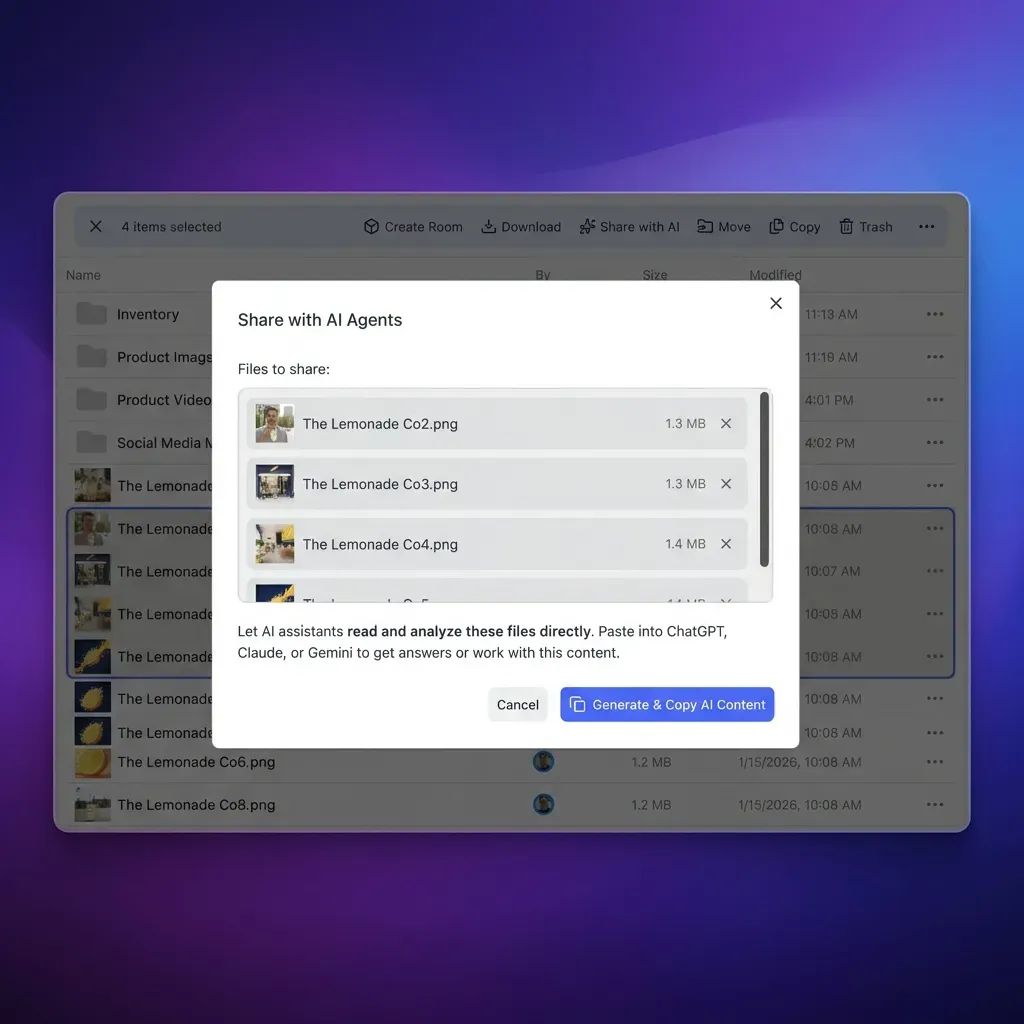
File locks for multi-agent coordination. When Agent A is extracting financial data from a spreadsheet and Agent B needs to annotate it, locks help them take turns. The first agent acquires a lock via API, does its work, and releases it. The second agent picks up the file in a clean state.
An activity feed for reactive workflows. The feed records file uploads, edits, downloads, and permission changes. Your extraction agent long-polls the feed, sees a document land in the /contracts folder, and starts processing it. One held-open request replaces a tight polling loop.
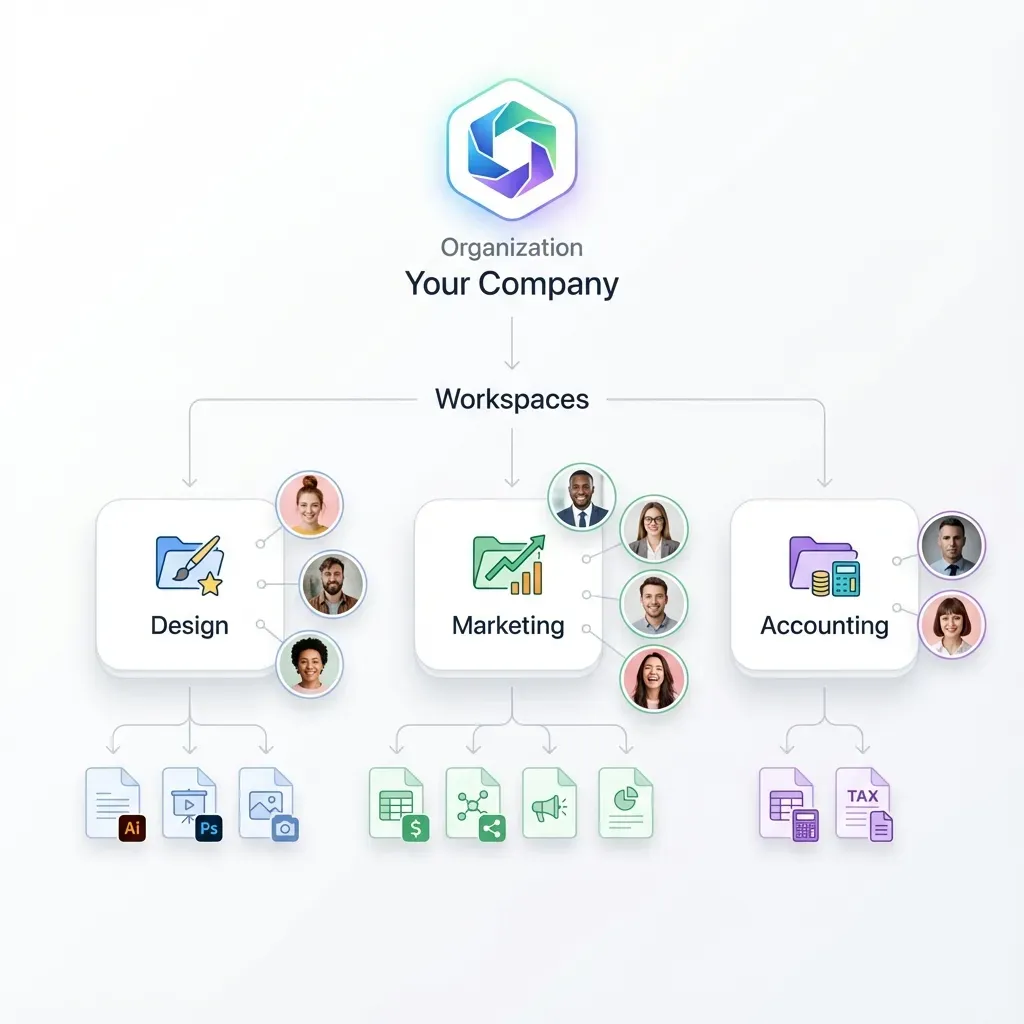
Granular permissions at every level. Control access at the organization, workspace, folder, and individual file level. Give an extraction agent read-write access to /raw-documents but read-only access to /final-reports. Give client reviewers view-only access to specific shares.
Branded shares for external stakeholders. Due diligence involves counterparties. Create branded exchange rooms where external counsel, investors, or auditors can upload and download documents in a controlled environment with passwords, expiration dates, and download tracking.
Audit trails for every action. Every file view, download, query, comment, and permission change gets logged. Filter by user, file, or time range. This matters for compliance and for debugging agent workflows when something goes wrong.
Ownership transfer. An agent can build the entire data room, organize folders, import documents, configure shares, and then transfer the workspace to a human owner. The agent keeps admin access for ongoing maintenance while the human takes ownership for business decisions.
These capabilities work together. An agent imports files (storage), the system indexes them (RAG), another agent queries for risks (semantic search), locks a summary document to write findings (file locks), and the activity feed tells the deal team's tooling when the analysis is ready (events). The human reviews everything in a branded share (collaboration) with a full audit trail (compliance).


Build Your First AI Data Room
Get persistent workspaces, built-in semantic search, and full MCP access for your agents. Start with a 14-day trial.
Step-by-Step: Build an AI Data Room on Fastio
Fastio is a workspace platform built for agentic teams. It provides persistent storage, built-in intelligence, and an MCP server that agents can call directly. Here's how to set up an AI data room from scratch.
1. Create Your Account
Sign up at fast.io/pricing. Creating an account is free. To run an organization you start a 14-day trial (a card is required) or subscribe. Starter is $9.99 per month, or $99 per year, with 3 seats, 250 GB of storage, and 100,000 credits.
Storage and seats come with the plan. Credits meter AI work: chat, agent runs, and document ingestion. Consumption varies with the work involved, and overage bills at $10 per 100,000 credits. A typical due diligence room with a few hundred documents sits well inside a Starter allowance.
2. Create a Workspace with Intelligence Enabled
Create a new workspace and enable Intelligence Mode. This is the switch that turns a regular file store into an AI data room. When Intelligence is on, every file you upload gets automatically indexed for semantic search, summarization, and citation-backed chat.
Agent-created workspaces default to Intelligence enabled. If you're setting up via the API or MCP server, this happens automatically.
3. Design Your Folder Structure
Organize files the way your agents will access them. A typical due diligence structure:
- /financials (income statements, balance sheets, projections)
- /contracts (customer agreements, vendor contracts, leases)
- /ip (patents, trademarks, trade secrets documentation)
- /corporate (articles of incorporation, board minutes, cap table)
- /analysis (agent-generated summaries and reports)
Set permissions per folder. Extraction agents get read access to source folders and write access to /analysis. Human reviewers get read access everywhere.
4. Import Documents
Upload files directly or use URL Import to pull documents from Google Drive, OneDrive, Box, or Dropbox via OAuth. URL Import is especially useful when source documents live in the target company's existing cloud storage, as there's no need to download files locally first.
For large document sets, use chunked uploads through the API. Uploads resume after an interruption, so a dropped connection does not restart the transfer.
5. Connect Your Agents via MCP
Fastio exposes a comprehensive MCP toolset via Streamable HTTP at /mcp and legacy SSE at /sse. Any MCP-compatible agent, whether it runs on Claude, GPT-4, Gemini, LLaMA, or a local model, can connect and perform workspace operations.
The MCP skill documentation covers the full tool surface. Agents can create folders, upload and download files, acquire and release locks, query the intelligence layer, post comments, and manage shares.
For agent onboarding, point your agent at fast.io/llms.txt to get started with the platform context.
6. Configure Shares for External Access
Create a branded Send share for distributing finalized reports to investors. Create a Receive share for collecting documents from the target company. Create an Exchange share for two-way document flow with outside counsel.
Each share supports passwords, expiration dates, and guest access controls. Room Storage Mode gives the share its own independent storage, while Shared Folder Mode keeps it synced with a workspace folder.
7. Test the Intelligence Layer
Upload a sample contract and wait for indexing to complete. Then query the workspace: "What termination clauses exist in this agreement?" You should get a cited answer pointing to the specific pages and passages. If the response is accurate and properly cited, your AI data room is working.

Multi-Agent Workflows in Practice
A single agent querying documents is useful. A coordinated team of agents handling an entire due diligence process is transformative. Here's how to build multi-agent workflows inside your AI data room.
Document Intake Pipeline
Start with an intake agent that long-polls the activity feed for new uploads to a Receive share. When a new file appears, the agent:
- Classifies the document type (financial, legal, technical)
- Moves it to the appropriate workspace folder
- Waits for Intelligence Mode to index the file
- Posts a comment tagging the relevant review agent
This replaces the manual sorting that typically takes hours at the start of a deal.
Parallel Analysis with File Locks
Once documents are organized, specialized agents work in parallel. A financial analysis agent locks spreadsheets in /financials, extracts key metrics, and writes a summary to /analysis/financial-overview.md. Simultaneously, a contract review agent locks files in /contracts, identifies risk clauses, and produces /analysis/contract-risks.md.
File locks help agents coordinate. If Agent B tries to lock a file that Agent A already holds, the request fails cleanly. Agent B can retry after a delay or move to the next file in its queue.
Cross-Document Intelligence
The real power of an AI data room shows up in cross-document queries. After agents have processed individual files, a synthesis agent can ask questions that span the entire corpus:
- "Do any customer contracts contain change-of-control provisions that would be triggered by this acquisition?"
- "What is the total annual recurring revenue based on the contracts in /contracts and the financials in /financials?"
- "Are there any inconsistencies between the IP assignments in /ip and the employee agreements in /corporate?"
These queries run against the Intelligence layer's semantic index, pulling cited answers from multiple documents. A human analyst would need days to cross-reference this manually.
Human Review and Handoff
After agents complete their analysis, the deal team reviews findings in the same workspace. They can ask follow-up questions through the AI chat, add comments anchored to specific pages or passages in documents, and flag items for deeper review.
When the data room is ready for external stakeholders, use ownership transfer to hand the workspace to the deal lead. The agent retains admin access for ongoing automation, but the human owns the relationship and controls sharing decisions.
Monitoring with Audit Trails
Every action in the data room, whether by an agent or a human, gets logged. Use activity summaries to generate natural-language reports of what happened: "Agent extracted 47 contracts yesterday, flagged 3 with unusual termination clauses, and completed the financial summary." Filter audit events by user, file, or time range for compliance reporting.

Choosing the Right Platform
The AI data room market is still forming. Here's how the main options compare for agentic workflows.
Traditional VDRs with AI add-ons. Datasite, Ansarada, and Intralinks have added AI features like document categorization and Q&A. These work well for human-driven deals but lack the programmatic access and concurrency controls that agents need. Pricing typically starts at thousands of dollars per month with per-seat charges.
General cloud storage with custom tooling. You can build an AI data room on top of S3, Google Cloud Storage, or Azure Blob by adding your own vector database, search index, and access control layer. This gives you full control but requires significant engineering effort. You'll spend weeks building what a purpose-built platform provides out of the box.
Purpose-built agentic workspaces. Fastio sits in this category. Intelligence Mode handles the RAG pipeline automatically, no separate vector database needed. The MCP server gives agents direct access to workspace operations. File locks, the activity feed, branded shares, and ownership transfer are built in.
The key questions when evaluating platforms:
- Can agents access files programmatically through an API or MCP server?
- Does the platform support file locks for multi-agent coordination?
- Is semantic search built in, or do you need to build your own retrieval pipeline?
- Can you create branded shares for external stakeholders?
- What does the audit trail cover? Just file access, or AI queries and agent actions too?
- Can an agent build the room and transfer ownership to a human?
Fastio's Business Trial lets you test all of these capabilities without financial commitment. Start with a small document set, connect one or two agents, and evaluate whether the platform fits your workflow before scaling up.
Sources
References used to verify factual claims in this guide.
-
AI-assisted review can cut due diligence timelines by roughly 40%
-
1,445% surge in multi-agent system inquiries from Q1 2024 to Q2 2025
-
Fastio Starter is $9.99 per month with 3 seats, 250 GB of storage, and 100,000 credits
Frequently Asked Questions
What is an AI data room?
An AI data room is a secure workspace with embedded AI for semantic search, file analysis, and agent coordination. Unlike traditional virtual data rooms that only store and permission documents, an AI data room auto-indexes files so you can query them in natural language and get cited answers from specific pages and passages.
How do AI agents enhance data rooms?
Agents automate the repetitive parts of due diligence. They classify incoming documents, extract key data points from contracts and financials, flag risk clauses, and generate summary reports. File locks coordinate parallel work across multiple agents, and the activity feed chains one agent's output into the next agent's input.
What's the difference between an AI data room and a regular VDR?
A regular VDR stores documents with permissions and audit trails. An AI data room adds semantic search, RAG chat with citations, programmatic API access for agents, file locks for concurrency, and an activity feed agents can poll. The AI layer turns passive document storage into an active analysis environment.
How much does an AI data room cost?
Costs vary widely. Traditional VDRs charge thousands per month with per-seat pricing. Fastio Starter is $9.99 per month, or $99 per year, with 3 seats, 250 GB of storage, and 100,000 credits, and Business is $49.99 per month, or $499 per year, with 10 seats and 5 TB. Storage and seats come with the plan, while credits meter AI work such as chat, agent runs, and document ingestion. You can evaluate on a 14-day trial.
Can AI agents build a data room and hand it to a human?
Yes. On Fastio, an agent can create an organization, set up workspaces and folders, import documents, configure shares, and then transfer ownership to a human via a claim link. The agent retains admin access for ongoing automation while the human takes ownership of business decisions and sharing controls.
What types of documents can an AI data room index?
Fastio's Intelligence Mode indexes PDFs, documents, spreadsheets, code files, and images. Once indexed, these files are searchable by meaning, not just keywords, and can be queried through the AI chat interface with citations pointing to specific content.
Do I need to set up a separate vector database?
Not with Fastio. Intelligence Mode handles document ingestion, embedding, and retrieval automatically. Upload a file to an Intelligence-enabled workspace and it's indexed for semantic search and RAG chat without any additional infrastructure.
How do file locks work in a multi-agent data room?
An agent acquires a lock on a file through the API or MCP server before making changes. Other agents that attempt to lock the same file receive a failure response and can retry later. The holding agent releases the lock when finished, so the next agent knows it can start.
Related Resources

Build Your First AI Data Room
Get persistent workspaces, built-in semantic search, and full MCP access for your agents. Start with a 14-day trial.