How to Manage AI Content Generation Agent Files
AI agents generate thousands of files: drafts, metadata, and images. Standard storage can't handle the volume. To keep publishing workflows moving, you need a structured system with versioning and API access.

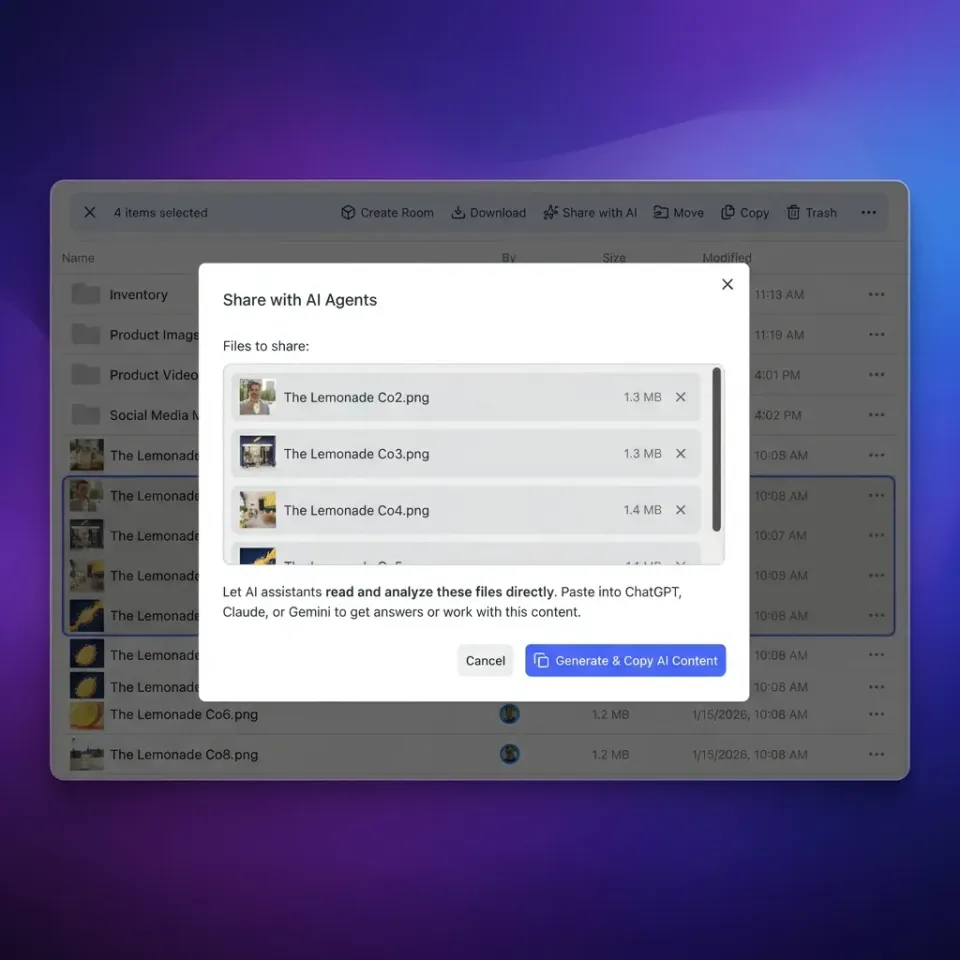
What Files Do AI Content Agents Create?
Agents generate far more files than human writers. A human saves one document, but an agent creates a group of related files for every piece of content. This includes text, raw data, reasoning steps, and media assets.
Here are the specific file types that fill agent workflows:
- Markdown (.md) with Frontmatter: The standard for content bodies. Agents separate text from metadata using YAML frontmatter blocks. This stores titles, dates, author details, and SEO tags right in the file. It also stores agent-specific data like
model_version(e.g., gpt-4o-2024-05-13) andgeneration_id, allowing you to track exactly which model configuration produced the text. - JSON/YAML Metadata Sidecars: For every content file, agents often generate a sidecar file (e.g.,
article-slug.meta.json). These hold operational details that shouldn't clutter the main content, such as the full prompt chain used, token usage costs, uncertainty scores, and the raw "chain of thought" or reasoning trace. This data helps you debug why an agent made a specific decision. - Media Assets: Modern content isn't just text. Agents generate and edit images (WebP, PNG), vector graphics (SVG), and audio files. These assets link to the markdown, requiring precise relative path management so links don't break when files move between "Draft" and "Published" folders.
- HTML Exports: Agents often produce pre-rendered HTML for previewing or for CMS platforms that don't support Markdown. These are usually ephemeral files generated on-demand.
- Vector Embeddings: For RAG (Retrieval-Augmented Generation), agents save
.npyor binary vector files. This lets other agents understand the content semantically without reading the full text again, speeding up internal search and cross-referencing.
Helpful references: Fastio Workspaces, Fastio Collaboration, and Fastio AI.

Related guides
- How to Manage Files for Image Generation AgentsImage generation agents create thousands of files in minutes. Learn how to organize prompts, version outputs, and...
- How to Manage Files with the Gemini APIGoogle's Gemini API offers powerful multimodal capabilities, allowing you to analyze images, audio, and video directly....
- How to Manage Files in Rasa ChatbotsRasa file management includes storing conversation data, training files, model artifacts, and user documents. Rasa...
- How to Manage Files for Resume Parsing AgentsManaging files for resume parsing agents means organizing candidate documents for AI recruitment systems. Learn to...
- How to Connect AI Agents to Files and Cloud StorageConnecting AI agents to files is the practical bottleneck most developers hit after getting their agent logic working.
- Best AI File Organizers in 2026: 8 Tools That Actually Sort Your FilesMcKinsey estimates that employees spend 1.8 hours every day just searching for and gathering information. AI file...
More on this subject: Agent File and Document Workflows (325 guides)
Why Standard Storage Fails for Agent Workflows
Tools like Google Drive, Dropbox, and basic S3 are built for humans interacting at human speeds. They throttle speed, limit concurrent operations, and lack the event-driven architecture agents need. Scale your operation to hundreds of articles a day, and these systems break.
Why they fail in production:
- Rate Limiting: Agents work fast, often firing hundreds of file operations per minute. Standard APIs interpret this as abuse and block the requests, causing agent crashes and lost work.
- No Concurrency Control: In a multi-agent system, a "Researcher Agent" might try to update a file while a "Writer Agent" is reading it. Without file locking or atomic operations, they overwrite each other, leading to corrupted data or lost updates.
- Poor Search capabilities: You usually need an exact name to find a file in standard cloud storage. Agents need to find files by metadata, for example, "all drafts from the last hour tagged with 'finance'." Standard storage struggles with this, forcing agents to download and parse thousands of files just to find the right one.
- No Events or Triggers: Standard storage is passive. Agents need to know when a file is saved to trigger the next step. Polling a directory ("Is the file there yet?") is inefficient and slow. You need a system that pushes events to your agents.


Give Your AI Agents Persistent Storage
Fastio gives teams shared workspaces, MCP tools, and searchable file context to run ai content generation agent files workflows with reliable agent and human handoffs.
Structuring Your Agent's File System
A messy file system breaks automation. Agents need a clear, deterministic path to find context and save work. Flat structures fail as files pile up, but deep nesting is too slow for traversal.
Try this scalable structure for high-volume content operations:
/drafts/{topic-slug}/{version-id}/: The sandbox. Keep every iteration here. Grouping by topic and version keeps folders clean and allows for easy A/B testing of different drafts./review/{topic-slug}/: When an agent finishes a draft, it moves here. Editors or "Reviewer Agents" monitor this directory. This separation ensures that work-in-progress never accidentally gets published./published/{year}/{month}/: The final location. Only approved files go here. Organizing by date keeps folders manageable and improves listing performance./assets/{topic-slug}/: Store images and diagrams here. This keeps text folders clean and makes media management easier. Using a consistent asset folder makes it easy for the agent to construct relative links (e.g.,./assets/topic/image.png)./logs/{agent-id}/: Operational logs go here. Keep error logs separate from content. This allows a "DevOps Agent" to monitor system health without wading through content files.
This setup enforces security through structure. A "Writer Agent" writes to /drafts but only reads /published, while the "Publisher Agent" is the only one with write access to the final directories.
Security and Access Control for Content Agents
When multiple agents access the same storage, security matters. You don't want a "Research Agent" accidentally deleting your "Published" archive. This requires a storage solution that supports granular, token-based access control.
Use the Principle of Least Privilege for your agents:
- Read-Only Tokens: Give your research and ingestion agents tokens that only allow
GETandLISToperations. They can consume existing knowledge but can never alter it. - Write-Only Tokens: Ingestion agents that dump raw data (like news feeds or scraped logs) should have tokens that allow
PUTbut notDELETE. This prevents data loss. - Scoped Access: Restrict agents to specific directories. The "Finance Writer Agent" should only have access to
/drafts/finance/, preventing it from seeing or modifying "HR" or "Legal" documents. - Audit Logging: Every action an agent takes, such as reading a file, overwriting a draft, or deleting a log, should be recorded. If content mysteriously disappears, you need an audit trail to identify which agent (and which prompt) caused the issue.
Version Control for AI-Generated Content
Agents work in iterations, often producing multiple versions before finalizing content. Tracking history helps with quality assurance, model tuning, and compliance. You need to know not just what the final text is, but why the agent wrote it that way.
Ways to handle versioning:
- Timestamped Folders:
content-v1-YYYYMMDD-HHMMSS. Simple and clear, though frequent updates can create folder clutter. - Hash-Based Naming: Name files by their content hash (SHA-256). Unique content gets a unique ID. If an agent writes the exact same text twice, it points to the same file, saving space and preventing duplicates.
- Manifest Files: Keep an
index.jsonormanifest.yamlat the root of the topic folder. This file lists every version, its timestamp, the agent ID, and its status (draft, reviewed, rejected). It tracks the history without cluttering the file system with hundreds of folders. - Retention Policies: You don't need every draft forever. Implement lifecycle policies to delete old drafts after 7 days, keep "review" files for 30 days, and keep "published" files indefinitely. This keeps your storage costs low and your file system performant.

Automating Publishing via Webhooks
Delivery is the final step. Storage is useless if the file doesn't reach your audience. Polling scripts ("checking for new files every minute") are slow and waste resources.
Use webhooks instead. When an agent moves a file to /published, the storage system triggers an event.
- The Workflow: The system sends a POST request with the file path and metadata to your API or CMS.
- The Payload:
{ "event": "file.moved", "path": "/published/{year}/{month}/ai-agents-guide.md", "size": "{bytes}", "timestamp": "{iso-timestamp}", "metadata": { "author": "agent-gpt4", "status": "final" } } - Immediate Action: Your CMS (WordPress, Ghost, or a custom static site generator) receives this webhook, fetches the content, and publishes it instantly.
- Security: Webhooks should be signed with a secret key. Your server checks the signature to confirm the request came from your storage system and not an attacker.
- Error Handling: Good systems retry automatically. If your CMS is down for maintenance, the storage system should try again later (exponential backoff) so you don't lose content.
This makes storage an active part of your workflow, rather than just a passive hard drive.
Sources
References used to verify factual claims in this guide.
-
Agent-specific model_version data like gpt-4o-2024-05-13 and generation_id for tracking which model configuration produced the text
-
Hash-based naming using SHA-256 content hash gives unique content a unique file identifier
-
Implement lifecycle retention policies to delete old drafts after 7 days and keep review files for 30 days
Frequently Asked Questions
How do content agents store outputs?
Content agents store outputs as structured text files (Markdown, JSON) organized in hierarchical directories, often separating drafts, metadata, and final versions to maintain context and order.
What files do AI writing agents create?
AI writing agents typically create Markdown files for text, JSON or YAML sidecars for metadata and reasoning traces, and image files (WebP, PNG) for visual assets.
How to organize AI-generated content?
Organize AI content by lifecycle stage (Drafts, Review, Published) and use consistent naming conventions (like timestamps or hashes) to manage the high volume of variations.
Can I use standard cloud storage for AI agents?
While possible, standard storage often lacks the API-first design, low latency, and concurrency controls agents need. Specialized storage offers the programmatic access and event triggers required for autonomous workflows.
Why is versioning important for AI content?
Versioning is critical because agents generate many iterations. It allows you to compare outputs, revert to better drafts, and audit the agent's decision-making process over time.
Related Resources

Give Your AI Agents Persistent Storage
Fastio gives teams shared workspaces, MCP tools, and searchable file context to run ai content generation agent files workflows with reliable agent and human handoffs.