How to Set Up an AI Coding Agent
An AI coding agent is an autonomous system that reads, writes, and modifies code across files while maintaining project context. This guide walks you through setting up a coding agent with persistent file access using MCP (Model Context Protocol), so your agent retains context between sessions and can work across your full codebase. You'll go from zero to a working agent in under 30 minutes.

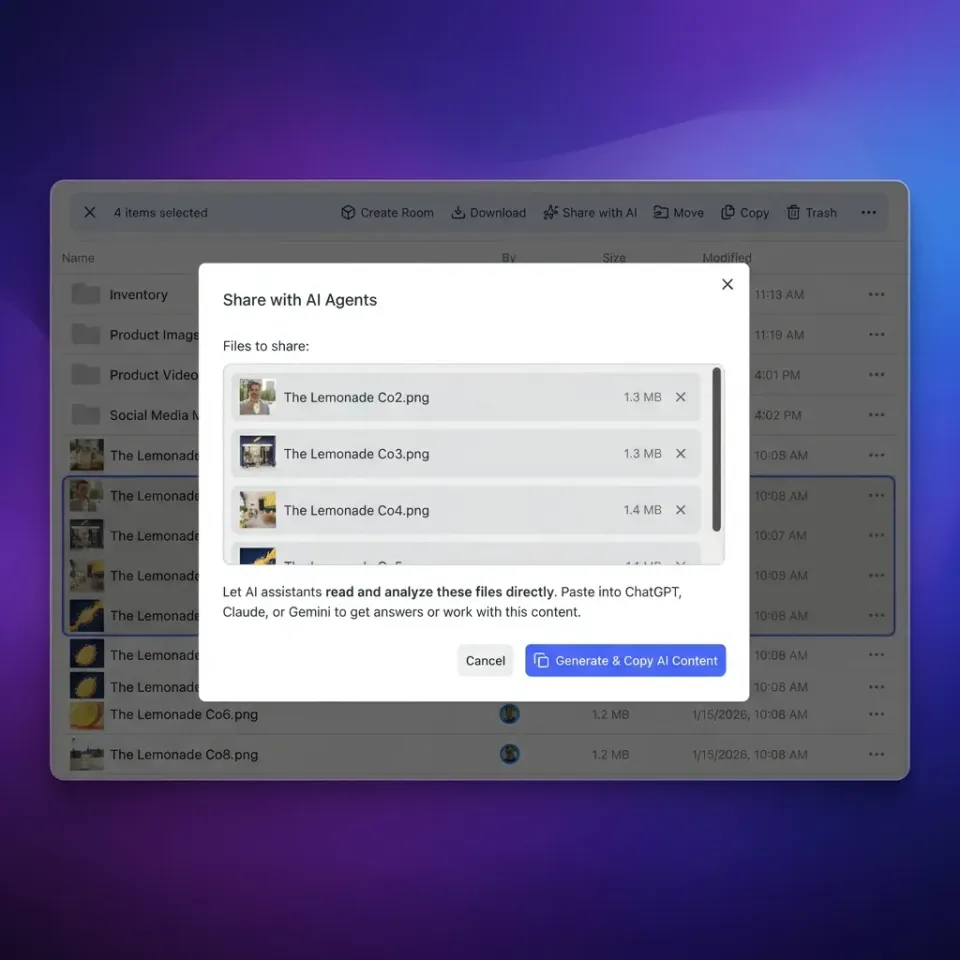
What Is an AI Coding Agent?
An AI coding agent uses a large language model to plan, execute, and verify software development tasks. It reads your codebase, proposes changes across multiple files, runs terminal commands, and iterates until the job is done. This makes it different from a code assistant like basic Copilot, which suggests the next few lines based on your cursor position. An agent takes a high-level instruction like "refactor the authentication module to use JWTs" and handles file navigation, code changes, and test execution on its own. Recent developer surveys show coding agents reduce development time by roughly 40% on routine tasks like boilerplate generation, refactoring, and test writing. Claude, GPT-4, and Gemini are the most commonly used models for coding agents in production. The catch? Most agent setups are ephemeral. Once you close the session, the agent forgets everything. The setup below solves that with persistent storage.
Related guides
- How to Set Up MCP Servers in CursorCursor MCP server setup is the process of connecting Model Context Protocol servers to the Cursor AI code editor,...
- How to Set Up MCP Servers in VS CodeGuide to vscode mcp server setup: Model Context Protocol (MCP) servers in VS Code connect GitHub Copilot Chat to...
- Codex Google Drive Integration: Connect Coding Agents to Cloud StorageA Codex Google Drive integration links autonomous coding agents to cloud repositories containing project documentation,...
- How to Connect Cursor to Dropbox via MCP: Step-by-Step SetupConnecting Cursor to Dropbox via MCP allows Cursor agent mode to retrieve documents and code assets directly from cloud...
- Best Storage Solutions for Base44 WorkflowsAccording to the Flexera 2025 State of the Cloud Report, 84% of organizations identify managing cloud spend and...
- How to Manage Aider Token Limits: Repo-Map Budgets, Chat History, and MCP RetrievalThe Aider token limit is governed by two configurable thresholds: the repository map budget set by --map-tokens...
More on this subject: AI Coding Assistants (82 guides)
Why Persistent File Access Matters
Most AI coding agent guides skip the storage question. They show you how to prompt the model and get code back, but ignore where that code lives between sessions. Without persistent file access, your agent is a developer who gets amnesia every time they close their laptop. It can't remember the project structure, the architectural decisions made yesterday, or where the half-finished feature branch is.
What ephemeral agents lose between sessions:
- Project file structure and navigation context
- Previous code changes and the reasoning behind them
- Documentation, READMEs, and configuration files
- Test results and debugging history
Running locally solves part of this, but breaks down when you need to share agent workspaces across a team, hand off results to a client, or run agents on machines without local storage. Better approach: give your agent its own cloud storage account with full read/write access.


Give Your AI Agents Persistent Storage
Fastio gives teams shared workspaces, MCP tools, and searchable file context to run ai coding agent setup workflows with reliable agent and human handoffs.
Prerequisites Checklist
Before you start, gather these four components:
- An MCP-compatible client. This is the interface your agent uses. Options include Claude Desktop, Cursor, VS Code, Devin Desktop (formerly Windsurf), or OpenClaw.
- An LLM with strong coding ability. Claude Sonnet 4.5, GPT-4o, or Gemini 2.0 Pro. The model handles reasoning and code generation.
- A persistent storage layer. Fastio provides persistent cloud storage workspaces with a consolidated MCP toolset and granular permissions.
- Node.js 18+. Only needed for local MCP servers; the Fastio MCP server is remote and needs nothing installed. You can swap these components for alternatives. The Model Context Protocol is an open standard, so any MCP-compatible client works with any MCP server.
Step 1: Set Up the Storage Layer
Your agent needs a place to store files that persists across sessions. We'll use Fastio because it offers workspaces designed for autonomous agents, connected via a remote MCP server that exposes a consolidated MCP toolset.
Set up an organization: Start with a 14-day Business Trial (requires a credit card) at fast.io/storage-for-agents/.
Create a workspace and API key: Log in, create a workspace for your project, then go to Settings > Devices & Agents > API Keys and click Create API Key to generate a scoped, long-lived API key. Your agent will authenticate with this key for REST operations or a headless MCP connection; interactive MCP clients sign in through the browser.
Step 2: Connect the MCP Server
The Model Context Protocol is the bridge between your LLM and your storage layer. It gives the agent structured access to file operations: reading, writing, searching, organizing, and querying files.
Option A: Claude Desktop / Cursor / VS Code
In Claude Desktop, open Customize, then Connectors, add a custom connector with https://mcp.fast.io/mcp/tools, and select Connect to sign in to Fastio. For Cursor, add this to ~/.cursor/mcp.json (VS Code uses .vscode/mcp.json with the same URL under "servers" and "type": "http"):
{
  "mcpServers": {
    "fastio": {
      "url": "https://mcp.fast.io/mcp/code"
    }
  }
}
The remote MCP server exposes a consolidated MCP toolset via Streamable HTTP. Your agent connects using its URL and signs in to Fastio in the browser, with no local packages to install or containers to run.
Option B: REST API
If you're building a custom agent or integration, hit the REST API at https://api.fast.io/current/ directly. Every file and workspace operation is accessible via standard HTTP endpoints.

Step 3: Enable Intelligence Mode
Raw file storage works. Searchable, queryable file storage works better. Once Intelligence is enabled for the workspace, Fastio's Intelligence Mode indexes every uploaded file and turns the workspace into a knowledge base with built-in RAG.
How to enable it:
- Open your workspace settings in the Fastio dashboard
- Toggle Intelligence Mode to ON
- Wait for the initial indexing to finish (usually under a minute for small projects)
With Intelligence Mode active, your agent can do semantic searches instead of filename lookups. Ask "find the authentication logic" instead of "read src/auth/login.ts", and the system retrieves relevant code snippets across your entire workspace with source citations. This matters for large codebases where you can't fit every file into the LLM's context window. The agent queries the knowledge base, gets back the relevant chunks, and works with those. No separate vector database needed, no Pinecone or Weaviate setup, no embedding pipeline to maintain.
Step 4: Test Your Agent
Open your MCP client and run through these three tests to confirm everything works.
Test 1: Write access
Prompt: "Create a folder called src in my Fastio workspace. Inside it, create a Python file called hello_agent.py that prints a timestamped greeting."
If the agent creates the file without errors, write access works.
Test 2: Read and verify
Prompt: "Read the hello_agent.py file you just created. What does it do?"
The agent should describe the file contents accurately. This confirms persistent storage is working across prompts.
Test 3: Semantic search (if Intelligence Mode is on) Prompt: "Search my workspace for any Python files that handle timestamps."
If the agent finds your file through a semantic query rather than a direct path, your RAG setup is working. All three passing? Your coding agent now has persistent, searchable storage. It can pick up where it left off tomorrow, next week, or next month.
Going Further: Handoffs, Teams, and Multi-Agent Systems
Once your basic agent setup is running, you can build on it in several directions.
Ownership transfer. Your agent can build an entire project in a workspace and then transfer ownership to a client or teammate. The agent keeps admin access, and the human gets full control. Useful for agencies and freelancers who build deliverables with AI assistance.
Team collaboration. Add human teammates to the same workspace. They see the same files, get real-time presence indicators, and can leave comments for the agent to act on. The agent works alongside humans, not in isolation.
Multi-agent coordination. If you run multiple agents on the same project, agents can acquire an advisory file lock before writing, heartbeat it while working, and release it when done; peer agents attempting to lock the same file receive an HTTP 409 and can wait, while version history preserves every revision.
Event feeds for reactive workflows. Poll the realtime activity feed or connect to the WebSocket events feed so your agent detects changes as soon as files are uploaded or modified.
Sources
References used to verify factual claims in this guide.
-
Developer surveys show coding agents reduce development time by roughly 40% on routine tasks
-
Fastio MCP server exposes a consolidated MCP toolset via Streamable HTTP Working agent setup from zero in under 30 minutes with MCP configuration Step 4 Test Your Agent by running through three tests to confirm everything works with your MCP client MCP server provides a consolidated toolset for file operations configured via URL
-
Fastio Business Trial provides a 14-day evaluation for teams Fastio plans include usage-based credits for AI work Fastio Starter includes 3 seats and 250 GB of storage Fastio supports high-capacity file storage across workspaces
-
Agent needs a place to store files that persists across sessions for Step 1 setup
-
Step 2 Connect the MCP Server as the bridge between your LLM and storage layer with full access
-
Step 3 Enable Intelligence Mode for searchable queryable file storage that works better than raw storage LLMs with strong coding ability: Claude Sonnet 4.5, GPT-4o, Gemini 2.0 Pro
-
Run agents locally using open-weight models like LLaMA 3 through Ollama but coding quality drops compared to frontier models
Frequently Asked Questions
What is the best AI coding agent?
There is no single best agent. Claude Code (Anthropic's CLI agent) is strong for terminal-based workflows. Cursor works well if you prefer an IDE. GitHub Copilot Workspace handles issue-to-PR pipelines. The best choice depends on whether you need IDE integration, terminal access, or autonomous operation. Pairing any of these with persistent cloud storage like Fastio makes the agent much more useful across sessions.
How do I give an AI agent access to my code?
Use the Model Context Protocol (MCP). An MCP server acts as a controlled bridge between your files and the AI model. The agent reads and writes files through defined API tools rather than getting raw filesystem access to your entire machine. Fastio's remote MCP server provides a consolidated MCP toolset for file operations, connected directly via its URL endpoint.
Is GitHub Copilot an AI agent?
Standard GitHub Copilot is a code assistant, not an agent. It predicts the next few lines of code based on your cursor position. It does not browse your file system, plan multi-file changes, or run commands independently. GitHub Copilot Workspace is closer to an agent, as it can plan and implement changes across a repo from an issue description, but it still requires human approval for each step.
Can AI coding agents work offline?
Most coding agents need an internet connection because they rely on cloud-hosted models like GPT-4 or Claude for reasoning. You can run agents locally using open-weight models like LLaMA 3 through Ollama, but the coding quality drops compared to frontier models. A hybrid approach works too: use a cloud model for reasoning and local storage for files.
How much does it cost to run an AI coding agent?
The LLM cost depends on your provider and usage. For storage, Fastio offers a 14-day Business Trial requiring a credit card, with paid plans starting at Starter $9.99/mo (3 seats, 250 GB, 100,000 credits/mo), Business ($49.99/mo), and Enterprise ($199.99/mo).
Related Resources

Give Your AI Agents Persistent Storage
Fastio gives teams shared workspaces, MCP tools, and searchable file context to run ai coding agent setup workflows with reliable agent and human handoffs.