How to Set Up Synced File Workspaces for AI Agents
Synced file workspaces keep files current for AI agents across runs and teams. Without good sync, agents re-download files, miss updates from others, and lose past context. This guide reviews three sync methods (failures cause 25% of agent errors) and RAG setup.

Why AI Agents Need Synced File Workspaces
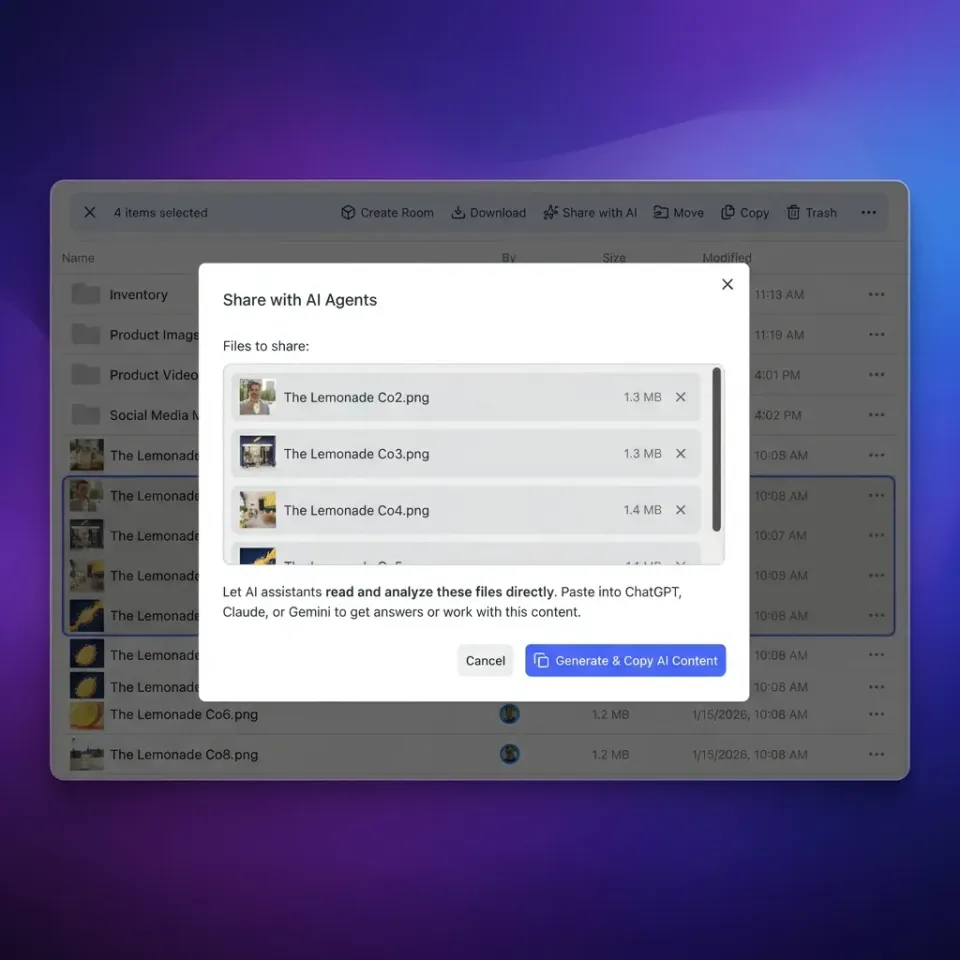
Synced file workspaces keep file state across agent runs and teams. Agents now run workflows that last hours or days. They track internal state and base decisions on prior sessions while working with other agents or humans. The key issue: reliable file storage that lasts. Basic options like local temp dirs, short-lived cloud folders, or plain S3 handle one-off jobs. But in production, agents restart from scaling, errors, or schedules. No persistent sync means every run starts over, re-downloading data, skipping parallel updates, repeating effort. Synced workspaces provide storage that agents access via API or MCP, and humans via web. Changes show up right away. Version history avoids losses, search skips digging around, and RAG makes files queryable. Picture a research agent. It scrapes data, turns it into CSVs, uploads to /processed/data/. A visualization agent checks that folder, grabs the newest files, builds reports. A human can jump in, see the same setup, check work, add notes, or ask for tweaks. Fastio MCP tools match every UI action. Fastio data shows sync issues cause 25% of agent errors: 40% stale reads, 35% missing files post-restart, 25% overwrite fights. Version history and activity feeds in synced workspaces fix that. Take a pipeline with scraper, analyzer, reporter. Each checks files before writing. No sync, analyzer uses half-done scraper output for bad reports. With sync, it waits for complete files. Plus ownership transfer: agents set up workspaces, hand off to humans, keep admin rights. URL imports from Drive/Box skip local downloads. See also: Fastio Workspaces, Fastio Collaboration, Fastio AI, /storage-for-agents/.

Related guides
- How to Set Up an Agentic Team WorkspaceAgentic team workspaces enable human-agent hybrid collaboration with shared intelligence and persistent storage. While...
- Zero Retention Workspaces for AI Agents: A Practical GuideA zero retention workspace gives AI agents a place to read, write, and process files without leaving file content...
- How to Build and Query Box RAG Workspaces with AI AgentsBox RAG enables AI agents to retrieve and cite context from enterprise Box documents without downloading entire folder...
- Best Knowledge Graph Tools for RAG: Enhancing Agent MemoryRAG systems often fail when they only use vector search. Adding a knowledge graph gives AI agents the context to...
- How to Perform RAG with Large Files: Strategies for Heavy DocumentsRetrieval Augmented Generation (RAG) on large files requires smart chunking, indexing, and retrieval strategies to...
- Best Embedding Models for RAG Agents in 2026Your RAG agent is only as good as its embedding model. A weak embedding layer means missed context, irrelevant...
More on this subject: Agent Memory and Storage (250 guides)
Three Methods for Syncing Files in Agent Workflows
Agents sync files three main ways. Each balances speed, reliability, and effort differently. Pick based on file size, agent count, and team needs. Local-first sync downloads everything to the agent's machine. Rsync, Git, or Drive SDKs handle it. Agent reads with normal file APIs. Background sync pushes changes back. Pros:
- Standard code, no new APIs.
- Works offline.
- Quick access to cached files. Cons:
- Slow for big files. GBs take minutes.
- Conflicts easy with multiple agents.
- Burns bandwidth and disk space. Cloud-native streaming skips downloads. Agents pull ranges or streams via API, read as needed. Pros:
- Good for TB files.
- Cloud always current, no conflicts.
- Minimal storage use. Cons:
- Needs stream code.
- First read slower. Fast. Example:
stream = mcp.call("file-stream", {"workspace": "project", "path": "/large-video.mp4", "range": "0-"})
Hybrid caches common files locally, checks cloud for freshness via ETags or timestamps, streams if old. Pros:
- Fast when cached, consistent.
- Handles spotty connections. Cons:
- Cache bugs tricky.
- Possible short delays.


Give Your AI Agents Persistent Storage
Start with generous storage, included credits a month, and a consolidated MCP toolset. Made for agent file sync. Built for agent synced file workspaces workflows.
How Sync Failures Break Agent Workflows
Sync problems hit agent flows in set ways. Missing files, old data, bad outputs. Know the breaks to build tough systems. Sync delay or cleanup empties paths. Crashes follow. Common in serverless with temp storage. Fix: API list files first, retry or fallback on missing. Bad calls result. Fix: Check ETag or timestamp on open. Last one wins. Fix: Lock files before write, or unique paths like /agent-{id}/output.json. Partial transfers: Network drops mid-upload. Local ok, cloud junk. Fix: Chunk uploads with resume, hash checks after. Access denied: Permissions shift mid-run. Fix: Scoped tokens, role checks. Fastio cuts these with activity feeds, atomic ops, full logs. For missing files, list first: Check before you read: list the input folder through the MCP toolset and, if the expected file is missing, import it from the source URL or wait for the upstream step. Stale data? Compare the file's version from the activity feed with the one you cached and re-fetch when it has moved on. Conflicts? Skip locks. Give each agent its own output path, let version history keep every prior write, and use the audit log to see who changed what. These make flows strong. Logs help debug.
Building Agent Workspaces with RAG Integration
RAG makes synced workspaces smart knowledge bases. Files index for search and chat, no hunting. Agents with docs hit context limits fast. RAG grabs just relevant parts. Setup:
- Create workspace, turn on Intelligence Mode.
- Upload files. Auto-chunk, embed, index.
- Ask: "Risks in latest vendor contract?" Get cites. Fastio handles this built-in. No Pinecone needed. Seconds to index, scales workspaces. Files searchable by sense right away. Agent code:
response = mcp.call("ai-chat-create", { "workspace": "legal", "query": "Summarize indemnity clauses in Q1 contracts", "scope": "/contracts/"
})
### Returns summaries with page-level citations
Cites point to pages. Agents check sources, humans audit. Builds trust. Humans use same: browser query, same cited answers. Shared index. Handles edges: multi-doc blends info, supports PDF/video/code/spreadsheets. Edits re-index changes only. Folder scopes like /q1-contracts/ sharpen results. "Indemnity risks in vendors?" Top 5 cites. Human runs query, checks clauses, approves. Works for sales proposals, support docs, tech specs. Any doc-heavy work. Fastio RAG skips separate DB/embed pipe. Upload indexes it. Workspace is the base.
Integrating Fastio with OpenClaw and Other AI Frameworks
Fastio works with OpenClaw (ClawHub) and other agent frameworks. Multiple ways to add synced workspaces. OpenClaw Integration OpenClaw builds agents with natural commands. Connect to Fastio via the remote MCP server URL at https://mcp.fast.io/mcp/tools with a consolidated MCP toolset. Agents say "upload analysis to client workspace" or "list today's project files." Handles auth, calls, errors. Covers files (up/down/list/delete), workspaces (create/share/transfer), smarts (search/chat/summarize). Matches MCP. OpenClaw teams skip custom storage code. Agents use persistent spaces humans access too. Other Frameworks HTTP or MCP works anywhere. LangChain calls MCP direct. LangGraph tool nodes. AutoGen file backend. Custom? REST API mirrors MCP. Good for existing setups. Pick Path New? LangChain/LangGraph? MCP, no refactor. Custom? REST, docs solid, limits fair. All paths share one workspace as truth. Agents, skills, humans sync up. No state headaches.
Real-World Agent Workspace Patterns
Agent workspace patterns split solo, multi-agent, hybrid human-agent. Each fits scale and collab needs.
Solo: One agent owns workflow. Private workspace per task. Uploads intermediates, pulls finals. No share.
Steps:
- mcp.call("org-create-workspace", {"name": "solo-task"})
- Process, upload /outputs/
- Share-create for delivery.
Research agent: daily scrape to JSON /daily-research/, PDF summary /summaries/. Overwrites dailies. Humans see finals.
Multi-agent: Specialists share workspace hub. Version history, activity feeds, and names coordinate.
Research pipe: A to /raw/. Activity feed notifies B, B processes with version tracking. Event stream notifies C for reports.
Scales: D images, E text. Subfolders /agent-a/ avoid clashes.
Activity feeds key, no polling waste.
Hybrid: Agent joins human workspace, adds outputs for review.
Product team: /raw/, /insights/, /approved/. Humans upload feedback /raw/. Agent themes/sentiment to /insights/. Humans move approved.
Ownership transfer: Agent builds, hands admin to lead, keeps contribute.
Data room: Agents prep diligence/contracts, transfer to client. Agency keeps admin.
Fastio: advisory file locks, version history concurrency, realtime activity feeds, MCP access. Scales solo to enterprise.
Best Practices for Agent File Synchronization
Production tips from millions of ops monthly. 1. Idempotent: Safe re-runs. Unique IDs task-{uuid}.json. Check exist, verify hash/ETag post-upload. Restarts resume clean. 2. Pre-checks: List inputs via the storage tool's list action. Match times/sizes. Retry if off. 3. Paths: /inputs/{date}/, /intermediates/{agent}/{stage}/, /outputs/{final}/. No overwrites, clear audits, RAG scopes. 4. Platform search: Fastio finds "Q1 sales" in PDF/spreadsheet. RAG indexes uploads. 5. Locks: Acquire a file lock before writing, heartbeat it while working, and release it when done; others receive HTTP 409 and wait, while version history preserves every write. 6. Events: Realtime activity feed beats manual polling loops. 7. Dead letter after max. Fail perm errors fast. 8. Monitor: Latency/errors/throughput. Alert highs. Log problem files/agents. 9. Test real: End-to-end scenarios, failures like mid-upload drop. 10. Docs: Prompts with schemas/fallbacks. Workspace data/owners/retention. 11. Versions: Note pre-op, rollback easy. 12. Match workflow: Sequential stream, parallel lock, mixed cache. Pilot, measure, iterate.
Sources
References used to verify factual claims in this guide.
-
Sync failures cause 25% agent errors Fastio streaming delivers files at speeds up to 1TB per minute
Frequently Asked Questions
What are the best synced workspaces for AI agents?
Look for storage + API/MCP + RAG + multi-agent. Fast.Fastio offers a Business Trial with storage and agent tooling for testing this workflow.
How do I sync files in agent workflows?
Local, stream, or hybrid. Stream best: on-demand, no cache mess, cloud truth. List/fetch via MCP/API, version multi-agent.
How do sync failures affect AI agent performance?
Restarts miss files, caches stale, writes clash. Worst serverless/multi-machine.
Can agents use RAG with synced workspaces?
Yes. Intelligence Mode auto-indexes uploads. MCP natural query, cited answers. No extra DB. Folder scopes.
What's the difference between synced storage and streaming for agents?
Synced copies local; stream pulls needed. Synced offline/repeat ok, but stale/conflict risk. io.
How does Fastio handle overwrite conflicts in multi-agent workflows?
Fastio provides advisory file locks so agents can coordinate before writing. If two writes land concurrently, version history preserves every revision and logs changes in the activity log.
What's the fast way to sync large files for AI agents?
Stream range fetches. Fast. Cache repeats. Test workload.
How do event feeds improve agent file workflows?
Instant change notices, no short-polling. WebSocket events feed: A uploads, B notified in seconds. Cuts latency/API.
Can humans and agents work in the same workspace?
Yes. Browser for humans, MCP/API agents. Same files/versions/index. Agent builds, transfer own human.
How does RAG reduce token usage in agent workflows?
Relevant chunks not full docs. 500-page? Cites verify.
Related Resources

Give Your AI Agents Persistent Storage
Start with generous storage, included credits a month, and a consolidated MCP toolset. Made for agent file sync. Built for agent synced file workspaces workflows.