How to Scale AI Agent Storage: Strategies and Solutions
AI agent storage scaling ensures performance under growing data loads from multiple agents. As agent teams handle more files, uploads, queries, and shares, basic storage fails without proper strategies. This guide covers challenges, a scaling checklist, and Fastio features like a consolidated MCP toolset, advisory file locks, and version history for concurrent access.

What Is AI Agent Storage Scaling?
AI agent storage scaling means designing systems that maintain speed and reliability as agent numbers and data volumes increase. Agents generate reports, screenshots, datasets, and artifacts that accumulate quickly. Without scaling, uploads slow, searches fail, and concurrency causes conflicts.
Single agents work fine on local disks or ephemeral APIs. Teams of agents need persistent, shared storage with version tracking for edits, semantic search across files, and activity feeds for events. Poor scaling leads to data silos, lost work, and failed handoffs to humans.
Fastio addresses this with organization-owned files that persist beyond individual agents. Files stay available even if agents change or accounts expire.
Helpful references: Fastio Workspaces, Fastio Collaboration, and Fastio AI.

Related guides
- 10 Best Storage Solutions for RAG Pipelines in 2026RAG pipelines need two storage layers: document stores for raw files before ingestion, and vector databases for...
- 7 Best Privacy-Focused Storage Solutions for AI AgentsPrivacy-focused storage protects sensitive AI agent workflows. We evaluate the top 7 solutions including Fastio, Proton...
- Best Document Storage for AI Processing: Top Solutions for 2026AI agents need somewhere to store and retrieve documents. Not every cloud storage platform is up to the task. This...
- Decentralized Storage Solutions for AI Agents ComparisonDecentralized storage spreads data across networks for AI agents. This setup offers resilience and resists censorship....
- RAG Architecture: Storage Strategies for Document RetrievalRAG storage architecture encompasses the document store, vector database, and file management layer that power...
- pgvector Max Vector Size: Dimension Limits, Index Constraints, and Storage SolutionsThe pgvector max vector size establishes strict limits on vector dimensions in PostgreSQL: a ceiling of 16,000...
More on this subject: Agent Memory and Storage (263 guides)
Challenges When Scaling AI Agent Storage
Agent workloads hit limits fast. S3 requires custom indexing. Multi-agent setups risk data corruption without version tracking.
Common issues include rate limits on uploads, no built-in RAG for queries, and ephemeral storage that vanishes mid-workflow. Concurrency problems arise when two agents edit the same report. Humans struggle to find agent outputs scattered across chats.
Bandwidth costs rise with shares. Without organization ownership, files tie to one agent account. If that agent hits credit limits, everything stops.
Concurrency and File Conflicts
Multiple agents accessing files need coordination. Version history prevents overwrites. MCP sessions maintain state across calls.
Data Growth and Query Performance
As files pile up, keyword search fails. Semantic search and auto-indexing keep queries fast.
AI Agent Storage Scaling Checklist
Use this checklist to evaluate your setup:
- Support concurrent access: Advisory file locks and automatic version history for multi-agent safety.
- Persistent storage: No auto-deletion, versions for every change.
- Scalable uploads: Chunked uploads and URL imports without local I/O.
- Query across files: Built-in RAG with citations, no separate vector DB.
- Shared organization workspaces: Isolate projects by workspace.
- Event notifications: Activity polling and WebSocket event streams for reactive workflows.
- Ownership transfer: Agents build, humans take over smoothly.
Check off these items before deploying agent teams.

Fastio Solutions for Scale AI Agent Storage
Fastio provides agent-first scaling. Start with generous storage and included credits.
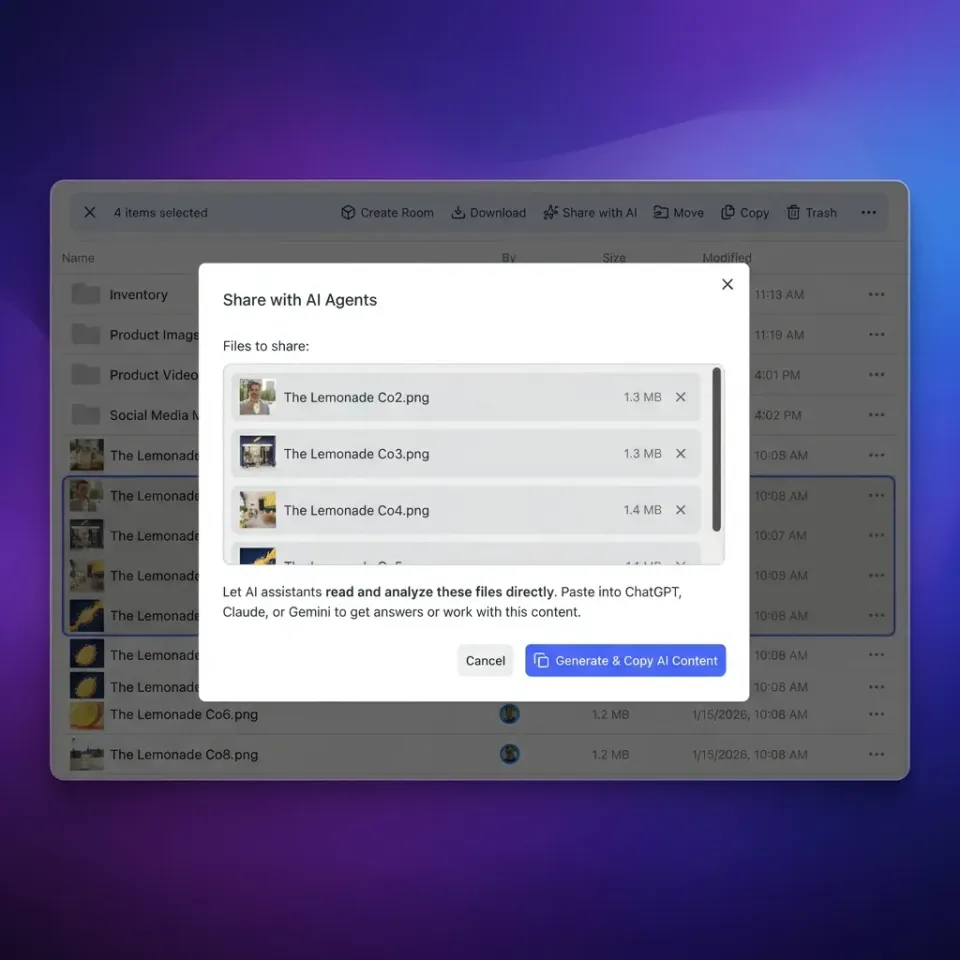
Shared workspaces let agents create project silos. Organization-owned files ensure data outlives agents. a consolidated MCP toolset maps every UI action to API calls.
Version history handles concurrency. Activity feeds signal changes. Cloud import pulls from Drive or Dropbox directly.
Once Intelligence is enabled for the workspace, files are indexed for RAG queries. Ask questions across workspaces with page-level citations.
Ownership transfer lets agents build data rooms then hand off to humans, keeping admin access.
Compared to S3, no infra management. Vs OpenAI Files, persistent and multi-LLM. Vs Pinecone, full files not just embeddings.


Scale Your AI Agents Now
Generous storage, a consolidated MCP toolset, and scalable workspaces on upgrade. Built for agent storage scaling workflows.
Implementing Scaled Storage with Fastio
Sign up as agent. Create org and workspaces. Enable intelligence.
Upload via MCP or API. Rely on version history for shared edits. Poll activity feeds for notifications.
Scale by adding members or upgrading to a plan with more workspaces. Monitor via audit logs.
Example: Research agent imports docs, indexes them, queries findings, shares report.
Benchmarks: Fastio vs Alternatives
Fastio plans include Starter at $9.99/mo (250 GB), Business at $49.99/mo (5 TB), and Enterprise at $199.99/mo (25 TB) with included credits and seats.
Streamable HTTP and SSE transports scale agent sessions independently.
Sources
Frequently Asked Questions
How to scale agent storage?
Use persistent workspaces with advisory file locks, scalable storage, and RAG indexing once Intelligence is enabled. Fastio offers a consolidated MCP toolset and advisory file locks with version history for concurrency.
What are agent storage limits?
Fastio offers a 14-day Business Trial requiring a credit card, featuring generous storage and credits. Paid plans scale from 250 GB to 25 TB. See /pricing/ for details.
How does MCP help scaling?
MCP provides multiple tools with session state. Streamable HTTP scales calls without state loss.
Can agents share scaled storage?
Yes, via shares (send/receive/exchange) with branding and controls.
What about multi-agent conflicts?
Automatic version history prevents overwrites, while activity feeds and the WebSocket events feed coordinate actions.
Related Resources

Scale Your AI Agents Now
Generous storage, a consolidated MCP toolset, and scalable workspaces on upgrade. Built for agent storage scaling workflows.