How to Choose a File Conversion API for AI Agents
AI agents often hit a wall when they encounter proprietary file formats like PDF, DOCX, or PSD. A file conversion API bridges this gap, allowing agents to transform unreadable binary data into text or standard formats they can process. This guide explores the best APIs for agentic workflows and introduces a zero-conversion alternative.


What is a File Conversion API for AI Agents?
A file conversion API for AI agents is a service that transforms files between formats, such as converting PDF to text, DOCX to Markdown, or HEIC to JPG, so agents can ingest, process, and deliver content in the format each downstream system requires.
Unlike standard conversion tools meant for humans, these APIs are designed for programmatic access. They handle authentication, rate limiting, and error reporting in ways that autonomous agents can manage without human intervention.
The core value is bridging the gap between how files are stored and how LLMs consume information. Most business documents exist as binary blobs that an agent cannot read directly. A conversion API turns those opaque files into structured text the agent can reason about, search through, and act on. This is especially important in AI-powered workflows where agents process documents from multiple sources.
Related guides
- How to Upload Files: Fastio API File Upload TutorialFollowing a Fastio API file upload tutorial is the fast way to get your applications talking to intelligent agent...
- How to Manage Files with the Gemini APIGoogle's Gemini API offers powerful multimodal capabilities, allowing you to analyze images, audio, and video directly....
- How to Preserve Metadata During File ConversionConverting files between formats often strips embedded metadata without warning. Author names, creation dates, GPS...
- How to Build a File Sharing Portal with Fastio APIBuilding a custom file sharing portal gives your team control over the user experience without managing backend...
- How to Upload a Base64 String as a File to the Fastio APIAgents can upload a file as a Base64 string through the Fastio MCP upload_manage tool. Pass content_base64 on a...
- How to Implement Generative UI File Uploads with Fastio APIGenerative UI file uploads use LLMs to dynamically render interactive upload components backed by the Fastio API based...
More on this subject: Agent File and Document Workflows (325 guides)
Why Agents Need Specialized Conversion Tools
Most Large Language Models (LLMs) differ from multimodal models in how they handle files. While multimodal models can "see" images and PDFs, they often struggle with complex layouts, embedded tables, or proprietary industry formats (like CAD or PSD files).
Common Agent Challenges:
- Token Limits: Raw PDF code consumes massive context windows. Agents need clean Markdown or JSON.
- Hallucinations: OCR errors in standard libraries (like Tesseract) often lead agents to misinterpret numbers or dates.
- State Management: An agent needs to know if a conversion failed, why it failed, and have a retry mechanism.
- Format Diversity: Enterprise workspaces contain dozens of file types, from spreadsheets to CAD drawings, each requiring a different extraction strategy.
The Agent Conversion Workflow
Format Detection
The agent identifies the MIME type of the incoming file (e.g., application/pdf).
Transformation Strategy Based on the goal, the agent selects a target format. For analysis, it converts to text/Markdown. For user delivery, it might convert to PDF.
Validation and Storage The agent verifies the output (checking for empty files or error flags) and stores both the original and the converted version, linking them in its memory.
Top File Conversion Approaches Compared
You have three main options when equipping an agent with file skills: building it yourself, using a dedicated API, or using an intelligent storage layer.
Recommendation: For agents that simply need to understand the content of a file (e.g., "Summarize this contract"), intelligent storage is faster and cheaper. For agents that need to produce specific visual outputs (e.g., "Convert this Word doc to a print-ready PDF"), a dedicated API is necessary.
The Alternative: Zero-Conversion Pipelines
The most efficient conversion is the one you don't have to perform. In a traditional pipeline, an agent downloads a file, sends it to a conversion API, waits for the result, downloads the result, and then processes it. This introduces multiple points of failure and significant latency.
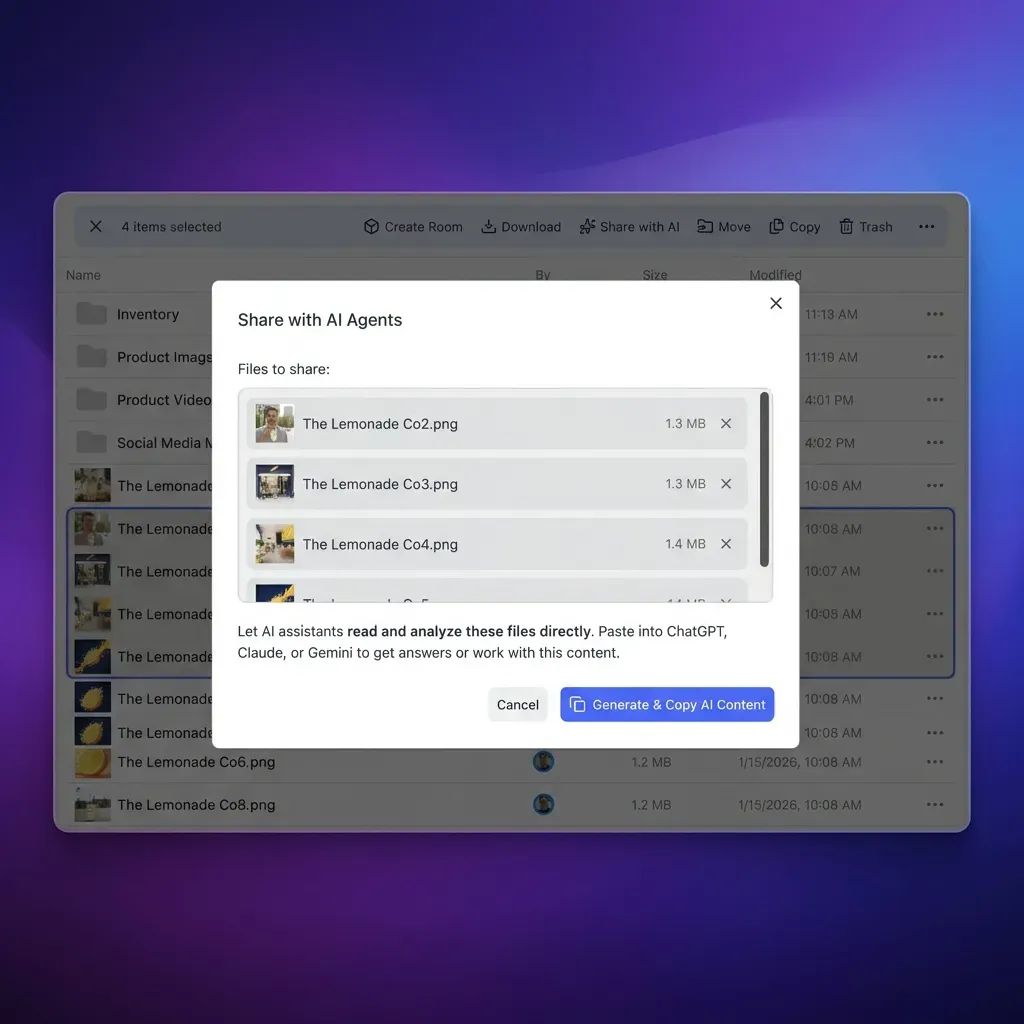
Modern "storage for agents" platforms handle this natively. When a file arrives in a Fastio workspace, the platform's Intelligence Mode automatically parses it. The text, metadata, and vectors are immediately available to the agent via the MCP server or API.
This means your agent can query "What is the total in invoice.pdf?" without ever writing a line of conversion code.



Stop Building Conversion Pipelines
Fastio automatically indexes PDFs, docs, and media so your agents can read them instantly. No APIs to manage, no storage limits.
Implementing Conversion via MCP
The Model Context Protocol (MCP) provides a standard way for agents to access these capabilities. Instead of hard-coding API calls to CloudConvert or Adobe, you can expose conversion tools as MCP resources.
If you are using Fastio, the conversion happens automatically. You simply use the read_resource tool. The platform delivers the content in a format the LLM understands, abstracting away the underlying file complexity.
For external APIs, you would wrap their endpoints in an MCP server. This allows your agent to say "I need to convert this," and the MCP server handles the specific API negotiation.
The benefit of the MCP approach is portability. If you switch conversion providers later, you only update the MCP server implementation. The agent code stays the same because it calls the same tool interface regardless of the backend service doing the actual conversion.
Best Practices for Agent File Handling
To build reliable agents, follow these rules for file management:
- Always Async: Large files take time. Use webhooks or polling rather than holding an HTTP connection open.
- Preserve Originals: Never overwrite the source file. Store the converted version as a sibling or child resource.
- Validate MIME Types: Don't trust file extensions. Use a library to inspect the file header bytes.
- Error Gracefully: If a conversion fails, the agent should be able to report "I couldn't read that specific format" rather than crashing.
- Log Everything: Track which files were converted, the input and output sizes, and how long each conversion took. This data helps you spot bottlenecks and failing formats before they affect production workflows.
- Cache Results: If the same file gets converted repeatedly, store the result. Conversion is expensive in both time and API credits, so avoiding duplicate work saves real money at scale.

Frequently Asked Questions
How do AI agents handle PDF tables?
Standard text extraction often destroys table structure. Agents perform better with APIs that convert PDFs to Markdown or HTML, which preserve the row/column relationships for the LLM to understand.
Can AI agents convert files locally?
Yes, using libraries like Pandoc or FFMpeg. However, this requires the agent's runtime environment to have these heavy dependencies installed, which can be difficult in serverless or sandboxed deployments.
What is the most accurate OCR API for agents?
Google Cloud Vision and Amazon Textract are industry leaders for accuracy, especially with handwriting. For general purpose conversion where layout preservation is less critical, standard conversion APIs are often more cost-effective.
Does Fastio support video conversion for agents?
Fastio automatically processes video files to make them searchable and streamable (via HLS). Agents can query the content of the video without needing to convert or download the raw file.
Related Resources

Stop Building Conversion Pipelines
Fastio automatically indexes PDFs, docs, and media so your agents can read them instantly. No APIs to manage, no storage limits.