How to Set Up AI Agent Figma Integration
AI agent Figma integration transforms design operations by enabling autonomous agents to read, critique, and export designs via the Model Context Protocol (MCP). Unlike traditional plugins that require human activation, these agents work in the background to automate QA, asset organization, and developer handoff.

The Shift from Plugins to Autonomous Agents
For years, designers have relied on Figma plugins to speed up specific tasks. These tools are "human-in-the-loop," requiring a designer to select a frame, click a button, and wait for a result. While effective for individual productivity, they don't solve the larger coordination problems in design operations.
AI agents represent a fundamental shift. Instead of waiting for a click, an agent can autonomously monitor a Figma file for changes. When a designer updates a component, the agent can instantly check it against accessibility standards, export it to the development repository, or flag inconsistencies with the design system. This "human-on-the-loop" model allows creative teams to focus on strategy while agents handle the repetitive mechanics of execution.
Related guides
- How to Connect n8n to OneDrive: AI Workflow Integration GuideAn n8n OneDrive integration connects n8n automated workflows and AI agents to Microsoft OneDrive cloud storage,...
- How to Integrate AI Agents with Salesforce: Patterns and ArchitecturesIntegrating agents with Salesforce transforms static CRM data into active intelligence that can autonomously update...
- How to Integrate Fastio Events with Temporal.ioIntegrating Fastio with Temporal.io lets developers start durable workflows whenever files arrive or change in a...
- How to Build Fault-Tolerant AI Agents with TemporalTemporal gives AI agents something they badly need: the ability to survive failures mid-execution and pick up exactly...
- How to Integrate Prefect with AI AgentsPrefect integrates AI agents into reliable data pipelines. Use Prefect to run AI agent workflows with retries, caching,...
- How to Connect AI Agents to WebhooksWebhooks let AI agents react instantly to real-world events. Instead of checking for updates every minute, agents wait...
More on this subject: Agent Integrations and APIs (192 guides)
How AI Agent Figma Integration Works
The Model Context Protocol (MCP) provides the standard language for AI agents to interact with Figma. Rather than building custom API connectors for every workflow, agents use a standardized Figma MCP server to read and manipulate design files.
The Architecture:
- The Agent: An LLM-powered assistant (like Claude or a custom Python agent) running in a persistent workspace.
- The MCP Server: A bridge that translates the agent's natural language intent into specific Figma REST API calls.
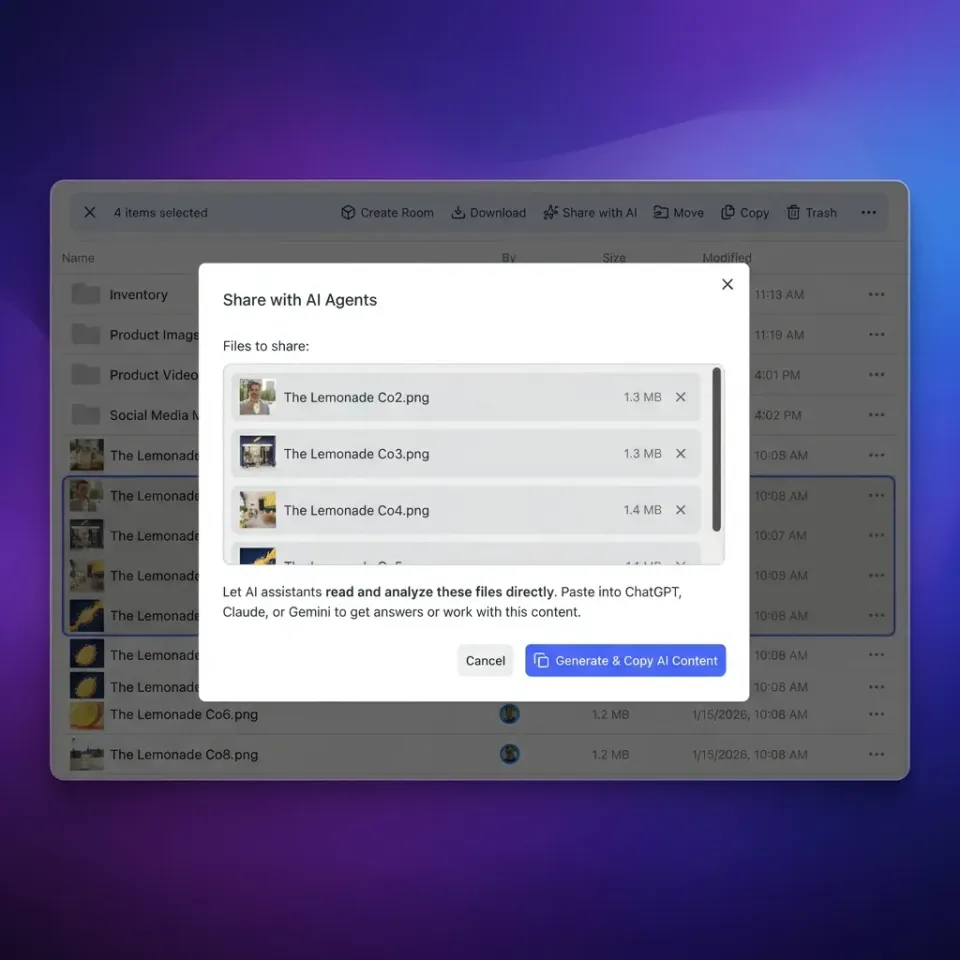
- The Workspace: A shared environment like Fastio where the agent stores exported assets, logs QA reports, and syncs code snippets.
This architecture decouples the intelligence from the tool. You can switch LLMs without rewriting your integration code, or point the same agent at different Figma teams without reconfiguration.


Give Your AI Agents Persistent Storage
Connect your Figma agents to Fastio's intelligent storage to automate asset delivery and design handoffs.
High-Value Use Cases for Figma Agents
Implementing autonomous agents in your design workflow typically yields immediate ROI in key areas.
1. Automated Design QA Agents can scan every frame in a "Ready for Dev" page to ensure compliance. They verify that text layers use defined styles, colors match the token library, and touch targets meet minimum size requirements. According to UXPin, websites using excellent design systems have shown a 400% increase in consumer conversions.
Agents catch issues early, reducing development cycles through integrated QA.
2. Intelligent Asset Handoff Instead of designers manually renaming and exporting SVGs, an agent watches for changes. When a new icon is finalized, the agent automatically exports it in all required formats (SVG, PNG, WebP) and organizes it into the team's shared file system.
This eliminates back-and-forth between design and engineering, speeding up iteration.
3. Context-Aware Code Generation Agents can extract design properties and generate component code that adheres to your specific engineering standards. Unlike generic "Figma-to-Code" plugins, an agent can read your existing codebase to ensure the generated React or Vue components match your team's specific patterns and naming conventions.
By accessing your codebase via Fastio storage, agents generate production-ready code.
Step-by-Step: Connecting an Agent to Figma
Setting up your first Figma agent requires connecting an MCP-compatible environment to your Figma account.
Step 1: Generate a Figma Personal Access Token Go to your Figma settings, navigate to the "Security" tab, and generate a new Personal Access Token. This key gives your agent permission to read files and comments.
Step 2: Configure the MCP Server
In your agent configuration (e.g., fast-io/mcp-server-figma), provide your access token and the file keys you want the agent to monitor.
Step 3: Define Agent Permissions
For security, start with read-only access. Allow the agent to GET file nodes and comments but restrict POST actions until you trust its behavior. This prevents accidental deletions or unauthorized design changes.
Step 4: Establish a Persistent Workspace Connect your agent to a Fastio workspace. This gives the agent a "hard drive" to save its work, whether that's a JSON report of design errors or a folder of optimized image assets.
Why Agents Need Persistent Storage
A common mistake is treating AI agents as ephemeral chat bots. For design operations, an agent needs a permanent place to store its output. If an agent exports dozens of assets from Figma, those files need to live somewhere accessible to the engineering team. Without persistent storage, agent outputs often get lost in chat histories or temporary folders.
Fastio provides this persistent layer. When an agent runs a Figma export task, it writes the files directly to a shared Fastio workspace. These files are immediately indexed, searchable, and available via high-speed CDN. This closes the loop between "design concept" and "production asset" without human intervention.
Persistent storage enables multi-agent collaboration, allowing design export agents to feed directly into code-generation agents in the shared space.
This setup ensures reliable handoffs between multiple agents and human teams.
Sources
References used to verify factual claims in this guide.
-
websites leveraging excellent design systems have shown a 400% increase in consumer conversions
Frequently Asked Questions
Is Figma's API free for AI agents?
Figma's REST API is available on all plans, but rate limits apply. The Starter plan has stricter limits suitable for testing, while Professional and Organization plans support the higher volume of requests typical for autonomous agents.
Can an AI agent edit my Figma designs?
Yes, if granted write access. However, most teams configure agents with read-only permissions initially to handle tasks like inspection, code generation, and asset export, avoiding the risk of unintended design changes.
How does this differ from plugins like Magician?
Plugins like Magician operate inside the Figma canvas and require a user to trigger them. An AI agent operates externally and autonomously, running in the background to monitor files and trigger workflows without human initiation.
Do I need to be a developer to set this up?
Basic familiarity with API keys and configuration is helpful. However, platforms like Fastio and open-source MCP servers are making it increasingly "low-code" to deploy these agents using simple configuration files.
Is my design data secure with an AI agent?
Security depends on the agent's hosting. Using a private agent in a secure workspace like Fastio ensures your design data isn't used to train public models. Always check the data retention policies of any third-party AI services you connect.
Related Resources

Give Your AI Agents Persistent Storage
Connect your Figma agents to Fastio's intelligent storage to automate asset delivery and design handoffs.