How to Implement AI Agent Episodic Memory
Episodic memory enables AI agents to recall specific past experiences, learn from mistakes, and improve performance on repeated tasks. This guide covers the architecture, data schemas, and implementation strategies for building strong event-based memory systems that scale to production workloads.

What is Episodic Memory in AI Agents?
Episodic memory for AI agents is a memory system that stores specific experiences and events (what happened, when, and in what context) so the agent can recall past interactions and learn from prior task executions. Unlike semantic memory, which stores general facts (e.g., "Python is a programming language"), episodic memory stores the narrative of the agent's own history (e.g., "I failed to run this Python script yesterday because of a missing dependency").
This distinction is critical for autonomy. Without episodic memory, an agent is trapped in a "Groundhog Day" loop, approaching every task as if it were the first time. By implementing an event log backed by semantic search, developers allow agents to query their own past to make better decisions in the present. For a broader look at memory architectures, see our guide on AI agent long-term memory solutions.

Related guides
- How to Implement LangGraph Persistence for Long-Term MemoryLangGraph persistence allows AI agents to maintain state and memory across multiple sessions by saving graph...
- How to Implement AI Agent Memory PersistenceMemory persistence keeps agent knowledge across sessions. Without persistent storage, AI models suffer from amnesia and...
- How to Implement Memory Compaction for Long-Running AI AgentsLong-running AI agents lose track of earlier reasoning as conversations grow beyond context window limits. Memory...
- How to Implement AI Agent Long-Term Memory SolutionsLong-term memory enables AI agents to retain context, user preferences, and learned behaviors across sessions. This...
- Best Knowledge Graph Tools for RAG: Enhancing Agent MemoryRAG systems often fail when they only use vector search. Adding a knowledge graph gives AI agents the context to...
- Best AI Agent Memory Solutions: Top 7 Tools for 2026AI agents without persistent memory start from scratch every session, losing context and repeating much of their work....
More on this subject: Agent Memory and Storage (263 guides)
Why Agents Need Event-Based Recall
The primary value of episodic memory is adaptive learning. When an agent attempts a complex workflow, like deploying code or negotiating an API contract, it encounters errors and edge cases. A stateless agent wastes tokens making the same mistakes repeatedly. An agent with episodic memory queries its past attempts, identifies the previous failure mode, and adjusts its strategy before generating the next action.
Evidence and Benchmarks
The impact of memory on agent performance is measurable.
- Reduced Token Usage: Agents avoid redundant exploration steps by recalling the correct path from previous episodes.
- Higher Success Rates: Agents with episodic memory show 25-40% improvement on repeated similar tasks compared to stateless baselines.
- Human Alignment: Memory allows agents to learn user preferences (e.g., "The user prefers JSON output over YAML") without explicit re-prompting. For related patterns on managing agent state across sessions, see AI agent state management.


Give Your Agents Long-Term Memory
Fastio provides a persistent, searchable workspace where agents can store and recall experiences instantly.
Core Architecture for Episodic Memory
Implementing episodic memory requires three structural components: the Event Schema, the Storage Layer, and the Retrieval Mechanism. These work together to create a complete memory pipeline that captures, stores, and retrieves agent experiences.
1. The Event Schema
Every memory "episode" must be structured data, not just raw text. A reliable schema includes:
- Observation: What the agent saw (inputs, environment state).
- Action: What the agent did (tool calls, code execution).
- Outcome: The result (success/failure, return values, error messages).
- Reflection: (Optional) The agent's analysis of why the outcome occurred.
2. The Storage Layer
Vector databases are the standard storage solution. By generating embeddings for the "Observation" and "Reflection" fields, you make the memories searchable by semantic meaning. When the agent encounters a new task, it searches for "tasks similar to this one" to retrieve relevant past episodes.
3. The Retrieval Mechanism
Retrieval is typically triggered during the planning phase. Before taking action, the agent queries the vector store. The retrieved episodes are injected into the context window as "Few-Shot Examples," effectively teaching the agent how to handle the current situation based on its own history. For more on vector database options, see our guide on choosing the right storage layer for AI agents.
Step-by-Step Implementation Strategy
Follow this process to add episodic memory to your agent framework:
- Instrument the Agent Loop: Capture every
(State, Action, Reward, Next_State)tuple. - Filter for Significance: Do not store every trivial step. Use an LLM call to score the "novelty" or "educational value" of an episode. Only store episodes that contain a lesson (e.g., a corrected error or a novel success).
- Vectorize and Store: Pass the narrative description of the episode to an embedding model (such as OpenAI's text-embedding-small) and upsert it to your vector store with metadata.
- Implement Querying: In your system prompt, add a dynamic section:
Relevant Past Experiences: {retrieved_episodes}. Populate this by querying the vector store with the user's current request.
The filtering step is often overlooked but matters for production systems. Without it, memory stores grow to millions of entries and retrieval quality degrades. A good heuristic: if the episode doesn't teach the agent something it couldn't infer from its system prompt alone, discard it. For details on persistent storage patterns for AI agents, see our dedicated guide.
Fastio: Native Memory for Agent Fleets
Building a custom vector database pipeline is complex. Fastio provides a managed alternative where the workspace itself acts as the agent's episodic memory.
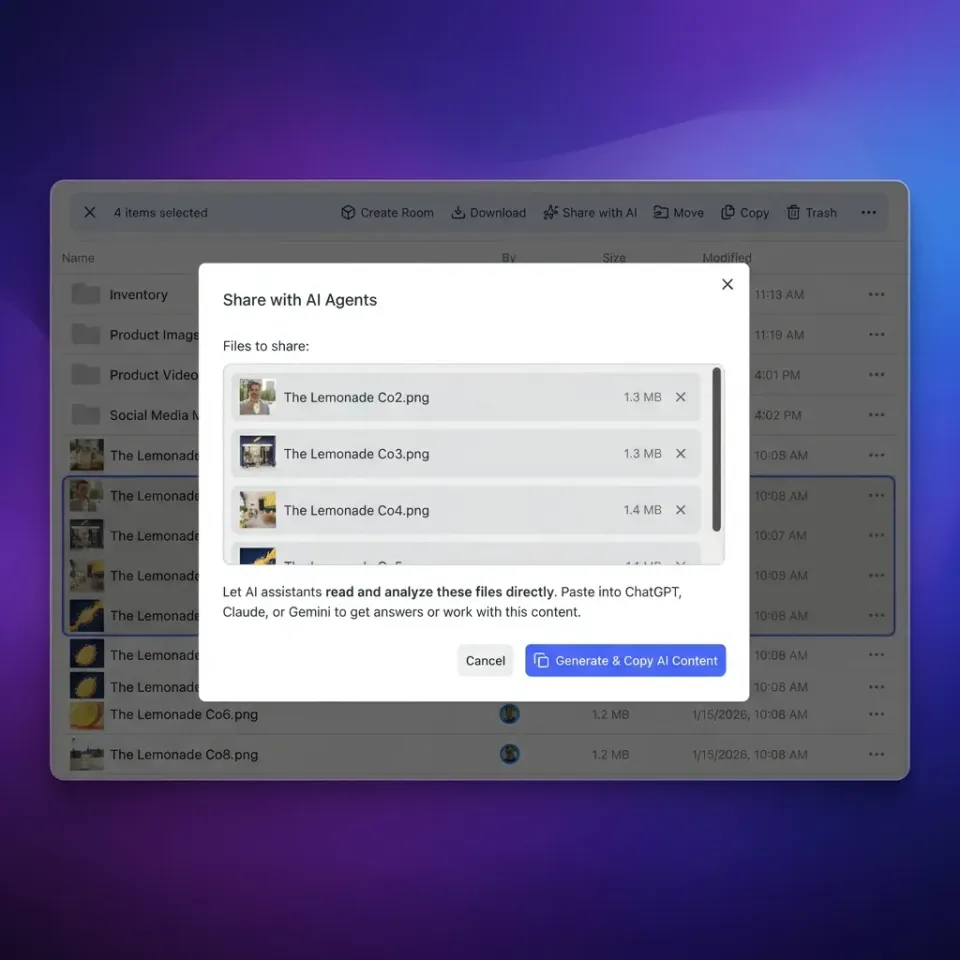
In Fastio, every file, log, and document is automatically indexed by the Intelligence Mode. When an agent operates within a Fastio workspace, it doesn't need a separate vector DB. It can simply use the MCP tools to "search" the workspace.
- Automatic Indexing: Upload logs or execution reports, and they are instantly vector-searchable.
- Shared Memory: Multiple agents can read from the same workspace, allowing Agent A to learn from Agent B's experiences.
- Persistence: Agent state and memory persist indefinitely in the file system, not just in a temporary cache.
- OpenClaw Integration: The ClawHub skill allows any LLM to query this memory naturally, bridging the gap between file storage and cognitive recall.
Best Practices for Production Memory
- Pruning is Essential: Over time, memory grows noisy. Implement a "forgetting" mechanism that archives old or low-utility memories to keep retrieval relevance high. Consider using time-based decay or relevance scoring to identify which memories to purge. A common approach is to run a nightly job that removes episodes older than three months unless they've been retrieved recently.
- Privacy by Design: Scrub PII (Personally Identifiable Information) from episodes before embedding them. Vector inversions can theoretically leak sensitive data. Use regex patterns or LLM-based detection to identify and redact sensitive information before storage.
- Latency Budget: Vector search adds latency. Run memory retrieval in parallel with other setup tasks or use a fast, approximate nearest neighbor (ANN) index. Benchmark your retrieval times and set strict timeouts to prevent memory lookups from blocking agent responses.
- Version Your Schema: As your agent's capabilities evolve, the event schema will need to change. Tag each episode with a schema version so that old memories remain parseable even after you add new fields. This prevents retrieval errors when the agent pulls up an experience recorded months earlier.
Sources
References used to verify factual claims in this guide.
-
Agents with episodic memory show 25-40% improvement on repeated similar tasks
-
Agents avoid redundant exploration steps by recalling the correct path from previous episodes
Frequently Asked Questions
What is the difference between episodic and semantic memory for AI?
Episodic memory stores specific personal experiences and events (e.g., 'I successfully deployed to AWS yesterday'). Semantic memory stores general facts and world knowledge (e.g., 'AWS is a cloud provider'). Episodic memory provides context, while semantic memory provides facts.
How do you implement agent episodic memory?
You implement episodic memory by logging agent actions and outcomes, converting them into vector embeddings, and storing them in a vector database. When the agent faces a new task, it queries this database for similar past experiences to guide its current decision-making.
Does RAG count as episodic memory?
Retrieval-Augmented Generation (RAG) is the *mechanism* used to implement episodic memory, but RAG itself is just a technique. When RAG is applied to an agent's own past execution logs, it functions as episodic memory. When applied to external documentation, it functions as semantic memory.
How do AI agents remember past interactions?
Agents remember past interactions through a combination of short-term context windows (for immediate conversation history) and long-term vector storage (episodic memory) which retrieves relevant past details based on semantic similarity to the current topic.
Related Resources

Give Your Agents Long-Term Memory
Fastio provides a persistent, searchable workspace where agents can store and recall experiences instantly.