How to Design a Data Pipeline Architecture for AI Agents
A data pipeline for AI agents is the backbone of reliable autonomous systems. It moves unstructured data from sources through normalization and embedding to make it accessible for agent reasoning. This guide breaks down the essential architecture layers for production-ready agents.

What is an AI Agent Data Pipeline?
A data pipeline for AI agents is the end-to-end architecture that moves data from source systems through ingestion, transformation, storage, and indexing stages so agents can access, query, and act on it. Unlike traditional analytics pipelines that focus on structured rows and columns, agent pipelines must handle unstructured files like PDFs, videos, codebases, and images in near real-time.
The quality of your agent's output is directly capped by the quality of its data pipeline. If the pipeline feeds the agent stale, fragmented, or poorly indexed context, the agent will hallucinate or fail tasks. Building this plumbing is often the most time-consuming part of agent engineering.

The Pareto Principle in Agent Development
It is a well-known reality in machine learning that the vast majority of effort goes into data preparation rather than model tuning. For autonomous agents, this is even more critical because "data preparation" happens dynamically at runtime.
The majority of AI development time is spent on data pipeline plumbing and preparation. For agents, this means building systems that can instantly ingest a user's uploaded file, parse it, chunk it, embed it, and make it retrievable for the LLM within seconds.
Related guides
- How to Master AI Agent Job Scheduling for Production WorkflowsAI agent job scheduling enables autonomous agents to execute tasks on predefined schedules while maintaining context...
- How to Handle Long-Running Tasks in AI AgentsAI agents that run for minutes or hours need more than a basic request-response loop. This guide covers five production...
- How to Build an AI Agent Data Enrichment PipelineMost data enrichment pipelines connect to a single API and stop there. An AI agent enrichment pipeline chains multiple...
- How to Integrate AI Agents with Argo CDAI agent Argo CD integration enables autonomous continuous deployment management through GitOps principles. Agents can...
- How to Architect Terraform Infrastructure for AI AgentsAutonomous AI agents need infrastructure that's reproducible and scales. This guide explains how to use Terraform to...
- How to Build an AI Agent Service Mesh: A Guide for 2026As enterprises deploy more autonomous agents, managing their communication becomes critical. An AI agent service mesh...
More on this subject: Agent Infrastructure and Deployment (55 guides)
The Five Layers of Agent Data Architecture
A production-grade agent pipeline consists of five distinct layers. Each layer transforms the data to make it more "understandable" for the Large Language Model (LLM).
- 1. Ingestion Layer: Connects to data sources (APIs, cloud storage, local files) and pulls raw data. It must handle authentication, rate limiting, and incremental syncs.
- 2. Normalization Layer: Converts various file formats (PDF, DOCX, HTML) into clean, plain text. This is often the messiest layer, requiring OCR for images and specialized parsers for complex documents.
- 3. Semantic Layer (Embedding): Breaks text into chunks and converts them into vector embeddings using models like OpenAI's text-embedding-small. This gives the data "meaning" that computers can search.
- 4. Storage Layer: Persists both the raw files (for reference) and the vector embeddings (for search).
- 5. Retrieval Layer: The interface the agent uses to query data. It typically involves a "Retriever" tool that performs semantic search to find relevant context for a user's prompt.


Give Your AI Agents Persistent Storage
Fastio gives your agents a pre-built data layer. Files are automatically indexed, vector-embedded, and ready for semantic search the moment they hit the workspace.
Why Standard Cloud Storage Fails Agents
Most developers start by storing agent data in standard buckets like S3 or Google Drive. However, these services are designed for humans or static applications, not for reasoning engines.
- No Native Indexing: S3 doesn't know what's inside your PDF. You have to build a separate "sidecar" infrastructure just to index the content.
- Latency: Polling a drive for changes adds delay. Agents need event-driven architectures to react instantly when a new file arrives.
- Permission Mismatch: A human user has one set of permissions; an agent needs granular, scoped access to specific folders or files to prevent security risks.
Fastio solves this by treating the storage layer as the intelligence layer. When you toggle "Intelligence Mode" on a workspace, every file uploaded is automatically indexed and made queryable via the MCP (Model Context Protocol).
How to Build a Reactive Agent Pipeline
To move beyond static data, your pipeline must be reactive. Agents shouldn't just read data; they should be triggered by it. Reactive pipelines enable agents to respond to changes in real time, processing new information as it arrives rather than waiting for scheduled batch jobs. This shift from pull-based to push-based architecture fundamentally changes how agents interact with their environment.
The key to reactivity is building systems that can handle asynchronous events and maintain state across interactions. When a user uploads a document in the middle of the night, the agent should wake up and process it immediately. When a database updates, the agent should be notified and take action. This requires careful design of event handlers, state management, and error recovery mechanisms to ensure the pipeline remains resilient under load.
Event-Driven Triggers
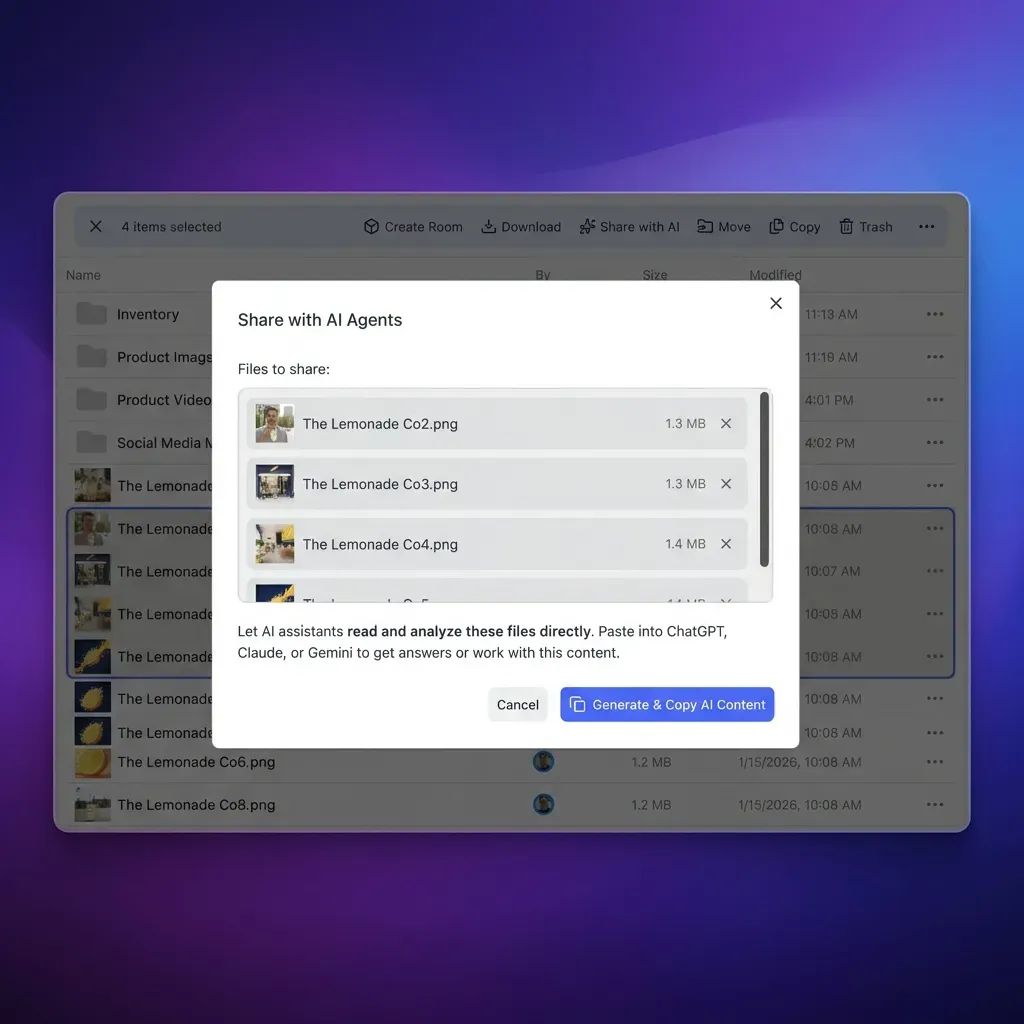
Instead of running a cron job to check for new files, subscribe to change events from your storage layer. In a Fastio workspace, the agent can listen on the WebSocket events feed, or long-poll for activity if the connection drops, and learn about each upload as it happens. This allows the agent to wake up and process the new information immediately.
The Human-in-the-Loop Handover
Data doesn't always end with the agent. Often, the agent's output, whether a report, a generated image, or a code patch, needs to be delivered back to a human.
A strong architecture supports "Ownership Transfer." The agent creates a workspace, populates it with results, and then programmatically transfers ownership of that workspace to the human user. This keeps the agent's internal environment clean while delivering a professional, branded package to the end user.
Measuring Pipeline Health
How do you know if your pipeline is working? Monitor these three metrics:
- Ingestion Latency: Time from file upload to "searchable" status. For interactive agents, aim for sub-second latency where possible. Slow ingestion means users wait for their data to become available, breaking the illusion of instant intelligence.
- Retrieval Relevance: How often does the retrieved context actually answer the user's question? Use "LLM-as-a-Judge" evaluation where a separate model scores whether the retrieved chunks helped answer the query. Aim for high relevance.
- Pipeline Cost: Track token usage for embedding and storage costs for vectors. Monitor cost per thousand documents indexed and set alerts when embedding costs exceed budget thresholds. Fastio's plans (Starter at $9.99/mo, Business at $49.99/mo) provide predictable storage and credits for agent pipelines; see /pricing/.
Sources
References used to verify factual claims in this guide.
-
Fastio offers a 14-day Business Trial with usage credits and workspace collaboration features
Frequently Asked Questions
What is the difference between an ETL pipeline and an agent pipeline?
ETL pipelines typically process structured data for analytics dashboards. Agent pipelines process unstructured data (text, images) for semantic search and immediate LLM context, requiring vector embeddings and lower latency.
Do I need a vector database for my AI agent?
Yes, if you want your agent to have long-term memory or access to custom knowledge. A vector database stores the 'meaning' of your data. Fastio includes this natively with Intelligence Mode, so you don't need to manage a separate vector DB instance.
How can agents handle real-time data updates?
Use an event-driven architecture. In Fastio, the agent can subscribe to the workspace events feed over WebSocket, or long-poll for activity, to learn about changes as they happen instead of checking for updates on a schedule.
What is the best way to handle file permissions for agents?
Use a system that supports granular access tokens or scoped permissions. Fastio's MCP server allows you to give agents access to specific workspaces without exposing your entire drive.
Related Resources

Give Your AI Agents Persistent Storage
Fastio gives your agents a pre-built data layer. Files are automatically indexed, vector-embedded, and ready for semantic search the moment they hit the workspace.