How to Use AI Agent Webhook File Events for Real-Time Workflows
AI agent webhook file events drive modern, event-driven agent architectures. Instead of wasting resources checking for new files, agents can receive instant notifications when uploads occur. This guide shows how to implement file webhooks to trigger AI workflows in real time.

What Are AI Agent Webhook File Events?
AI agent webhook file events are HTTP callbacks triggered when files are uploaded, modified, or deleted in cloud storage. They enable AI agents to react to file changes in real time without polling. They connect the storage layer to the agent's logic, transmitting signals directly to the agent. In a traditional setup, an agent might ask a storage API, "Are there any new files?" every minute. This is inefficient and introduces latency. With webhooks, the storage system pushes a notification to the agent the moment an event occurs. This notification typically includes a rich metadata payload containing the file ID, file path, size, MIME type, and the timestamp of the event. For developers building autonomous AI agents, this shift from polling to event-driven architecture is important. It reduces API costs by eliminating redundant GET requests, minimizes latency by removing the "wait for next poll" window, and ensures that data processing pipelines start immediately after a file lands in storage. This real-time capability is necessary for interactive applications like chat-with-your-files or automated document triage.
Why Polling Kills AI Agent Performance
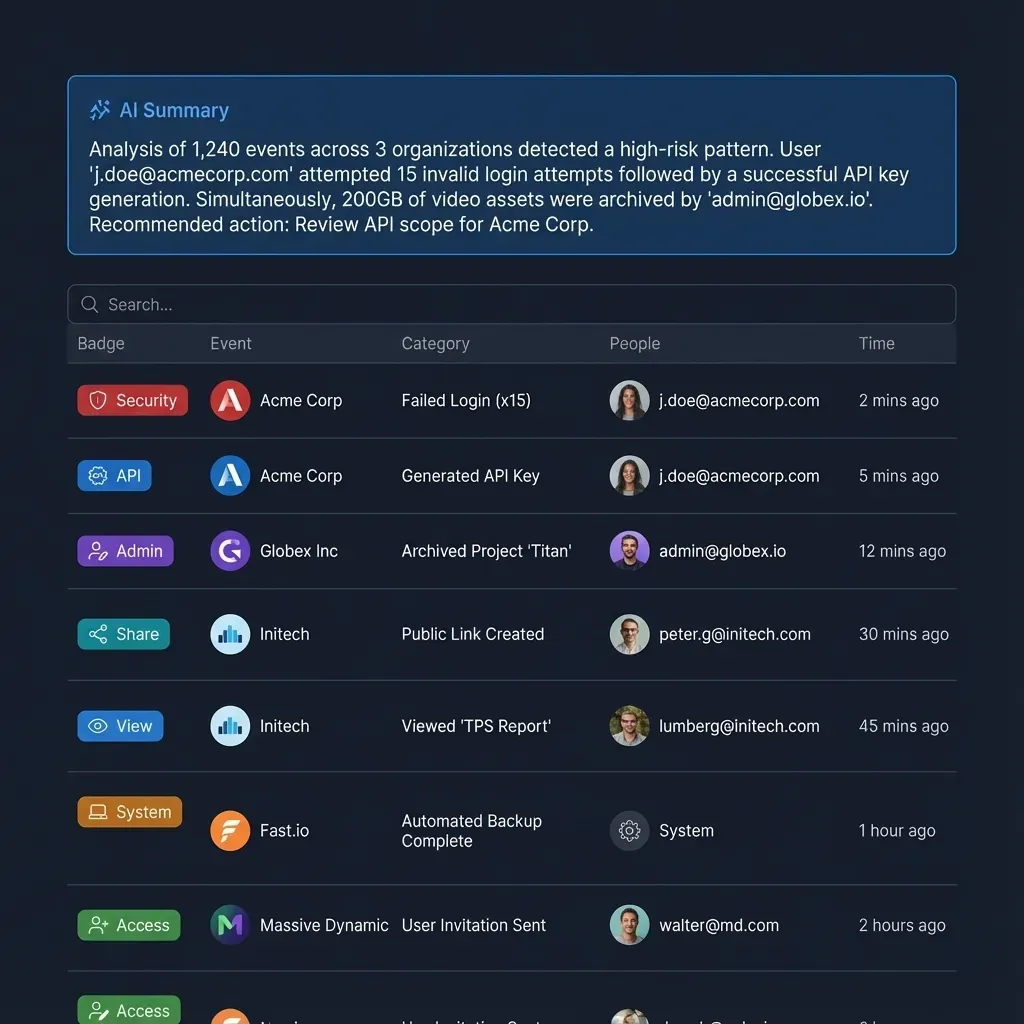
Polling means repeatedly checking a resource to see if its state has changed. For AI agents managing thousands of files across multiple folders, this approach scales poorly and creates overhead for both the agent and the storage provider. According to recent cloud architecture benchmarks, event-driven systems reduce unnecessary API calls by over 90% compared to polling intervals of 60 seconds. When an agent polls for files, most checks return "no change." This wastes compute cycles and network bandwidth, raising the cost of running the agent. Also, polling creates a "blind spot" between checks. If an urgent document is uploaded seconds after a poll, it sits idle until the next interval.
The Polling vs. Webhook Difference:
- Polling: Agent checks every minute. File uploads at 12:01:05. Agent finds it at 12:02:00 (Latency: 55s).
- Webhooks: File uploads at 12:01:05. Storage sends event instantly. Agent processes at 12:01:06 (Latency: 1s). By adopting webhooks, agents can remain in a low-power "sleep" state or focus on other tasks until the storage system tells them there is work to do. This leads to faster, cheaper, and scalable AI systems.


Give Your AI Agents Persistent Storage
Fastio gives teams shared workspaces, MCP tools, and searchable file context to run ai agent webhook file events workflows with reliable agent and human handoffs.
How to Configure Webhooks for File Events
To set up webhooks, you need a storage provider that supports granular event notifications and an agent capable of receiving HTTP POST requests. Follow these best practices to build a reliable setup.
1. Define the Endpoint
Your AI agent must expose a public URL (endpoint) to receive the webhook payload. If you are using a serverless function, a Docker container, or an agent framework like LangChain, this is typically a specific route (e.g., /api/webhooks/file-upload). Use a service like ngrok during development to expose your local environment to the web for testing.
2. Select Event Types Configure your storage provider to send events only for relevant actions to avoid overwhelming your agent with noise. Common triggers include:
file.uploaded: Trigger ingestion, OCR, or RAG indexing. *file.updated: Trigger re-analysis, versioning, or cache invalidation. *file.deleted: Trigger cleanup of vector embeddings or secondary artifacts.
3. Validate the Payload and Security Security is important when exposing an endpoint. Verify the webhook signature (usually a HMAC hash in the headers) to ensure the request actually came from your storage provider. Also, set up rate limiting to protect your agent from potential Denial of Service (DoS) attacks targeted at your webhook URL.
4. Implement Error Handling
Webhooks can fail due to network glitches or agent downtime. Ensure your endpoint returns a 200 OK status quickly to the sender, then processes the data asynchronously. If your agent is busy, use a message queue (like RabbitMQ or AWS SQS) to buffer incoming events and make sure you don't miss files.
Top 3 Use Cases for File-Triggered Agents
Event-driven file workflows enable new workflows for AI agents. Here are the most common implementation patterns used by modern engineering teams.
Automated RAG Indexing
When a user uploads a PDF or Markdown file to a shared workspace, a file.uploaded event triggers the agent. The agent downloads the file, chunks the text into smaller pieces, generates high-dimensional embeddings, and updates the vector database. This ensures that the agent's knowledge base is always current, allowing for "live" RAG where the agent can answer questions about a document seconds after it has been uploaded.
Media Processing and Creative Pipelines
For video production and design teams, an upload event can trigger an agent to perform complex media tasks. For example, uploading a raw .mp4 can trigger an agent to generate transcripts, create smart summaries, identify key speakers, and even extract still frames for thumbnails. Fastio's Intelligence Mode handles much of this automatically, but custom agents can extend these workflows for specific creative tasks, such as automated color grading or subtitle generation.
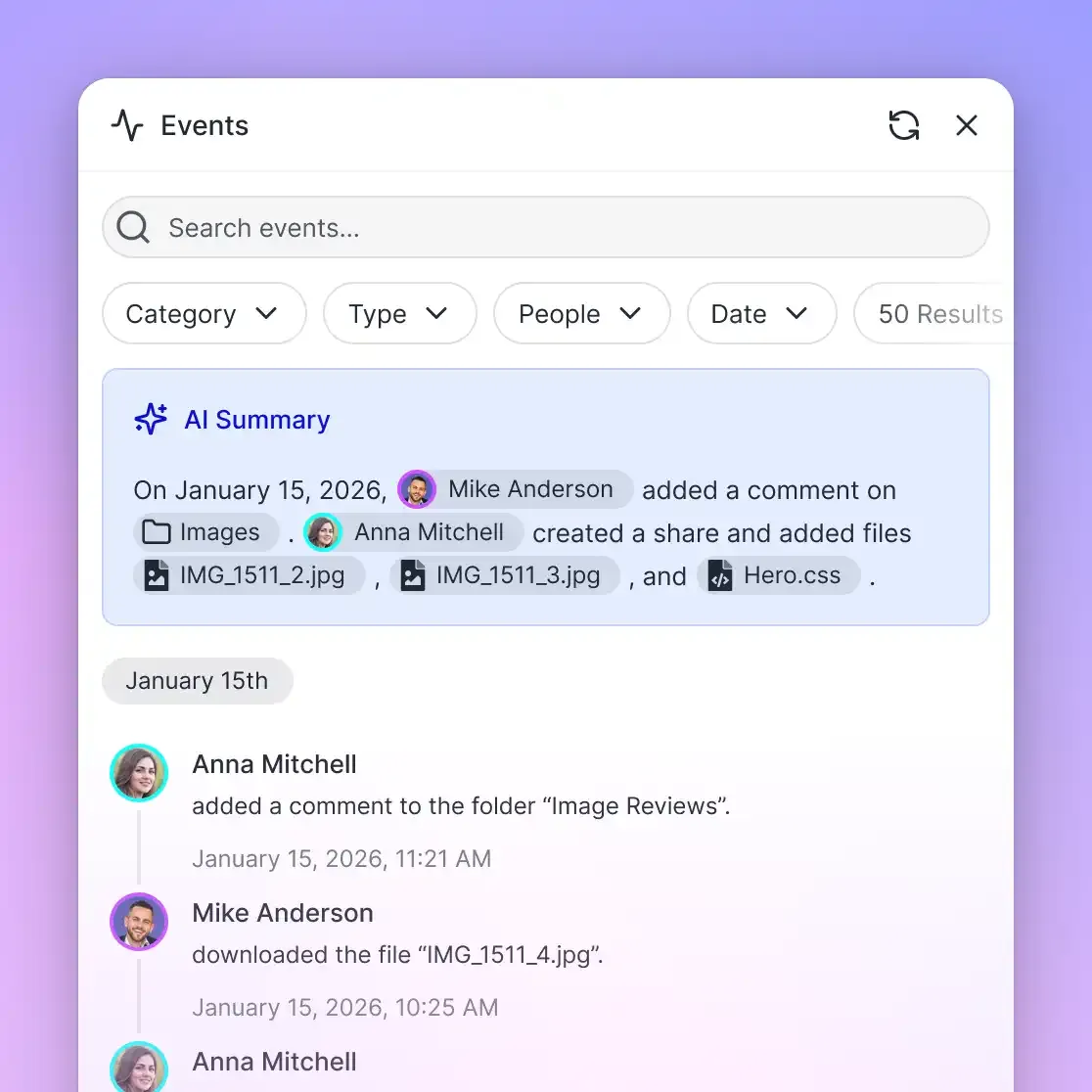
Compliance and Security Auditing An agent can act as a security monitor, listening for file uploads in sensitive folders. If a file is uploaded, the agent scans the content for PII (Personally Identifiable Information), secrets (like API keys), or compliance violations. If it finds a threat, the agent can programmatically move the file to a quarantine zone, notify the security team, and log the event for audit purposes.
Fastio's Event-Driven Architecture for Agents
Fastio is built to support these workflows. Unlike traditional cloud storage providers that treat agents as secondary users, Fastio provides a platform for building autonomous file-based agents.
Reliable Webhooks Fastio supports granular webhooks for file and folder events across your entire account. Developers can configure these directly via our API or management dashboard. Our webhook delivery system is built to be reliable, with automatic retries and detailed event logging to help you debug your agentic workflows during development and production.
Model Context Protocol (MCP) Integration Fastio offers an official MCP server with 251 pre-built tools, allowing agents to work with files directly. This integration allows your agents to not only receive events but also to perform actions, like moving files, updating metadata, or managing permissions, with minimal code.
Persistent, Secure Storage Every agent on Fastio receives its own account with 50GB of free, high-performance storage. This is not just temporary scratch space; it is a persistent, secure file system where agents can store their long-term memory, generated artifacts, and project-specific data. This persistence is important for agents that need to maintain state across multiple event-triggered sessions.
Frequently Asked Questions
How do AI agents respond to file changes?
AI agents respond to file changes using webhooks. When a file is modified in storage, the system sends an HTTP POST request to the agent, which then executes a specific function, such as re-indexing the document or notifying a user.
What is the difference between polling and webhooks?
Polling requires the agent to repeatedly ask 'is there new data?' which wastes resources. Webhooks let the storage system tell the agent 'here is new data' immediately, ensuring faster response times and lower API usage.
Can I use webhooks with the Fastio free agent tier?
Yes, Fastio's free agent tier includes full API access, including webhook configuration. Agents get 50GB of storage and can set up triggers for file uploads, updates, and more without a credit card.
How do I secure my AI agent's webhook endpoint?
To secure your endpoint, always verify the digital signature (HMAC) provided in the request headers by the storage provider. Also, use HTTPS for all communications, implement rate limiting to prevent abuse, and validate that the file metadata in the payload matches your expected schema.
Related Resources

Give Your AI Agents Persistent Storage
Fastio gives teams shared workspaces, MCP tools, and searchable file context to run ai agent webhook file events workflows with reliable agent and human handoffs.