How to Choose a White Label Data Room for Client-Facing Deals
A white label data room lets advisory firms, investment banks, and service providers rebrand a virtual data room with their own logo, colors, and domain. This guide explains how white label VDRs differ from standard branded rooms, what features to evaluate, and how to set one up for client-facing transactions.

What Is a White Label Data Room?
A white label data room is a virtual data room (VDR) that can be fully rebranded with your firm's logo, colors, and custom domain for client-facing deal management. Unlike standard VDRs where the provider's branding is visible, a white label solution removes all traces of the underlying platform. Your clients see your brand at every touchpoint, from the login page to email notifications to document watermarks.
The distinction matters for firms that manage deals on behalf of clients. When a law firm or investment bank opens a data room for a transaction, the room's appearance signals professionalism and trust. A generic "Powered by [Provider]" footer can undermine that perception, especially when the client is paying a premium for advisory services.
White label vs. branded data rooms
These terms often get conflated, but they describe different levels of customization:
- Branded data room: You can add your logo and adjust colors within the provider's existing interface. The provider's branding may still appear in certain places, such as login screens, email footers, or mobile views.
- White label data room: The provider's identity is completely removed. You control the domain, the login experience, the email templates, and the visual design. Clients interact with what appears to be your proprietary platform.
For firms running a handful of deals per year, branded customization is usually sufficient. For organizations managing dozens of concurrent transactions, or those reselling data room access as part of a service package, white labeling becomes a competitive requirement.
Why Firms Invest in White Label VDRs
The business case for white labeling goes beyond aesthetics. It touches revenue, client retention, and operational efficiency.
Brand consistency across transactions
Investment banks and advisory firms typically manage 50 or more concurrent data rooms at any given time. Each room represents a client relationship. When every room carries your firm's branding, clients experience a consistent, professional environment regardless of which deal they're working on. That consistency builds trust and reduces the cognitive overhead of switching between different-looking platforms.
Revenue through reselling
Some firms resell data room access as a line item in their advisory fees. A white label setup lets you price the service as your own product rather than passing through a third-party cost. Firms offering white label data rooms can command 20-40% price premiums over generic alternatives because clients perceive the room as a proprietary tool built for the firm's specific workflow.
Client perception and due diligence
During M&A transactions and fundraising rounds, every detail signals competence. A data room that looks purpose-built for your firm suggests you've invested in infrastructure, that you take security seriously, and that you handle enough transaction volume to justify a custom platform. Prospective clients evaluating your firm during a pitch may notice.
Operational control
White label arrangements often come with admin-level controls that standard plans don't include. You get dedicated subdomain routing, custom email templates, centralized user management across rooms, and consolidated billing, all features that matter when you're running data rooms at scale.
Key Features to Evaluate
Not all white label data room offerings are equal. Some providers offer surface-level branding while others provide deep customization. Here's what to look for when comparing options.
Custom domain and SSL
The most visible white label feature is a custom domain. Instead of logging in at provider.com/your-firm, clients access deals.yourfirm.com. This requires the provider to support custom domain mapping with SSL certificates, so the connection stays secure under your URL.
Email template control
Data rooms generate dozens of automated emails: invitations, access notifications, document upload alerts, expiration warnings. In a white label setup, all of these should carry your firm's branding, reply-to address, and tone. Check whether you can edit the email templates or if you're limited to swapping a logo.
Login page customization
The login screen is the first thing clients see. Full white label providers let you control the background image, color scheme, logo placement, and messaging on this page. Some also support custom terms of service or NDA acceptance as part of the login flow.
Document watermarking
Watermarks protect against unauthorized distribution. White label rooms should let you apply dynamic watermarks with your firm's name, the viewer's email, or a timestamp. The watermark should appear on PDFs, images, and printed documents.
Removing provider attribution
This is the true test of white labeling. Check for "Powered by" badges in the footer, provider logos on mobile views, provider names in browser tab titles, and provider-branded loading screens. A genuine white label product eliminates all of these.
Admin hierarchy
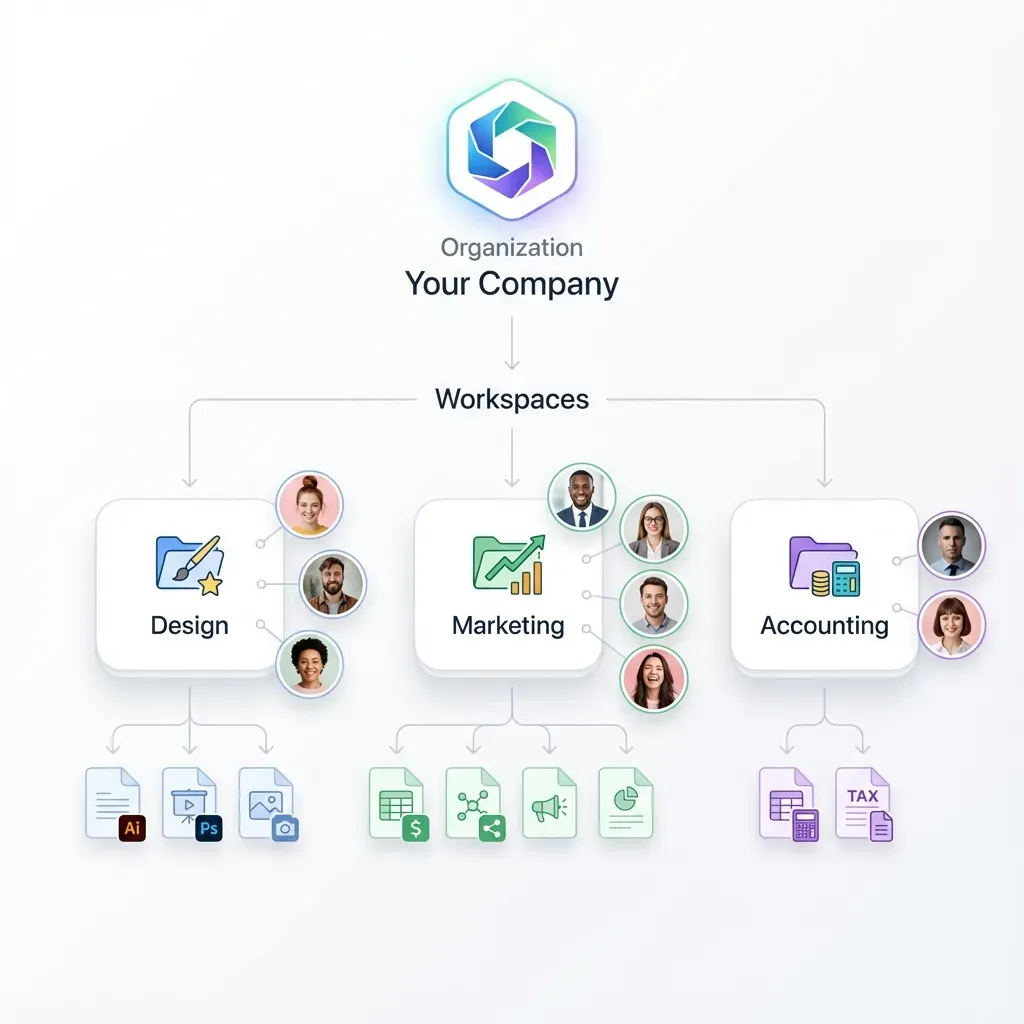
For firms managing many rooms, you need a management layer above individual data rooms. Look for features like centralized user directories, role templates that apply across rooms, and consolidated reporting that shows activity across all your active deals.


Need branded deal rooms with built-in document intelligence?
Fast.io Content Portals give your clients a branded, password-protected document experience with AI-powered search and Q&A. Start free with 50GB storage, no credit card required.
How to Set Up a White Label Data Room
The setup process varies by provider, but most follow a similar pattern. Plan for a one-to-two week setup window if you're configuring a custom domain and email templates for the first time.
Step 1: Configure your domain Point a subdomain (like dataroom.yourfirm.com or deals.yourfirm.com) to the provider's servers using a CNAME record. The provider handles SSL provisioning. Test the domain in a browser to confirm it loads the login page before inviting clients.
Step 2: Upload brand assets
Provide your logo in SVG or high-resolution PNG format. Set your primary and secondary brand colors using hex codes. Upload a background image for the login page if the provider supports it. Most platforms have a branding dashboard where you preview changes before publishing.
Step 3: Customize email templates
Configure the reply-to address and sender name for automated emails. Edit the email body templates to match your firm's communication style. Test each email type by triggering a sample: send yourself an invitation, upload a document to trigger an alert, and set a test expiration.
Step 4: Set default permissions
Create permission templates for common roles: deal team members who can upload and edit, advisors who can view and download, and observers who can only view without downloading. These templates save time when you're creating rooms frequently.
Step 5: Create your first room
Build a test room with sample documents. Invite a colleague as an external user to experience the client-facing view. Walk through the login, document browsing, and download experience. Note anything that still shows the provider's branding.
Platforms like Fast.io offer branded portal capabilities that include custom logos, colors, backgrounds, and vanity URLs. With Fast.io's Content Portals, you can create password-protected rooms where clients access documents through your firm's branded interface, and built-in Ripley AI lets clients ask questions about shared documents directly within the portal.

Comparing White Label Capabilities Across Providers
The market for white label data rooms ranges from basic branding add-ons to fully customizable platforms. Here's how the major providers stack up on key criteria.
Full white label providers
Imprima offers a turnkey white label VDR designed for resellers. Their model targets firms that want to offer data room services without building technology. You get a ready-made platform with your branding, plus dedicated project managers for client onboarding. Pricing is typically per-project.
Clinked provides white label customization with custom domain support, branded login pages, and email template control. Their portal-style interface works well for ongoing client relationships, not just one-time deals. Plans start around $300/month for data room features.
Digify focuses on white label URLs and branded link sharing. Their approach is lighter weight, suited for firms that need branded document access without the full data room feature set. Pricing starts lower but scales with usage.
Branded customization (not full white label)
iDeals is one of the most popular VDR providers and offers extensive branding: custom logos, color themes, watermarks, and language settings. However, their branding customization sits within the iDeals interface rather than removing it entirely.
Firmex allows branded deal rooms with custom headers and logos. Their white labeling is available on higher-tier plans. They're widely used in Canadian legal and financial markets.
What to ask in demos
When evaluating providers, request a client-facing walkthrough, not just an admin demo. Ask these questions:
- Can I use my own domain with SSL?
- Where does your company name still appear?
- Can I edit email templates or only swap the logo?
- Is white labeling included in the base price or an add-on?
- Can I manage all my rooms from one admin dashboard?
- Do you support reseller billing so I can invoice clients directly?
For teams that also need AI-powered document intelligence, Fast.io's data room capabilities combine branded portals with built-in semantic search and document Q&A, so clients can find answers in uploaded files without contacting your team.
Pricing and ROI Considerations
White label data room pricing is rarely straightforward. Providers use different models, and the white label component is often layered on top of base VDR pricing.
Common pricing structures
- Per-project pricing: You pay for each data room. Costs typically range from $400 to $1,500 per room per month, depending on storage and user limits. White label features may be included or cost extra.
- Per-user pricing: Base plans start at $15-25 per user per month, but white label features are usually restricted to enterprise tiers priced at $300/month or more.
- Flat-fee plans: Some providers charge a flat monthly rate (typically $250-500) that includes unlimited documents and users. White labeling is often an add-on at an additional $100-300/month.
- Reseller licensing: For firms planning to resell, some providers offer volume licensing with per-room costs that decrease as you scale.
Calculating return on investment
The ROI of white labeling depends on how you charge clients. If you bundle data room access into advisory fees, the math is simple: your white label cost per room versus the portion of your advisory fee attributable to document management. Many firms find that white labeling pays for itself when they can present the data room as a proprietary service rather than a pass-through expense.
For firms running fewer than five concurrent rooms, the premium for white labeling may not be justified. At 10 or more concurrent rooms, the per-room cost of white labeling typically drops to a point where the branding benefit is worth the investment.
Hidden costs to watch for Check for charges on custom domain setup, SSL provisioning, email template customization hours, and dedicated support. Some providers quote a low white label add-on price but charge professional services fees for the initial configuration. Ask for an all-in quote that covers setup and the first three months of operation.
Frequently Asked Questions
What is a white label data room?
A white label data room is a virtual data room that can be fully rebranded with your firm's logo, colors, and custom domain. Unlike standard branded rooms where the provider's name may still appear, a white label solution removes all traces of the underlying platform so clients interact with what appears to be your proprietary system.
Can you brand a virtual data room with your own logo?
Yes, most VDR providers offer some level of branding. Basic plans typically let you add your logo and adjust colors. Full white label options, available on higher-tier plans, let you use a custom domain, control email templates, customize the login page, and remove all provider attribution.
What is the best white label data room provider?
It depends on your needs. Imprima and Clinked offer the deepest white label capabilities with custom domains and reseller support. iDeals and Firmex offer strong branding within their own interfaces. Fast.io provides branded portal capabilities with built-in AI document intelligence. Evaluate based on whether you need full provider-name removal, reseller billing, or specific deal management features.
How much does a white label data room cost?
White label pricing varies significantly. Base VDR plans start at $15-25 per user per month, but white label features typically require enterprise tiers at $300 or more per month. Flat-fee plans with white labeling range from $350-800 per month. Reseller licensing may offer lower per-room costs at volume. Always ask for all-in pricing that includes setup fees.
What is the difference between a branded and white label data room?
A branded data room lets you add your logo and colors but the provider's name may still appear on login screens, emails, or footers. A white label data room completely removes the provider's identity. You control the domain, email templates, and every visual element. Clients have no indication that a third-party platform powers the experience.
Do I need a white label data room for M&A transactions?
Not necessarily. For occasional deals, a standard branded VDR is sufficient. White labeling becomes valuable when you manage many concurrent rooms, resell data room access as part of your services, or need consistent branding across all client touchpoints. Investment banks and large advisory firms benefit most from white labeling.
Related Resources

Need branded deal rooms with built-in document intelligence?
Fast.io Content Portals give your clients a branded, password-protected document experience with AI-powered search and Q&A. Start free with 50GB storage, no credit card required.