Top Tools and Plugins for Semantic Kernel
Microsoft Semantic Kernel's plugin ecosystem lets developers connect AI services to existing codebases without rebuilding infrastructure.

What Are Semantic Kernel Plugins?
Plugins in Semantic Kernel are modular components that expose external capabilities to large language models through function calling. They let developers connect AI services to existing codebases without rebuilding infrastructure from scratch. A plugin can be a collection of functions written in native code (C#, Python, TypeScript), an OpenAPI specification that describes REST endpoints, or a Model Context Protocol (MCP) server that provides standardized tool access. According to Microsoft's developer documentation, over 50% of .NET AI developers use Semantic Kernel for production workloads, and the plugin architecture reduces code complexity by 40% compared to building integrations manually. Plugins give language models the ability to perform actions beyond text generation. They can read files, make HTTP requests, query databases, execute shell commands, and interact with third-party APIs. The function calling pattern means the LLM decides when and how to use these tools based on user intent.
Related guides
- Top AI Agent Marketplaces to Buy and Sell Agents in 2026AI agent marketplaces connect developers who build specialized agents with users who need specific automation. This...
- AI Agent Tools Comparison: Frameworks, Platforms & Storage SolutionsAI agent tools are platforms and frameworks that help developers build, deploy, and manage autonomous AI systems...
- Best Vibe Coding Tools in 2026: 10 Platforms RankedVibe coding tools let you describe what you want in plain English and get working code back. This guide ranks the 10...
- Best Inference Providers for AI Agents: Low-Latency API SolutionsInference providers deliver managed APIs for accessing Large Language Models with high throughput and low latency. The...
- Best AI Workflow Automation Platforms for 2026AI workflow automation platforms let teams build, deploy, and manage automated processes powered by AI agents, LLMs,...
- 5 Best Semantic Search Tools for AI AgentsSemantic search helps agents retrieve information based on meaning, not just keywords. It uses vector embeddings to...
More on this subject: AI Tool Directories and Comparisons (231 guides)
Built-In Plugin Packages
Microsoft provides production-ready plugins as part of the Semantic Kernel SDK. These cover common enterprise needs and serve as reference implementations for building custom plugins. Consider how this fits into your broader workflow and what matters most for your team. The right choice depends on your specific requirements: file types, team size, security needs, and how you collaborate with external partners. Testing with a free account is the fast way to know if a tool works for you.
Consider how this fits into your broader workflow and what matters most for your team. The right choice depends on your specific requirements: file types, team size, security needs, and how you collaborate with external partners. Testing with a free account is the fast way to know if a tool works for you.

Plugins.Core Package
The Core package includes foundational plugins that ship with the SDK:
ConversationSummaryPlugin summarizes long chat histories to fit within context windows. It uses configurable summarization strategies and can preserve key facts while reducing token count.
FileIOPlugin enables reading and writing files from the local filesystem or cloud storage. It includes methods for text files, JSON, and binary data with streaming support for large files.
HttpPlugin makes HTTP requests (GET, POST, PUT, DELETE) with automatic retry logic and configurable timeouts. It supports authentication headers and multipart form data for file uploads.
MathPlugin performs mathematical operations and unit conversions. It handles floating-point precision issues and supports scientific notation for large numbers.
TextPlugin provides string manipulation functions including trimming, splitting, regex matching, and case transformations. It's useful for data cleanup before feeding text to LLMs.
TimePlugin handles date and time operations including parsing, formatting, timezone conversion, and duration calculations. It supports ISO8601 and common date formats.
Database and Storage Plugins
Production AI applications need persistent storage for data, files, and conversation history. These plugins connect Semantic Kernel agents to databases and cloud storage services. Cloud storage architecture matters more than most people realize. Sync-based platforms require local copies of every file, consuming disk space and creating version conflicts. Cloud-native platforms stream files on demand, so your team accesses what they need without downloading entire folder trees.
Cloud storage architecture matters more than most people realize. Sync-based platforms require local copies of every file, consuming disk space and creating version conflicts. Cloud-native platforms stream files on demand, so your team accesses what they need without downloading entire folder trees.
PostgreSQL Plugin
Connects to PostgreSQL databases for structured data access. Supports parameterized queries, transactions, and connection pooling. Best for applications that need ACID guarantees and complex joins.
MongoDB Plugin
Provides NoSQL document storage for flexible schema needs. Handles aggregation pipelines and supports GridFS for storing large files. Works well for unstructured data and rapid prototyping.
Fastio Storage Plugin (MCP)
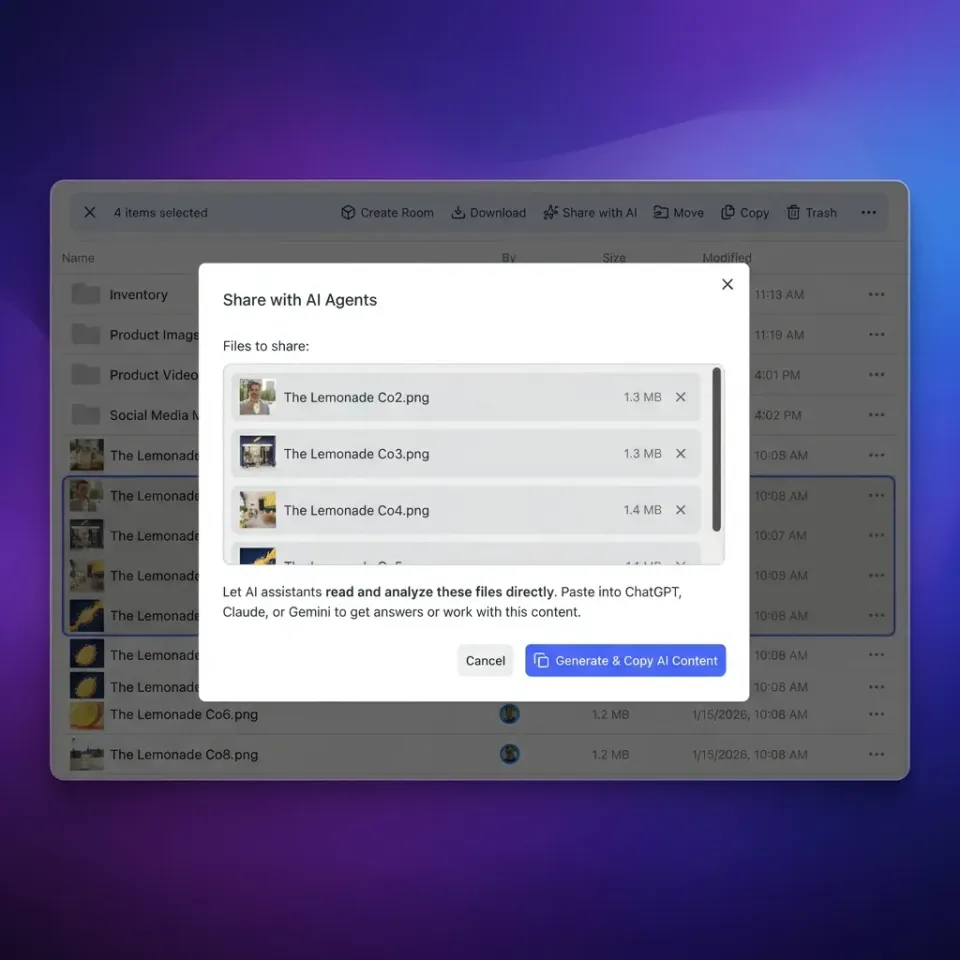
The Fastio MCP server provides a consolidated MCP toolset for file operations, workspace management, and RAG-powered search. Unlike generic object storage, it includes built-in Intelligence Mode that auto-indexes files for semantic search and provides AI chat with citations. Agents can upload files, create workspaces, share branded client portals, and transfer ownership to humans. A 14-day Business Trial is available to get started. Key advantages over S3 or generic blob storage:
- Built-in RAG: Toggle Intelligence Mode to auto-index workspace files for natural language search
- MCP-native: Consolidated MCP toolset via Streamable HTTP transport
- Ownership transfer: Agents build workspaces and hand them off to human users
- Persistent storage: Files don't expire, workspaces remain organized
- No infrastructure: No vector DB setup, no embedding pipeline management
Learn more at Fastio Agent Storage.
Web and Data Collection Plugins
AI agents often need real-time information beyond their training data. Web search and scraping plugins provide access to current information. Consider how this fits into your broader workflow and what matters most for your team. The right choice depends on your specific requirements: file types, team size, security needs, and how you collaborate with external partners. Testing with a free account is the fast way to know if a tool works for you.
Consider how this fits into your broader workflow and what matters most for your team. The right choice depends on your specific requirements: file types, team size, security needs, and how you collaborate with external partners. Testing with a free account is the fast way to know if a tool works for you.
Web Search Plugins
Multiple providers offer search capabilities:
Tavily Search provides AI-optimized search results with automatic source credibility scoring. It returns cleaned content without ads or navigation elements.
Google Search Plugin uses the Custom Search API for traditional web results. Supports advanced operators and site-specific searches.
SerpAPI Plugin aggregates results from multiple search engines including Google, Bing, and DuckDuckGo. Provides structured data extraction from result pages.
Browser Automation Plugin
For tasks requiring JavaScript rendering or form interactions, browser automation plugins use Playwright or Puppeteer to control headless browsers. They can fill forms, take screenshots, and extract data from dynamic web pages.
Code Execution and Shell Plugins
These plugins allow AI agents to write and execute code, making them powerful for data analysis and automation tasks. Consider how this fits into your broader workflow and what matters most for your team. The right choice depends on your specific requirements: file types, team size, security needs, and how you collaborate with external partners. Testing with a free account is the fast way to know if a tool works for you.
Consider how this fits into your broader workflow and what matters most for your team. The right choice depends on your specific requirements: file types, team size, security needs, and how you collaborate with external partners. Testing with a free account is the fast way to know if a tool works for you.

Python Code Generator
Generates and executes Python code in a sandboxed environment. Includes libraries like pandas, numpy, and matplotlib for data science workflows. It validates code safety before execution and limits resource usage to prevent runaway processes.
Shell Plugin
Executes system commands with configurable permissions. Supports command chaining with pipes and environment variable injection. Use with caution in production environments as it can modify the host system.


Give Your AI Agents Persistent Storage
Fastio provides a consolidated MCP toolset, built-in RAG, and generous storage for AI agents.
Enterprise Integration Plugins
Connect Semantic Kernel to enterprise systems and APIs. Consider how this fits into your broader workflow and what matters most for your team. The right choice depends on your specific requirements: file types, team size, security needs, and how you collaborate with external partners. Testing with a free account is the fast way to know if a tool works for you.
Consider how this fits into your broader workflow and what matters most for your team. The right choice depends on your specific requirements: file types, team size, security needs, and how you collaborate with external partners. Testing with a free account is the fast way to know if a tool works for you.
Microsoft Graph Plugin
works alongside Office 365 services including Outlook, Teams, SharePoint, and OneDrive. Enables reading emails, scheduling meetings, and accessing organization documents. Requires Azure AD authentication with delegated permissions.
OpenAPI Plugin Loader
Automatically generates plugins from OpenAPI specifications. Point it at a Swagger file and it creates typed function definitions for every endpoint. This eliminates manual integration code for REST APIs.
Teams Bot Integration
The teams-bot-semantic-kernel package provides a complete Teams bot framework with conversation state management and adaptive cards support. It handles authentication flows and message formatting automatically.
Memory and Vector Plugins
Semantic Kernel's memory system requires vector database connectors for semantic search and retrieval-augmented generation. Consider how this fits into your broader workflow and what matters most for your team. The right choice depends on your specific requirements: file types, team size, security needs, and how you collaborate with external partners. Testing with a free account is the fast way to know if a tool works for you.
Consider how this fits into your broader workflow and what matters most for your team. The right choice depends on your specific requirements: file types, team size, security needs, and how you collaborate with external partners. Testing with a free account is the fast way to know if a tool works for you.
Azure AI Search
Microsoft's native vector database with hybrid search combining semantic and keyword matching. Includes built-in data chunking and embedding generation.
Elasticsearch Plugin
Open-source option with kNN vector search. Supports custom analyzers and aggregations. Works well for organizations already using Elastic for logging or search.
Chroma Plugin
Lightweight vector database designed for LLM applications. Runs in-process or as a separate service. Clean API with automatic embedding generation.
Natural Language Database Plugins
These plugins let users query databases in plain English without writing SQL. Consider how this fits into your broader workflow and what matters most for your team. The right choice depends on your specific requirements: file types, team size, security needs, and how you collaborate with external partners. Testing with a free account is the fast way to know if a tool works for you.
Consider how this fits into your broader workflow and what matters most for your team. The right choice depends on your specific requirements: file types, team size, security needs, and how you collaborate with external partners. Testing with a free account is the fast way to know if a tool works for you.
NL2EF (Natural Language to Entity Framework)
Translates natural language questions into Entity Framework queries. It inspects your database schema and generates LINQ expressions that retrieve the requested data. Works with SQL Server, PostgreSQL, and MySQL.
SK Kernel Memory
A specialized library for indexing large datasets and performing semantic search. It chunks documents, generates embeddings, and handles retrieval with source citations. Think of it as a pre-built RAG pipeline.
How to Choose the Right Plugins
Selecting plugins depends on your application's requirements:
For agent file storage and RAG, Fastio's MCP server provides the most complete solution with a consolidated MCP toolset, built-in indexing, and ownership transfer. It eliminates the need to manage separate storage and vector database infrastructure.
For enterprise Microsoft ecosystems, Microsoft Graph Plugin integrates deeply with Office 365 and Azure services.
For real-time web data, web search plugins from Tavily or SerpAPI provide fresh information beyond the LLM's training cutoff.
For code execution, the Python Code Generator enables data analysis and visualization workflows within the agent.
For custom business logic, native code plugins (C#, Python, TypeScript) give you full control with minimal latency. The key is matching the plugin to the task. Start with built-in plugins for common needs, add MCP servers for standardized integrations, and write custom native code plugins only when necessary.
Installing and Using Plugins
Adding plugins to Semantic Kernel follows a consistent pattern regardless of the plugin type. Consider how this fits into your broader workflow and what matters most for your team. The right choice depends on your specific requirements: file types, team size, security needs, and how you collaborate with external partners. Testing with a free account is the fast way to know if a tool works for you.
Consider how this fits into your broader workflow and what matters most for your team. The right choice depends on your specific requirements: file types, team size, security needs, and how you collaborate with external partners. Testing with a free account is the fast way to know if a tool works for you.
Native Code Plugins
// C# example
var kernel = Kernel.CreateBuilder()
    .AddAzureOpenAIChatCompletion(deploymentName, endpoint, apiKey)
    .Build();

kernel.ImportPluginFromObject(new TimePlugin(), "time");
kernel.ImportPluginFromObject(new HttpPlugin(), "http");
The kernel automatically exposes these functions to the LLM through function calling.
OpenAPI Plugins
// Import from OpenAPI spec URL
await kernel.ImportPluginFromOpenApiAsync(
    "MyAPI",
    new Uri("https://api.example.com/openapi.json")
);
This generates function definitions for every endpoint in the specification.
MCP Server Plugins
MCP servers like Fastio's storage server connect via Streamable HTTP transport. Configuration happens through MCP client settings with automatic session management. The MCP protocol standardizes how AI assistants discover and invoke tools across different providers. It's becoming the preferred integration method for agent platforms.
Sources
References used to verify factual claims in this guide.
-
According to Microsoft developer documentation over 50% production Semantic Kernel production-ready used over 50% NET developers according Microsoft data
-
NET developers Semantic Kernel production workloads plugin architecture reduces complexity 40% compared building integrations manually Core enterprise-grade integrations Microsoft Graph Office 365 access database plugins persistent storage MCP servers Fast
-
Fastio provides a consolidated MCP toolset for file operations workspace management RAG-powered search Fastio MCP server provides complete solution with consolidated tools built-in indexing ownership transfer Fastio provides MCP server with consolidated tools for file storage workspace management RAG-powered search
-
Business Trial runs for 14 days and requires a credit card includes built-in Intelligence Mode auto-indexes files semantic search ownership transfer agents humans 14-day Business Trial
-
Microsoft Graph Plugin works alongside Office 365 services including Outlook Teams SharePoint OneDrive enterprise Microsoft ecosystems Microsoft Graph Plugin integrates deeply Office 365 Azure services
-
Fastio consolidated storage platform MCP server
Frequently Asked Questions
What plugins are available for Semantic Kernel?
Semantic Kernel includes built-in plugins like ConversationSummaryPlugin, FileIOPlugin, HttpPlugin, MathPlugin, TextPlugin, and TimePlugin. The community ecosystem provides database plugins (PostgreSQL, MongoDB), web search tools (Tavily, Google, SerpAPI), code execution engines, Microsoft Graph integration, and MCP servers like Fastio's consolidated storage platform. You can also build custom plugins from native code or OpenAPI specifications.
How do I write a custom Semantic Kernel plugin?
Create a class with public methods marked with [KernelFunction] attributes. Each method becomes a callable function for the LLM. Include [Description] attributes on the class, methods, and parameters to help the AI understand when to use each function. Then import the plugin with kernel.ImportPluginFromObject(). The kernel automatically exposes these functions through function calling to supported LLMs.
What is the difference between native plugins and MCP plugins?
Native plugins run in-process as compiled code (C#, Python, TypeScript) with minimal latency. They're ideal for business logic and performance-critical operations. MCP (Model Context Protocol) plugins are remote services accessed via HTTP or SSE, offering standardized tool discovery and session management. MCP plugins like Fastio's storage server provide complex capabilities (file storage, RAG, workspace management) without embedding all logic in your application code.
Can Semantic Kernel plugins work with any LLM?
Plugins work with any LLM that supports function calling, including OpenAI's GPT series, Azure OpenAI, Anthropic's Claude, Google's Gemini, and open-source models like LLaMA when hosted through compatible inference servers. The plugin system is LLM-agnostic because it uses a standardized function schema that gets translated to each provider's specific format.
What is the Fastio MCP server for Semantic Kernel?
Fastio provides an MCP server with a consolidated toolset for file storage, workspace management, and RAG-powered search. It includes built-in Intelligence Mode that auto-indexes files for semantic search, ownership transfer to hand projects from agents to humans, and a 14-day Business Trial. Unlike S3 or generic blob storage, it's designed specifically for AI agent workflows with no infrastructure setup required.
How many plugins can I use in a single Semantic Kernel instance?
There's no hard limit on plugin count, but practical limits exist around LLM context windows. Each plugin's function definitions consume tokens in the system prompt. With large context windows, you can comfortably use dozens of plugins before function descriptions crowd out conversation history. For large plugin sets, use planning strategies to select relevant plugins dynamically based on user intent.
What is the difference between Plugins.Core and community plugins?
Plugins.Core ships with the Semantic Kernel SDK and includes foundational capabilities like file I/O, HTTP requests, math operations, and text manipulation. These are officially maintained by Microsoft with stability guarantees. Community plugins are third-party packages for specialized needs like database access, web scraping, or API integrations. They offer broader functionality but may have varying support and maintenance levels.
Can I use Semantic Kernel plugins for production applications?
Yes, Semantic Kernel is production-ready and used by over 50% of .NET AI developers according to Microsoft's data. For production deployments, combine built-in Plugins.Core with enterprise-grade integrations like Microsoft Graph for Office 365 access, database plugins for persistent storage, and MCP servers like Fastio for file management and RAG capabilities. Always implement error handling, rate limiting, and security controls around plugin execution.
Related Resources

Give Your AI Agents Persistent Storage
Fastio provides a consolidated MCP toolset, built-in RAG, and generous storage for AI agents.