How to Set Up OpenClaw MCP Server
Connect OpenClaw to Fast.io's hosted MCP server for 19 tools covering files, sharing, and AI. The ClawHub skill handles authentication and tool registration with a single command. This guide covers prerequisites, setup steps, testing, and troubleshooting. It also explains what MCP is and how OpenClaw connects to any MCP server — not just Fast.io's.
What is MCP and how does OpenClaw use it?
Model Context Protocol (MCP) is an open standard for connecting AI models to external tools and services. It lets agents call into storage systems, APIs, databases, and custom tools using a consistent interface. Anthropic published the spec, but any vendor or developer can build an MCP server against it.
OpenClaw is an open-source local AI assistant that runs on your machine. It works alongside messaging apps like WhatsApp, Telegram, and Discord, and adds capabilities through skills from ClawHub. When you install an MCP skill, OpenClaw registers those tools and can call them during agent execution.
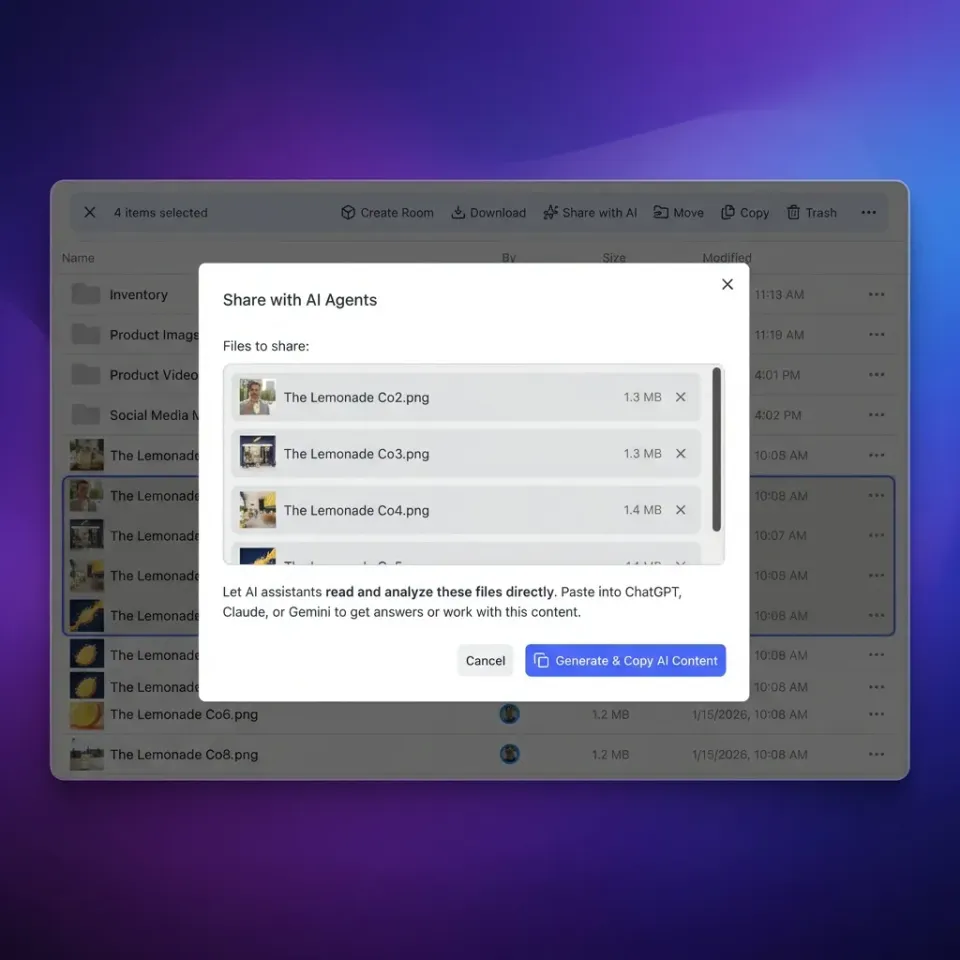
You can connect OpenClaw to any MCP server — there are community servers for databases, code execution, browser automation, and more. Fast.io's hosted MCP server at mcp.fast.io is one option, focused on file storage and collaboration. It exposes 19 consolidated tools covering workspaces, file operations, sharing, AI chat, webhooks, URL imports, and file locks.
The Fast.io ClawHub skill (dbalve/fast-io) installs and registers those tools with a single command — no config files, no environment variables. It's a good fit if you want cloud storage with built-in RAG and don't want to host anything yourself.
What Fast.io's MCP server provides
- Hosted server: No self-hosting. Connect via
https://mcp.fast.io/sse. - One-command install:
clawhub install dbalve/fast-ioregisters all 19 tools. - Free agent plan: 50GB storage, 5,000 credits/month, no credit card needed.
- Built-in RAG: Enable intelligence mode and documents get indexed automatically.
- Ownership transfer: Agents can create workspaces and hand them off to human users.
- Multi-LLM support: Works with Claude, GPT-4, Gemini, LLaMA, and local models.
- File locks: Prevent conflicts when multiple agents write to the same files.
- URL imports: Pull files from Google Drive, OneDrive, and Dropbox without local downloads.
Prerequisites
Before setting up OpenClaw with any MCP server, you need a working OpenClaw instance.
Runtime:
- Node.js 24 recommended. Node 22 LTS (22.16+) still supported.
- Install OpenClaw:
npm install -g openclaw@latest - Then run
openclaw onboard --install-daemonto configure your LLM and messaging channels.
LLM backend:
- An API key for your preferred provider: Anthropic, OpenAI, Google, or a local model via Ollama.
- OpenClaw prompts for this during onboarding.
For Fast.io specifically:
- No account needed upfront. The first tool call triggers browser-based OAuth and creates a free agent account automatically.
- The free tier includes 50GB storage and 5,000 credits/month.

Step-by-step setup with Fast.io
This covers connecting OpenClaw to Fast.io's MCP server using the ClawHub skill. If you want to connect a different MCP server, the pattern is similar — install the relevant skill or configure the server URL directly in OpenClaw's config.
Step 1: Install OpenClaw
npm install -g openclaw@latest
openclaw onboard --install-daemon
Follow the prompts to set your LLM provider and optional messaging channels. See openclaw.ai for details.
Step 2: Install the Fast.io skill
npx clawhub@latest install dbalve/fast-io
or, if you have clawhub installed globally:
clawhub install dbalve/fast-io
This registers 19 MCP tools for file management, sharing, and AI queries. No additional config required.
Step 3: Authenticate Send your OpenClaw instance a message: "Use Fast.io storage" or "Set up Fast.io." A browser tab opens for OAuth. Sign up for a free agent account or log in to an existing one. The session token persists across restarts.
Step 4: Verify Test with a few natural language commands:
- "List my workspaces"
- "Create a workspace called 'mcp-demo'"
- "Upload a note 'test.md' with content 'MCP setup successful'"
Check app.fast.io to confirm the workspace and file appeared. If something fails, see the troubleshooting section below.


Connect OpenClaw to Fast.io MCP
One command installs 19 MCP tools for file management, sharing, and AI queries. Free 50GB agent plan, no credit card needed.
Testing the integration
Run through these checks to confirm the setup works end to end.
Basic file operations:
"Create workspace 'test-mcp'. Upload note 'hello.md' with content 'OpenClaw MCP test.' List contents."You should get a workspace ID, a node ID for the file, and a confirmation. Browse to app.fast.io to see it.
RAG query:
"Enable intelligence on 'test-mcp'. Query: summarize workspace contents."With intelligence mode on, uploaded files get indexed. The response should cite 'hello.md'.
Share creation:
"Create a send share in 'test-mcp' for the root folder. Set password 'test123', return the public link."You'll get a share ID and a branded link you can open in a browser.
URL import:
"Import https://www.w3.org/WAI/ER/tests/xhtml/testfiles/resources/pdf/dummy.pdf to 'test-mcp'."Should return an import job ID and a node ID once complete.
File lock:
"Acquire lock on 'hello.md'. List locks. Release it."You should see a lock token appear and then clear.
Node IDs look like f3jm5-zqzfx-.... Check openclaw logs if anything returns an error.

Workflow examples
Here are some things you can do once the integration is running.
Attachment archiving:
"Save recent WhatsApp attachments to 'WhatsApp Archive'. Create subfolders /images, /docs, /audio and sort by type."
OpenClaw creates the workspace, uploads files, organizes into folders. The result is browsable at app.fast.io.
Document Q&A: Upload contracts or research PDFs to a workspace and enable intelligence mode.
"Enable intelligence on 'contracts'. Find all indemnity clauses across contracts, cite sources."
The built-in RAG pipeline indexes files and returns citations with page references.
Client data room:
"In 'Q4-reports', create a send share for root. Brand with client logo, password-protect, expire in 30 days."
Produces a share link with file previews. Audit logs track views.
Multi-agent coordination:
"Invite agent@example.com to 'team-project' as member. Acquire lock on 'shared-doc.md' before editing."
File locks prevent agents from writing to the same file simultaneously.
Ownership handoff:
"Create transfer token for my org. Generate claim link."
A human claims the workspace via the link and can upgrade the plan. The agent keeps admin access.
Ownership transfer
If an agent builds out a workspace for a client, the agent can transfer ownership without losing access:
- Create agent account, org, and workspace via MCP tools.
- Configure files, shares, and intelligence mode.
- Call the
orgtool with actiontransfer-token-createto get a 72-hour token. - Share the claim URL:
https://go.fast.io/claim?token={token}. - Human claims; agent keeps admin privileges.
This is also the workaround when the agent hits credit limits (402 errors) — transfer to a human account so they can upgrade. See agent guide.
Troubleshooting
Auth fails or token expired:
Run openclaw logout, then try "Use Fast.io" again. PKCE handles OAuth — if the browser tab gets stuck, disable any extensions blocking popups and copy the auth code manually.
Credit limits (402 error):
The free tier resets 5,000 credits every 30 days. Monitor with auth status. If you're hitting limits mid-workflow, transfer the org to a human account so they can upgrade at /pricing/.
Tool errors:
Run openclaw doctor for diagnostics. Check openclaw logs for specifics. If a skill seems outdated, run openclaw update or reinstall with npx clawhub@latest install dbalve/fast-io.
No workspaces visible:
Run org discover-external to find workspaces you've been invited to. Check auth status to confirm scopes.
RAG not working:
Confirm intelligence mode is enabled (workspace update intelligence=true). Files need to reach ai_state: ready — check with storage details. Large files take a minute to index.
Upload fails: Max file size is 1GB. Storage costs 100 credits/GB. Use chunked uploads for files approaching the limit.
Still stuck: Check the Fast.io MCP docs or the OpenClaw community.
Frequently Asked Questions
How do I set up MCP in OpenClaw?
Install a MCP skill from ClawHub with `clawhub install [skill-name]`. For Fast.io specifically, use `clawhub install dbalve/fast-io`. The first tool call triggers browser auth.
What are the prerequisites for OpenClaw MCP?
Node.js 24 (or Node 22.16+ LTS), OpenClaw installed, and an LLM API key. No Fast.io account needed upfront for the Fast.io skill.
How many tools does Fast.io's MCP server have?
19 consolidated tools: auth, user, org, workspace, share, storage, upload, download, ai, comment, event, member, invitation, asset, task, worklog, approval, todo, and apps. Each tool supports multiple actions.
Is Fast.io free for OpenClaw agents?
Yes. The free agent tier includes 50GB storage and 5,000 credits/month with no credit card required.
How do I handle credit limits?
Credits reset every 30 days. If an agent hits limits mid-workflow, transfer org ownership to a human account so they can upgrade, or wait for the reset.
Can OpenClaw share files externally?
Yes. The `share` tool supports send, receive, and exchange share types with optional passwords, branding, and expiry dates.
Related Resources

Connect OpenClaw to Fast.io MCP
One command installs 19 MCP tools for file management, sharing, and AI queries. Free 50GB agent plan, no credit card needed.