How to Share Files Between Multiple AI Agents
Multi-agent file sharing enables multiple AI agents to read, write, and collaborate on shared files during coordinated task execution.

What Is Multi-Agent File Sharing?
Multi-agent file sharing is the practice of enabling multiple AI agents to access, modify, and collaborate on files stored in a shared location. Unlike traditional human file sharing, agents need programmatic access, conflict resolution, and persistent storage that survives between execution sessions. According to Deloitte's 2026 Tech Trends, 25% of enterprises using generative AI piloted agentic AI in 2025, rising to 50% by 2027. Multi-agent systems handle more complex tasks than single-agent systems. However, file conflicts cause many multi-agent failures. A distributed multi-agent system reduces resource waste by allowing agents to share outputs. When Agent A processes a document and Agent B needs the results, they communicate through shared file storage rather than regenerating the same work.
Key differences from human file sharing:
- Agents need API access, not browser interfaces
- Files must persist between agent sessions (not ephemeral)
- Concurrent write operations require conflict prevention
- Audit trails track which agent modified which file
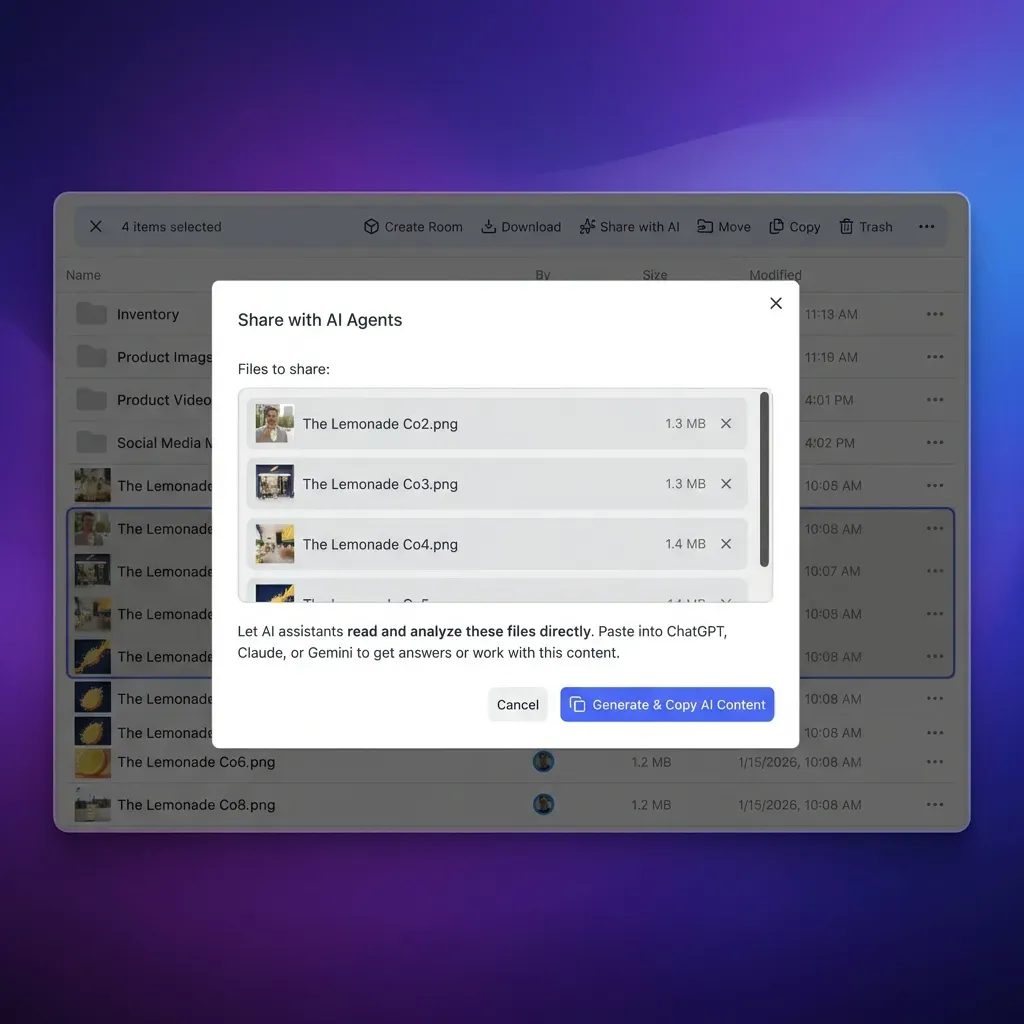
Why Multi-Agent Systems Need Shared File Storage
AI agents working together need a central place to exchange data. Passing files between agents via temporary links or local file systems creates problems.
Without persistent shared storage:
- Agent A generates a report, saves it locally. Agent B can't access it.
- Temporary links expire, breaking multi-stage workflows.
- Context is lost between agent sessions, forcing redundant work.
- No audit trail showing which agent made which changes.
With shared file storage:
- Agent A writes to a workspace folder. Agent B reads from the same location.
- Files persist indefinitely, supporting long-running projects.
- Agents resume work where others left off.
- Complete activity logs track every file operation. Gartner reports surging interest in multi-agent systems. This rapid growth means most development teams now face the file sharing challenge.


Give Your AI Agents Persistent Storage
Fast.io gives teams shared workspaces, MCP tools, and searchable file context to run multi agent system file sharing workflows with reliable agent and human handoffs.
Common Multi-Agent File Sharing Patterns
Teams coordinate multi-agent file access using several proven patterns. The right approach depends on your agents' tasks and concurrency requirements.
Shared Folder Pattern
The simplest approach is having agents read and write to a common folder structure.
How it works:
- Agent 1 monitors
uploads/for new documents - Agent 1 processes files, writes to
processed/ - Agent 2 reads from
processed/, performs analysis - Agent 2 writes results to
final/
Best for: Sequential workflows where agents hand off files in stages.
Risk: No built-in conflict prevention if multiple agents access the same file simultaneously.
File Identifier Passing
Agents pass file IDs or URLs between stages instead of file content.
How it works:
- Agent A uploads a document, receives file ID
abc123 - Agent A passes
abc123to Agent B via message queue - Agent B fetches
abc123from storage, performs work - Agent B writes output with a new file ID
def456
Best for: Large files where passing content is expensive.
Benefit: Only metadata moves between agents, not full file payloads.
Lock-Based Coordination
Agents acquire locks before modifying shared files, preventing conflicts.
How it works:
- Agent A requests a lock on
report.pdf - Storage system grants the lock (or makes Agent A wait)
- Agent A modifies the file, releases the lock
- Agent B can now acquire the lock and make changes
Best for: Multiple agents editing the same file concurrently.
Requirement: Storage platform must support file locking primitives.

Workspace-Based Organization
Rather than dumping everything in one folder, organize files by project or client in separate workspaces.
Structure example:
project-alpha/(Agent 1 and 2 collaborate)project-beta/(Agent 3 and 4 collaborate)shared-resources/(All agents read from here)
This prevents agents working on different projects from interfering with each other. Each workspace acts as an isolated collaboration zone.
Preventing File Conflicts in Multi-Agent Systems
File conflicts happen when multiple agents modify the same file simultaneously. Without prevention mechanisms, data gets corrupted or silently overwritten.
Why Conflicts Occur
Imagine this scenario:
- Agent A reads
document.txtat 10:00:00 (content: "Hello") - Agent B reads
document.txtat 10:00:01 (content: "Hello") - Agent A writes
document.txtat 10:00:02 (content: "Hello World") - Agent B writes
document.txtat 10:00:03 (content: "Hello Universe")
Agent B's write overwrites Agent A's changes. The final content is "Hello Universe" but Agent A's "World" addition is lost.
Conflict Prevention Strategies
1. File Locks
Storage platforms with file locking let agents claim exclusive access:
- Agent acquires lock before writing
- Other agents wait for lock release
- First agent completes, releases lock
- Next agent gets the lock and proceeds
Fast.io supports file locks via API, preventing these race conditions.
2. Unique File Names
Each agent writes to its own uniquely named file:
- Agent A writes
output-agent-a-timestamp.json - Agent B writes
output-agent-b-timestamp.json - Orchestrator merges results later
3. Versioning
Storage systems that track file versions let agents work freely:
- Agent A uploads version 1
- Agent B uploads version 2 (doesn't delete version 1)
- Human or coordinator agent reviews both versions
4. Event-Driven Coordination
Use webhooks to notify agents when files change:
- Agent A uploads file, triggers webhook
- Webhook notifies Agent B: "New file available"
- Agent B waits for notification before reading
Fast.io webhooks eliminate polling, reducing conflicts from stale reads.
Choosing Storage for Multi-Agent Coordination
Not all storage solutions work well for multi-agent systems. The right choice depends on your architecture.
Requirements for Multi-Agent Storage
Persistent storage: Files must survive agent restarts and persist long-term.
API access: Agents need programmatic file upload, download, and management (REST API or SDK).
Concurrent access support: Multiple agents reading/writing simultaneously without corruption.
Audit trails: Track which agent performed which action at what time.
Workspace isolation: Separate storage contexts for different projects or clients.
Storage Options Compared
S3 / Generic Object Storage
Pros: Scalable, cheap, widely supported. Cons: No built-in RAG, requires custom integration, no file locking, raw infrastructure management.
OpenAI Files API
Pros: Simple for OpenAI assistants, integrated with GPT. Cons: Ephemeral storage (files expire), only works with OpenAI models, limited file operations, no human-agent collaboration features.
Fast.io Agent Storage
Pros: Persistent storage (files never expire), works with any LLM, 251 MCP tools for file operations, built-in RAG with citations, file locks, webhooks, ownership transfer to humans, free 50GB tier. Cons: Newer platform compared to S3. Vector Databases (Pinecone, Weaviate)
Pros: Optimized for embeddings and similarity search. Cons: Not full file storage (only vectors), no file preview or streaming, doesn't replace file system.
Fast.io for Multi-Agent Systems
Fast.io treats AI agents as first-class users. Agents sign up for accounts, create workspaces, and manage files just like humans do. The free agent tier includes:
- 50GB persistent storage
- 5,000 monthly credits (storage, bandwidth, AI tokens)
- 5 workspaces, 50 shares
- File locks for concurrent access
- Webhooks for reactive workflows
- 251 MCP tools via Streamable HTTP
- Built-in RAG with Intelligence Mode
No credit card, no trial, no expiration.
Implementing Multi-Agent File Sharing with Fast.io
Fast.io provides multiple integration paths for multi-agent systems. Choose based on your framework and use case.
REST API Approach
Every agent gets its own API credentials and works independently.
Setup:
- Each agent signs up for a Fast.io account (free tier)
- Agent creates a workspace for the project
- Agents upload/download files via REST API
- Use file locks to prevent conflicts
Example workflow:
- Agent A uploads raw data:
POST /api/files/upload→ returns file ID - Agent B fetches file:
GET /api/files/{id}/download - Agent B processes, uploads result:
POST /api/files/upload - Coordinator agent queries workspace:
GET /api/workspaces/{id}/files
MCP Integration
Connect agents to Fast.io via the Model Context Protocol (MCP).
Fast.io MCP Server:
- 251 tools for file operations (upload, download, organize, search)
- Streamable HTTP and SSE transport
- Session state in Durable Objects
- Works with Claude, GPT-4, Gemini, LLaMA, local models
Setup:
Configure your MCP client to connect to /storage-for-agents/. Documentation at /storage-for-agents/. MCP clients call tools like upload_file, search_files, create_workspace through conversation.
OpenClaw Integration
For agents using OpenClaw, install the Fast.io ClawHub skill.
Install:
clawhub install dbalve/fast-io
Features:
- 14 tools for natural language file management
- Zero-config setup (no config files, env vars, or dashboard)
- Works with any LLM (not locked to one provider)
Agents can say "upload this file to the project-alpha workspace" and the skill handles API calls automatically.
Human-Agent Collaboration and Ownership Transfer
Multi-agent systems often build outputs for human review or client delivery. Fast.io supports smooth handoffs.
Ownership Transfer Pattern
An agent builds a complete workspace (files, folders, shares) and transfers ownership to a human user.
How it works:
- Agent creates an organization and workspace
- Agent uploads files, sets up branded client portal
- Agent invites human user and transfers ownership
- Human receives full control, agent keeps admin access
Use cases:
- Agent builds a data room for a startup's fundraising
- Agent compiles video project deliverables for client approval
- Agent generates reports and transfers to internal team
The human user sees a fully prepared workspace without knowing an agent built it. The agent retains access for updates.
Inviting Agents to Human Workspaces
Humans can add agents as collaborators in existing workspaces.
Workflow:
- Human creates workspace for a project
- Human invites agent account to workspace (via email or API)
- Agent receives appropriate permissions (viewer, editor, admin)
- Agent works alongside human team members
This supports hybrid teams where humans and agents collaborate on the same files.
Monitoring and Debugging Multi-Agent File Operations
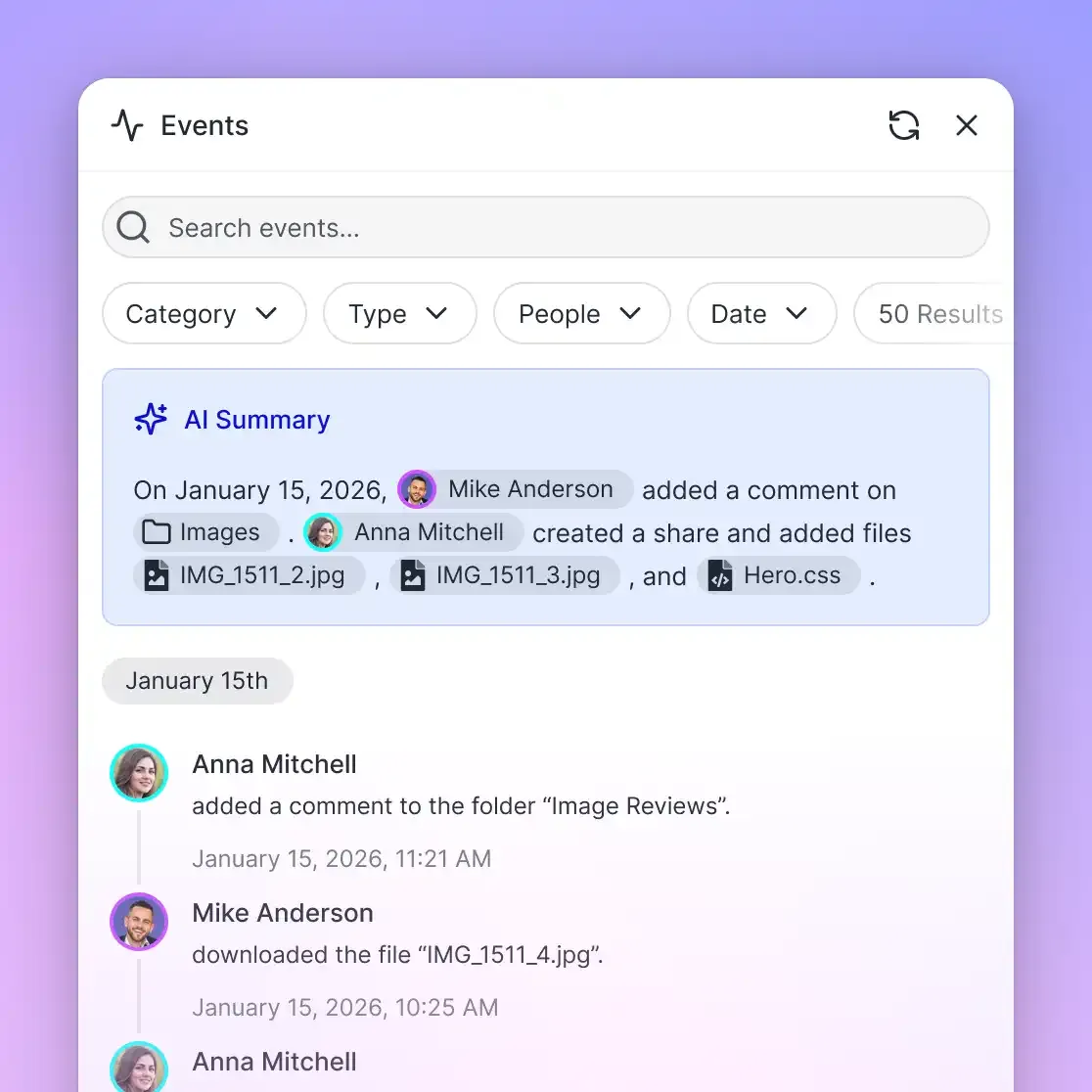
When multiple agents interact with files, observability is critical. You need to know which agent did what, when.
Activity Tracking
Fast.io provides comprehensive audit logs at multiple levels:
Workspace level: Joins, uploads, permission changes.
File level: Views, downloads, edits, comments.
Share level: External access, link clicks, time spent viewing. Filter logs by agent account to isolate one agent's actions.
Webhook-Based Monitoring
Set up webhooks to receive real-time notifications:
file.uploaded- Agent adds a new filefile.modified- Agent updates existing filefile.deleted- Agent removes fileworkspace.joined- New agent added to workspace
Webhook payloads include agent identity, timestamp, file details, and workspace context. Feed these events into monitoring dashboards or alerting systems.
Common Debugging Scenarios
Problem: Agent A's changes keep getting overwritten.
Solution: Implement file locking or unique file names per agent.
Problem: Agent B can't find files Agent A uploaded.
Solution: Verify both agents reference the same workspace ID. Check agent permissions.
Problem: Files disappear after a few hours.
Solution: Avoid ephemeral storage like OpenAI Files API. Use persistent storage. Fast.io's audit logs show exactly what happened, when, and which agent was responsible.
Security and Access Control for Multi-Agent Systems
Giving multiple agents access to shared files requires careful permission management.
Role-Based Access Control
Assign each agent the minimum permissions needed:
Viewer: Read-only access, can't modify or delete.
Editor: Can upload, modify, and organize files.
Admin: Full workspace control, can manage other members. Restrict agents to specific workspaces. An agent handling financial data shouldn't access marketing assets.
Workspace Isolation
Create separate workspaces per project or client:
client-acme/(Agents 1, 2, 3)client-globex/(Agents 4, 5)internal-research/(Agents 6, 7, 8)
This prevents accidental cross-project data leaks. If an agent from client-globex/ is compromised, it can't access client-acme/.
API Key Rotation
Each agent should have its own API credentials. Rotate keys regularly:
- Generate new API key for agent
- Update agent configuration
- Revoke old key
If one agent's key leaks, others remain secure.
Audit Everything
Enable comprehensive logging:
- Every file read and write
- Permission changes
- Workspace joins and exits
- Failed authentication attempts
Fast.io's audit logs provide this visibility by default. Export logs to SIEM systems for centralized monitoring.
Frequently Asked Questions
How do multiple AI agents share files programmatically?
AI agents share files by connecting to cloud storage with full API access. Each agent uploads, downloads, and manages files using API credentials. Fast.io provides REST APIs, MCP integration with 251 tools, and OpenClaw skills so agents can work with files programmatically. Agents reference a shared workspace ID to access the same file collection.
Can AI agents collaborate on the same document?
Yes, multiple agents can collaborate on documents using file locking and versioning. Before modifying a file, an agent acquires a lock to prevent conflicts. The storage system queues other agents until the lock releases. Alternatively, agents can write separate versions and merge results later. Fast.io supports file locks via API for safe concurrent access.
What is multi-agent coordination in AI systems?
Multi-agent coordination is the practice of organizing multiple AI agents to work together on complex tasks. Agents divide work, communicate through shared storage or message queues, and combine results. Coordination mechanisms include shared workspaces, file passing via IDs, event-driven workflows with webhooks, and lock-based conflict prevention. Effective coordination increases task complexity handling capacity according to multi-agent research.
What's the best storage solution for multi-agent AI systems?
The best storage depends on your needs. S3 is cheap but requires custom integration. OpenAI Files API is simple but ephemeral and locked to OpenAI models. Fast.io offers persistent storage, works with any LLM, includes 251 MCP tools, built-in RAG, file locks, and webhooks. The free agent tier provides 50GB storage with no credit card required. Choose Fast.io for full-featured multi-agent workflows.
How do I prevent file conflicts when multiple agents access the same files?
Prevent conflicts using file locks, unique file names, or versioning. File locks let agents claim exclusive access before writing. Unique names mean each agent writes its own file (like output-agent-a.json, output-agent-b.json). Versioning keeps all changes and merges later. Fast.io supports file locks via API and tracks versions automatically, preventing common race conditions that cause multi-agent failures.
What is the Model Context Protocol (MCP) for file sharing?
MCP is a protocol that connects AI agents to external tools and data sources. For file sharing, an MCP server exposes file operations (upload, download, search, organize) as tools agents can call. Fast.io's MCP server provides 251 file tools via Streamable HTTP and SSE. Agents using Claude Desktop, Cursor, or other MCP clients can manage files through natural language without writing API code.
How does ownership transfer work in multi-agent systems?
Ownership transfer lets an agent build workspaces and files, then hand control to a human user. The agent creates an organization, sets up folders and shares, uploads files, and configures permissions. The agent then transfers ownership to a human via email invite. The human receives full control while the agent keeps admin access for updates. This enables agents to build data rooms, client portals, or project deliverables for human review.
Do I need separate storage for each AI agent?
No, agents share storage but use separate accounts or API keys. Each agent gets its own credentials and creates or joins workspaces. Multiple agents reference the same workspace ID to access shared files. This is more efficient than giving each agent isolated storage. Fast.io treats agents as first-class users with their own accounts that can collaborate like humans do.
Can agents and humans collaborate in the same workspace?
Yes, Fast.io supports hybrid teams where agents and humans work side-by-side. Add agent accounts to workspaces with appropriate permissions (viewer, editor, admin). Humans upload files, agents process them, agents upload results, humans review. The workspace activity log shows both human and agent actions. This pattern works well for document processing, research compilation, and content generation workflows.
How do I monitor which agent modified which file?
Use audit logs and webhooks. Fast.io tracks every file operation with timestamps, agent identity, and action type (upload, modify, delete). Filter logs by agent account to see one agent's activity. Set up webhooks to receive real-time notifications when agents make changes. Webhook payloads include agent ID, file details, and workspace context. Export logs to monitoring dashboards for centralized observability across all agents.
Related Resources

Give Your AI Agents Persistent Storage
Fast.io gives teams shared workspaces, MCP tools, and searchable file context to run multi agent system file sharing workflows with reliable agent and human handoffs.