How to Set Up MCP Server Storage for AI Agents
MCP server storage is a file storage backend that works alongside the Model Context Protocol, giving AI assistants like Claude the ability to read, write, and organize files through its tool interface. This guide covers why agents need persistent storage, how to evaluate different MCP storage backends, and how to connect a cloud-native file system to your agent in minutes.

What Is MCP Server Storage?
MCP server storage refers to file storage backends that works alongside the Model Context Protocol, letting AI assistants like Claude read, write, and manage files through its tool interface. Think of it as giving your agent a hard drive it can access programmatically. The Model Context Protocol, released by Anthropic in November 2024 and donated to the Linux Foundation, defines a standard way for AI models to interact with external tools and data sources. Storage is one of the most common MCP use cases because file operations are among the most requested capabilities for autonomous agents. Here is what MCP server storage does:
- File CRUD operations: Create, read, update, and delete files and folders
- Persistent memory: Save work products that survive between agent sessions
- Document retrieval: Search and query files by content or metadata
- Permission management: Control who can access specific files
- Multi-agent coordination: Share files between agents working on the same project
"MCP servers" is a popular search term, with storage-related queries making up a large portion of that interest. Developers are actively looking for ways to give their agents persistent file access.

Why Agents Need Persistent Storage
Most AI interactions are stateless. You ask a question, get an answer, and the context disappears when the session ends. This works fine for one-off questions, but it breaks down for multi-step workflows. AI agents need persistent storage for most real-world autonomous tasks. Without it, an agent cannot:
- Save a research report today and reference it tomorrow
- Build a project folder structure over multiple sessions
- Hand off completed deliverables to human collaborators
- Maintain logs of past actions for debugging or audit trails
The gap between "chatbot" and "agent" is largely about state management. A chatbot answers questions. An agent does work, and that work needs to live somewhere. MCP server storage fills this gap by providing a standardized interface for file operations that any MCP-compatible model can use. Consider a practical example: you ask an agent to research competitor pricing, compile the data into a spreadsheet, and prepare a summary memo. Without persistent storage, the agent would need to complete this entire workflow in a single session. With MCP storage, it can save intermediate results, pick up where it left off, and deliver final files to a shared workspace when finished.
Comparing MCP Storage Backend Options
Not all storage backends are equal for agent workloads. Here is a breakdown of the three main approaches, with the trade-offs you should know about.
Local File System Servers
The official MCP filesystem server gives agents direct access to your local drive. It is simple to set up and costs nothing.
- Best for: Local development, quick prototyping, personal automation
- Limitations: Requires your machine to be running. No remote access. Security risks if the agent touches system files outside the sandboxed directory. Files are not backed up automatically.
Raw Cloud Storage (S3, GCS, R2)
You can connect agents to generic object storage through custom MCP servers. This gives you scalable, remote-accessible storage.
- Best for: Teams with existing cloud infrastructure and DevOps expertise
- Limitations: Requires building and maintaining custom MCP server code. No built-in search, preview, or collaboration features. You manage permissions, backups, and access control yourself.
Purpose-Built Agent Storage Platforms
These are cloud storage services designed specifically for AI agents, with pre-built MCP servers and features like built-in RAG, file locking, and ownership transfer.
- Best for: Production agents, multi-agent systems, human-agent collaboration
- Limitations: Adds a third-party dependency. May have usage limits on free tiers. For most developers, the choice comes down to where you are in the development cycle. Local file systems work during prototyping. Cloud-native platforms make sense once your agent needs to operate independently or collaborate with humans.
Setting Up Fast.io as Your MCP Storage Backend
Fast.io provides a cloud-native MCP server with 251 tools built specifically for AI agent file operations. The free agent tier includes 50GB of storage, 5,000 monthly credits, and no credit card requirement. Here is how to get connected:
1. Create an agent account
Agents sign up for their own accounts just like human users. The agent tier gives you 5 workspaces, 50 shares, and support for files up to 1GB each.
2. Connect via Streamable HTTP or SSE
The Fast.io MCP server at mcp.fast.io supports both Streamable HTTP and SSE transport protocols. Add it to your MCP client configuration and authenticate with your API key.
3. Start using file tools
Once connected, your agent gets access to tools for uploading, downloading, organizing, searching, and sharing files. You can also enable Intelligence Mode on any workspace to activate automatic RAG indexing. The key difference from raw S3 or local file access is that Fast.io treats agents as first-class users. An agent can create organizations, manage workspaces, set permissions, and even transfer ownership to humans when the work is done.
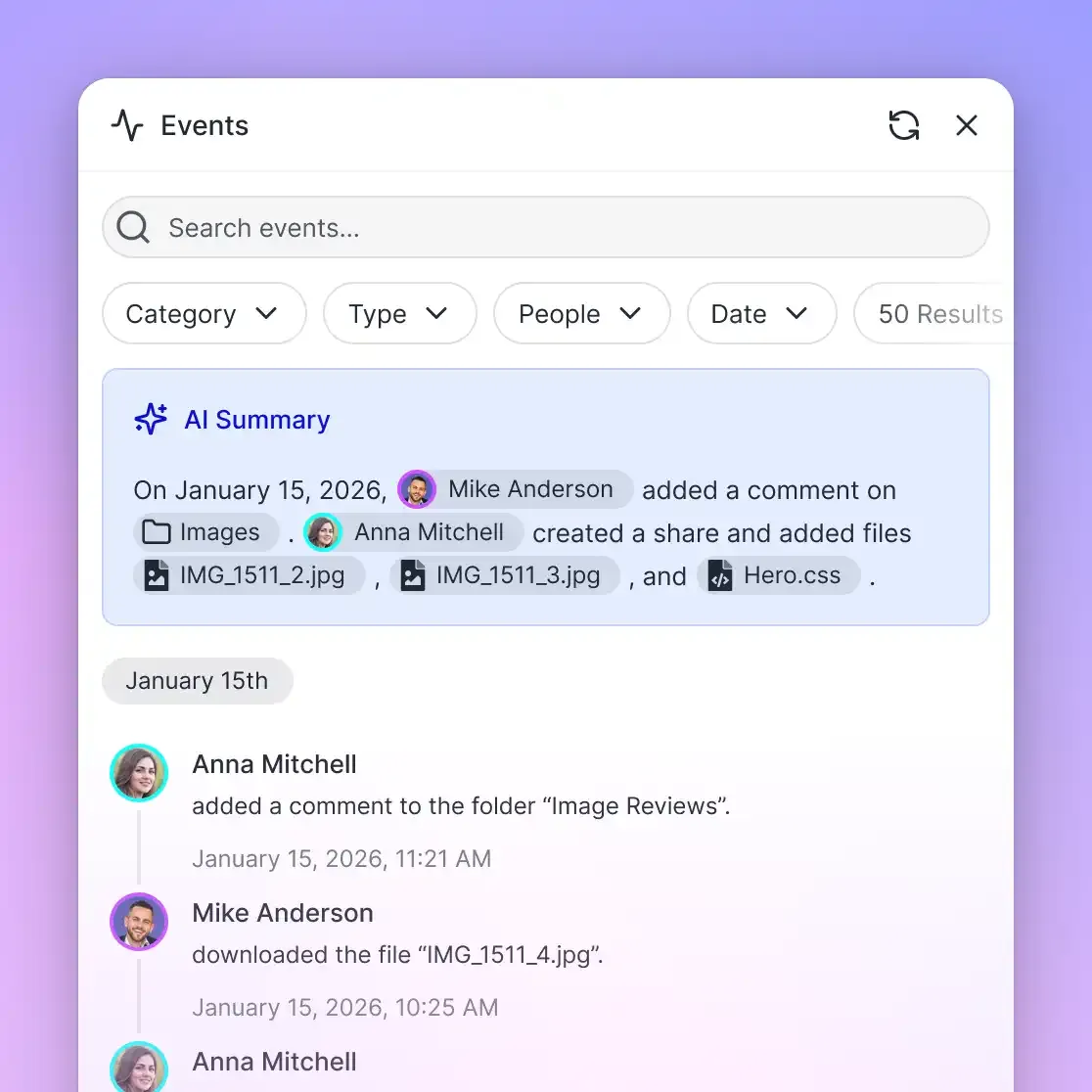


Give Your AI Agents Persistent Storage
Fast.io gives teams shared workspaces, MCP tools, and searchable file context to run mcp server storage workflows with reliable agent and human handoffs.
What 251 MCP Tools Get You
Tool count matters less than tool coverage. Here is what Fast.io's 251 MCP tools cover and why it matters for agent workflows.
Core File Operations
Upload, download, copy, move, rename, and delete files and folders. Chunked uploads handle files up to 1GB. Version history lets agents roll back changes.
Workspace and Organization Management
Create workspaces, invite collaborators, set permissions at the organization, workspace, folder, or file level. Agents can build entire project structures programmatically.
Sharing and Collaboration
Create branded Send, Receive, and Exchange shares with password protection, expiration dates, and access controls. Agents can set up client delivery portals without human intervention.
AI and Search
Toggle Intelligence
Mode to auto-index files for retrieval-augmented generation. Ask questions across an entire workspace and get answers with source citations. No separate vector database needed.
Comments and Annotations
Add threaded comments anchored to specific image regions, video timestamps, or PDF pages. This is useful for agents that perform document review or quality checks.
File Locks for Multi-Agent Systems
Acquire and release locks on individual files to prevent conflicts when multiple agents work concurrently. This is critical for multi-agent orchestration patterns where several agents might try to update the same document. The full tool reference is available at the MCP server documentation.
When to Use Local vs Cloud MCP Storage
Picking the right backend depends on your use case. Here is a decision framework.
Use local file system MCP if:
- You are building a personal automation that runs only on your machine
- You need to process files that cannot leave your local environment
- You are prototyping and want zero setup overhead
Use cloud MCP storage if:
- Your agent needs to run autonomously without your computer being on
- Multiple agents or humans need access to the same files
- You need persistent storage that survives session restarts
- You want built-in features like search, RAG, or collaboration tools
- You are building a production service that handles client deliverables
Many developers start with local storage during development and switch to cloud storage when deploying to production. The MCP protocol makes this transition straightforward since the tool interfaces stay the same regardless of the backend. For teams running multi-agent file sharing workflows, cloud storage is required. Local file systems create bottlenecks when agents run on different machines or need to operate on independent schedules.
Frequently Asked Questions
What is an MCP server?
An MCP server is a software component that implements the Model Context Protocol, an open standard for connecting AI models to external tools and data sources. For storage, an MCP server translates model requests into actual file operations like reading, writing, and listing directories. Anthropic created MCP in 2024, and it was donated to the Linux Foundation in late 2025.
How do I give Claude access to files?
Install an MCP server that exposes a file system. For local files, use the official filesystem MCP server from the modelcontextprotocol GitHub repository. For cloud storage, connect a platform like Fast.io through its MCP endpoint at mcp.fast.io. Claude Desktop, Cursor, VS Code, and other MCP clients all support adding MCP servers through their settings.
What storage backends work with MCP?
MCP works with any storage backend that has an MCP server implementation. Common options include local file systems, AWS S3, Google Cloud Storage, and purpose-built platforms like Fast.io. The protocol is backend-agnostic, so you can switch storage providers without changing your agent code.
How do AI agents access files?
AI agents access files through tool-calling interfaces. With MCP, the agent sends a structured request like 'read this file' or 'upload this document,' and the MCP server executes the operation on the actual storage backend. This keeps the agent sandboxed while still giving it real file system capabilities.
Is the Fast.io MCP server free?
Yes. The agent tier includes 50GB of storage, 5,000 monthly credits, and access to all 251 MCP tools. It does not require a credit card and has no expiration date. Credits cover storage, bandwidth, AI tokens, and document ingestion, resetting every 30 days.
Related Resources

Give Your AI Agents Persistent Storage
Fast.io gives teams shared workspaces, MCP tools, and searchable file context to run mcp server storage workflows with reliable agent and human handoffs.