How to Choose: Fast.io API vs Dropbox API for Agent Storage
When evaluating the Fast.io API vs Dropbox API for agent storage, developers face a distinct choice between an agent-native architecture and legacy file syncing. While the Dropbox API is designed for human file syncing, the Fast.io API is purpose-built for AI agents, offering native MCP integration and semantic search. This comparison explores the technical differences, integration overhead, and pricing models to help you select the best storage backend for your autonomous workflows.
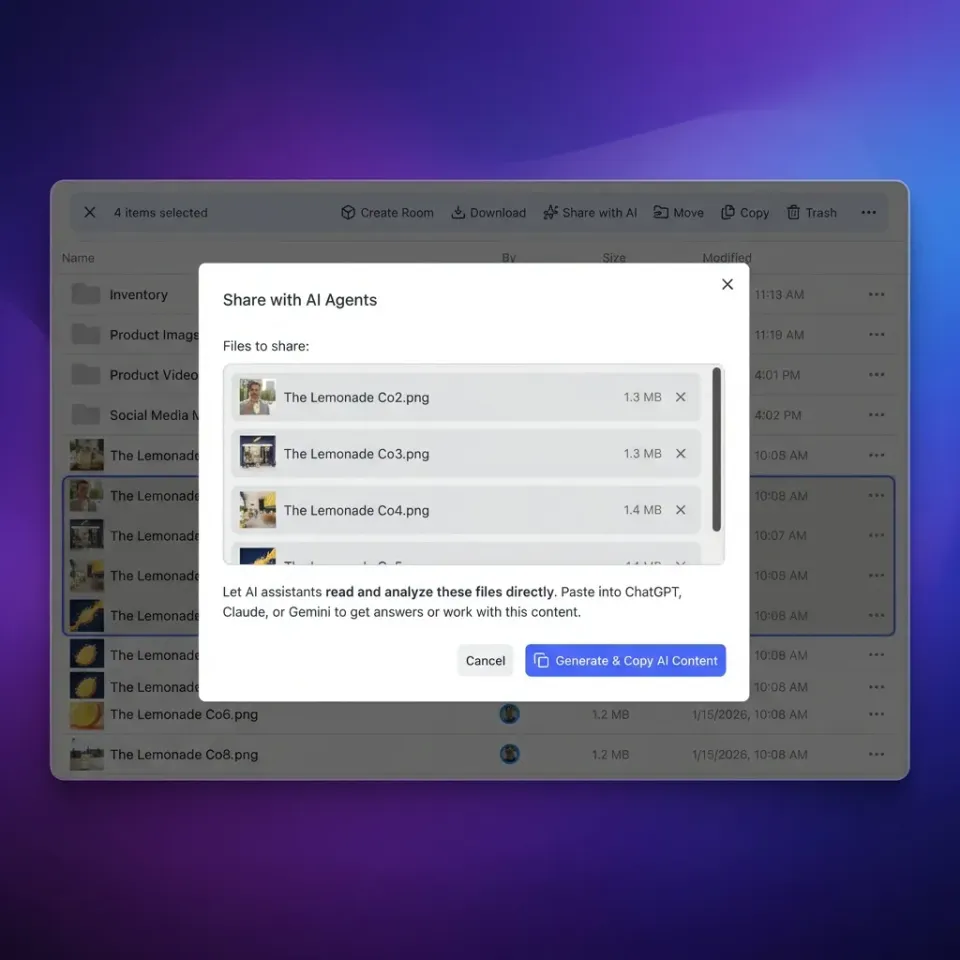
The Architectural Shift to Agentic File Storage
File sharing is the practice of distributing digital files between users over a network, typically using cloud storage or direct transfer services. However, when we shift our focus from human users to autonomous AI agents, the requirements change drastically.
General API comparisons ignore the specific needs of LLM-based applications, such as function calling compatibility and token optimization. Modern AI agents require persistent file access, direct semantic querying capabilities, and seamless integration with the Model Context Protocol (MCP). Without these features, developers are forced to build complex translation layers that map standard REST endpoints to LLM function calls. Choosing the correct storage infrastructure at the beginning of a project prevents massive technical debt and ensures that your agents can scale their workflows efficiently.
What is the Fast.io API?
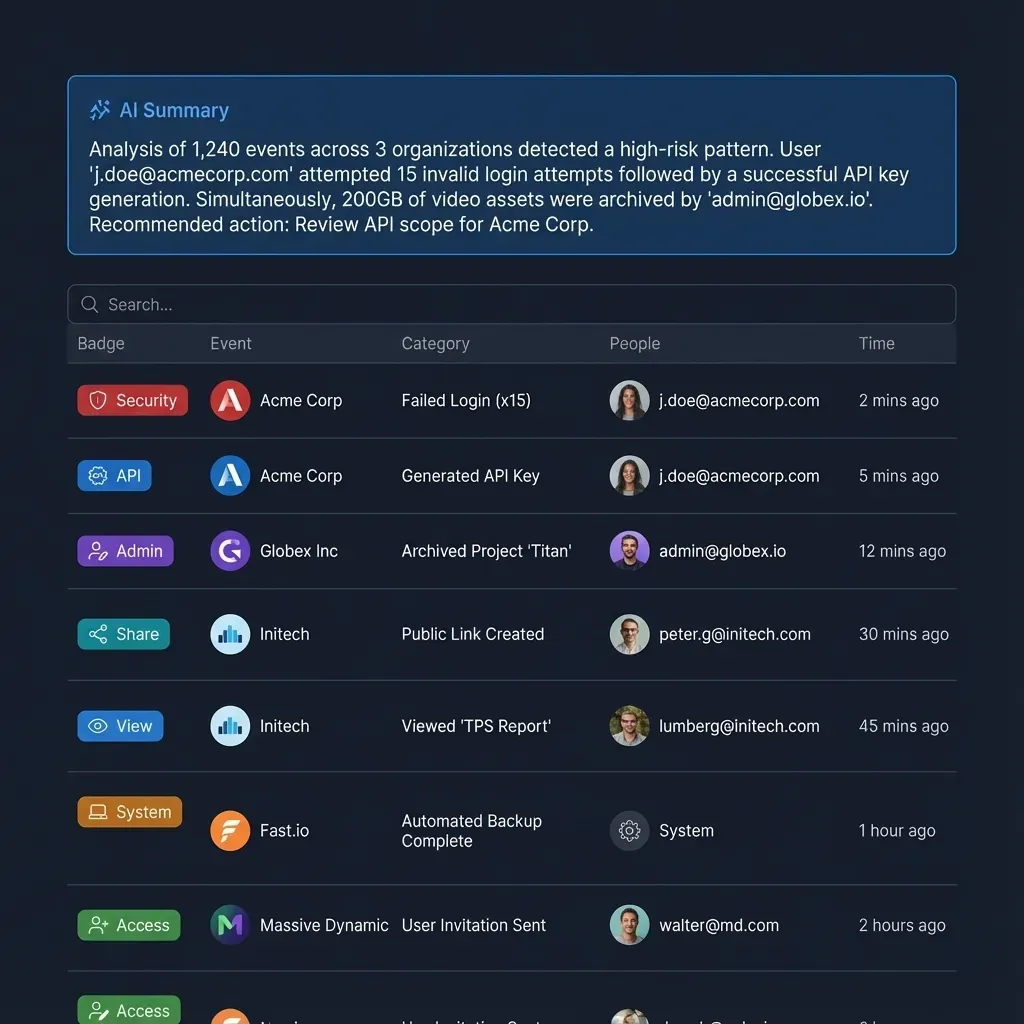
The Fast.io API is an intelligent workspace platform designed explicitly for AI agents and their human counterparts. It treats storage not as a static repository, but as an active, queryable coordination layer where autonomous systems can manage files, execute workflows, and collaborate with users.
According to Fast.io MCP Documentation, Fast.io provides 251 distinct MCP tools out of the box for direct workspace interaction. This means that instead of writing custom endpoints, your LLM can immediately read, write, and manage workspace files natively. Fast.io goes beyond simple binary storage by offering built-in Retrieval-Augmented Generation (RAG). When you toggle Intelligence Mode on a workspace, files are auto-indexed, allowing agents to ask questions and receive answers with precise citations without configuring a separate vector database.
What is the Dropbox API?
The Dropbox API is a reliable, general-purpose cloud storage solution primarily built for human users and traditional software integrations. It offers comprehensive endpoints for file management, including uploading, downloading, synchronization, and sharing.
According to the Dropbox Developer Platform, the API uses OAuth multiple.multiple for authorization and provides deep controls for enterprise-level features like digital rights management and data migration. However, because it was designed before the rise of autonomous agents, the Dropbox API lacks native semantic understanding and direct LLM function calling capabilities. Integrating it into an AI workflow requires developers to build custom middleware that handles authentication flows, manages token limits, and extracts text from binary files before feeding it into the model.
Integration Overhead: MCP Support vs Custom Middleware
The most significant difference between the Fast.io API and the Dropbox API for agent storage is the developer experience regarding integration.
Fast.io's Native MCP Integration
Fast.io offers native MCP server integration out of the box. Agents can connect to the workspace via Streamable HTTP and Server-Sent Events (SSE). By simply installing the ClawHub skill (clawhub install dbalve/fast-io), agents gain immediate natural language file management capabilities. The integration requires zero configuration, allowing models like Claude, GPT-multiple, and Gemini to start manipulating files instantly.
Dropbox's Custom Middleware Requirement Legacy APIs like Dropbox require custom middleware to function with LLM tool calling. Developers must write intermediate services that translate the LLM's intent into specific API requests. This involves managing access tokens, handling rate limits, and building retry logic for large file uploads. For developers, this translates to weeks of infrastructure work before the agent can perform its first meaningful file operation.

Data Retrieval: Built-in Semantic Search vs Keyword Matching
For an AI agent, finding the right information quickly is just as critical as storing it securely. The two APIs take fundamentally different approaches to search and retrieval.
Fast.io's Intelligence Mode Fast.io includes Intelligence Mode, a built-in RAG system. When a file is uploaded, Fast.io automatically indexes its contents. Agents can query the workspace using semantic search, asking questions like "What were the key takeaways from the Q3 meeting?" The system returns synthesized answers complete with citations pointing to specific paragraphs in the source documents. This eliminates the need to manage external vector databases or chunking algorithms.
Dropbox's Keyword Search Dropbox provides a standard keyword search endpoint. While highly effective for human users looking for specific filenames or exact phrase matches within text documents, it falls short for agentic workflows. To achieve semantic search with Dropbox, developers must download the files, extract the text, chunk the content, generate embeddings using an external model, and store those embeddings in a dedicated vector database like Pinecone or Weaviate. This creates a brittle, multi-hop pipeline that is difficult to maintain.
Managing Concurrency and Agent Coordination
In multi-agent systems, it is common for multiple autonomous agents to attempt to read or modify the same file simultaneously. Proper concurrency management is essential to prevent data corruption.
Fast.io solves this problem with built-in file locks. Agents can explicitly acquire and release locks before modifying a document, ensuring that their changes do not overwrite the work of another agent. This mechanism is essential for collaborative workflows where agents are working together to generate code, write reports, or process large datasets.
Conversely, the Dropbox API relies on file versioning and conflict resolution strategies designed for asynchronous human collaboration. While Dropbox will preserve both versions of a conflicting file by appending "conflicted copy" to the filename, this behavior breaks automated workflows. Agents lack the context to resolve these conflicts manually, leading to stalled processes and duplicated data.
Pricing Models for Autonomous Systems
Pricing structures designed for human users often break down when applied to autonomous agents, which generate orders of magnitude more API calls.
According to Fast.io Documentation, the free agent tier includes 50GB of persistent storage, 5,000 monthly credits, and a 1GB maximum file size, all with no credit card required. This tier is specifically structured to support the high-frequency micro-transactions typical of agent workflows. Agents can continuously read, index, and query files without immediately hitting paywalls or unexpected overage charges.
Dropbox offers free tiers primarily targeted at individual consumers. For extensive programmatic access, developers must move to paid enterprise plans. Because Dropbox's pricing assumes human usage patterns, the rapid, continuous polling and uploading performed by an agent can quickly trigger rate limits or incur significant costs. Developers must carefully optimize their API calls to avoid unmanageable expenses.


Ready to build smarter agent workflows?
Stop wrestling with legacy APIs and start building with the only storage platform designed for AI agents. Get 50GB of free persistent storage and full MCP integration.
Agent-to-Human Handoff and Ownership Transfer
A critical aspect of agentic workflows is the eventual handoff of the generated output to a human user. The storage platform must facilitate a smooth transition of ownership.
Fast.io supports seamless ownership transfer. An agent can create an organization, build out a complex workspace, generate reports, and then transfer administrative ownership entirely to a human client. The agent can retain specific, scoped access to continue providing updates, but the human user gains full control over the billing and administration of the workspace. This model is ideal for agencies deploying AI agents on behalf of their clients.
Dropbox manages sharing through strict hierarchical permissions and OAuth scopes. While an app can create folders and share them with users, the app itself remains tied to the developer's account. Transferring absolute ownership of an app folder or an entire file structure to an unrelated user while maintaining the agent's programmatic access requires complex, multi-step permission changes that are difficult to automate securely.
Evidence and Benchmarks: API Comparison
To summarize the differences, consider this direct comparison of features critical for AI agent integration.
- Native MCP Support: Fast.io includes full Model Context Protocol support natively. Dropbox requires external middleware integration.
- Semantic Search: Fast.io offers built-in RAG and semantic querying. Dropbox offers standard keyword search, requiring external vector databases for semantic capabilities.
- Concurrency: Fast.io provides explicit file locking for multi-agent systems. Dropbox relies on asynchronous conflicted copy generation.
- Agent Handoff: Fast.io enables direct ownership transfer from agents to humans. Dropbox relies on traditional folder sharing.
For developers building autonomous systems, prioritizing features like built-in RAG and MCP support significantly reduces time to market and infrastructure costs.
Frequently Asked Questions
Is the Dropbox API good for AI agents?
The Dropbox API is highly reliable for general file storage, but it requires significant custom development to work with AI agents. Developers must build middleware to translate standard REST API calls into LLM tool functions and integrate external vector databases to enable semantic search capabilities.
What is the best Dropbox alternative for AI storage?
Fast.io is the premier alternative to Dropbox for AI storage. It is purpose-built for agentic workflows, offering native Model Context Protocol (MCP) integration, built-in semantic search, and file locking mechanisms designed specifically for autonomous, multi-agent systems.
How do I migrate my agent's data from Dropbox to Fast.io?
You can migrate data using Fast.io's URL Import feature. This allows your agent to pull files directly from Dropbox via OAuth without requiring local I/O or downloading the files to a local server first. Once imported, Fast.io automatically indexes the content for immediate semantic search.
How does Fast.io compare to Dropbox for developers?
For developers building AI applications, Fast.io significantly reduces infrastructure overhead. While Dropbox requires you to build custom middleware for authentication and file chunking, Fast.io provides 251 native MCP tools and built-in RAG, allowing developers to focus on agent logic rather than storage plumbing.
Does Fast.io support webhooks for reactive workflows?
Yes, Fast.io supports comprehensive webhooks. Agents can subscribe to workspace events and receive instant notifications when files are added, modified, or deleted. This enables the creation of reactive workflows without the need for constant, resource-intensive polling.
Related Resources

Ready to build smarter agent workflows?
Stop wrestling with legacy APIs and start building with the only storage platform designed for AI agents. Get 50GB of free persistent storage and full MCP integration.