How to Improve Cross-Functional Team File Sharing and Workflows
Cross-functional team file sharing means sharing assets across departments while keeping control over who sees what. Research shows that 75% of cross-functional teams struggle because they lack a clear way to share info. By using agentic routing and a single source of truth, companies can break down data silos and finish projects twice as fast.

What is Cross-Functional Team File Sharing?
Sharing files across teams with specific permissions is the hallmark of a collaborative workspace. This means setting up a space where marketing, engineering, sales, and legal teams can access the assets they need safely. It's more than just storage; it's about moving data between groups that have different goals but shared projects.
When departments work together, they often use different tools. This leads to fragmented data where "final" versions are scattered. A cross-functional file sharing strategy fixes this by centralizing assets in one location. Permissions are defined by what a person does, not just which department they're in. For example, a project manager might have full access, while a freelance designer only sees the assets they need.
According to Harvard Business Review, 75% of cross-functional teams struggle because they lack a clear way to share information. Without a framework, projects stall when someone is waiting for permission or working from an old version. This friction slows everything down. A two-day delay in a Legal review can push a launch back by weeks. The best teams treat file sharing as a core part of how they work, not an afterthought.
Helpful references: Fast.io Workspaces, Fast.io Collaboration, and Fast.io AI.
The True Cost of Data Silos
Data silos do more than just slow you down. They're a major drain on company resources. According to a report by CIO, multiple% of enterprises experience critical workflow disruptions because info is locked away in departmental silos. This fragmentation means that multiple% of enterprise data goes completely unanalyzed. When data is trapped, decisions are made based on incomplete information, leading to missed opportunities and wasted budget.
When a marketing team cannot see the latest product specs or the legal team cannot review a sales contract in real-time, the entire organization slows down. These delays compound over time. On average, info workers save roughly 4 hours per week when they can search and access documents in one central location. That's multiple% of a work week saved just by organizing and sharing files better.
Evidence and Benchmarks
- Revenue Growth: Companies with strong cross-functional collaboration are multiple.multiple times more likely to outperform their peers in revenue growth.
- Search Efficiency: In organizations without standardized systems, 38% of employees report difficulty finding the information they need to do their jobs.
Bridging the Gap with Agentic Routing
Traditional file sharing tools often miss a key feature: agentic routing for cross-team files. Most platforms require people to manually move files or notify other departments when a task is finished. These manual handoffs are where errors happen and projects lose momentum. A file uploaded to the wrong folder might sit unnoticed for days, stalling the next stage of the project.
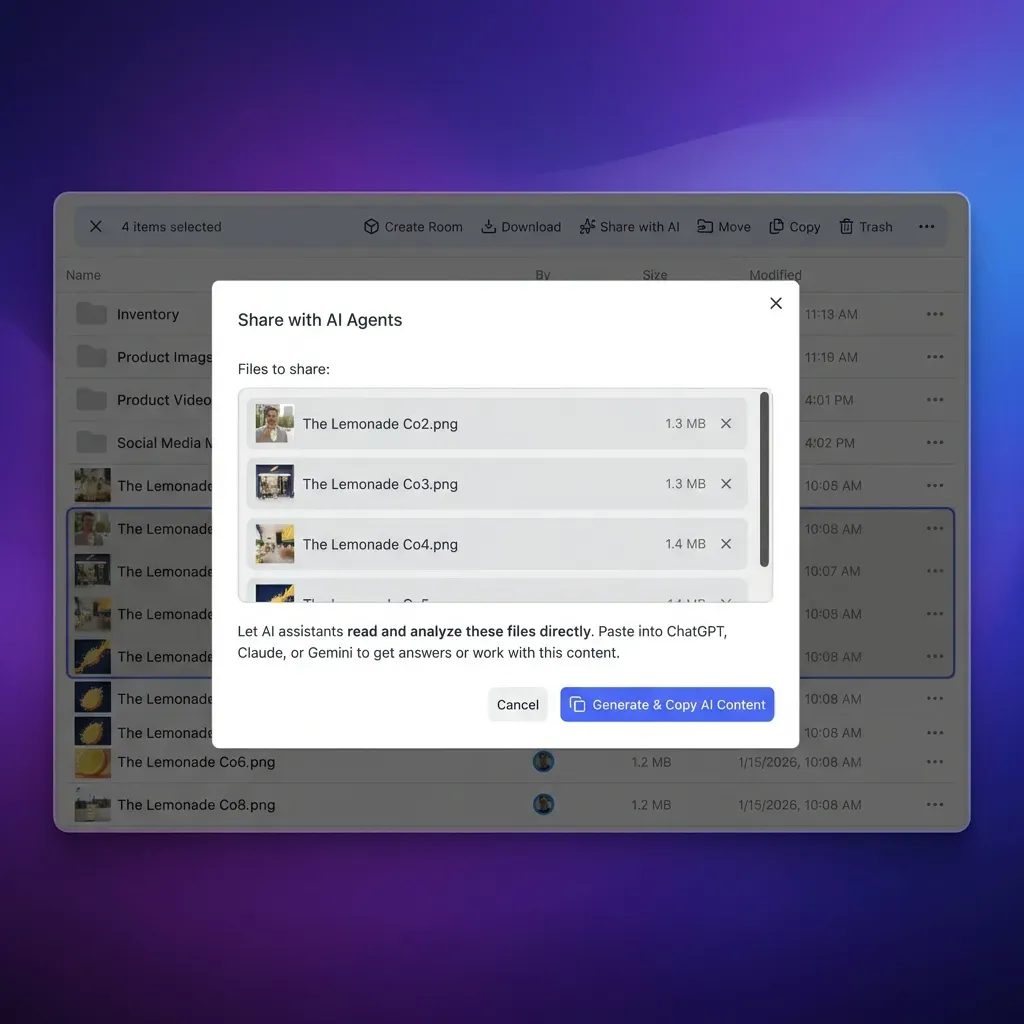
Agentic routing uses AI agents to move and index files based on what's in them. For example, when a salesperson uploads a signed contract, an AI agent can detect the document type, move a copy to the legal review workspace, and notify the finance team to issue an invoice. This ensures that the right people have access to the right files at the right time without any manual work.
Fast.io enables this through multiple MCP tools that let agents manage workspaces, set permissions, and transfer ownership. Instead of a person spending their afternoon organizing folders, an agent can maintain the structure and ensure everything stays organized. This lets people focus on creative and strategic work while the AI handles the logistics.


Collaborate on Files with Your Team
Join the thousands of teams using Fast.io to automate their cross-functional workflows. Get 50GB of free storage and 251 MCP tools today.
Industry Use Cases for Cross-Functional Sharing
Every industry benefits from better file sharing, but the needs change depending on the sector. Here is how different teams use cross-functional workflows to stay competitive.
Marketing and Creative Agencies
Agencies often juggle multiple clients and freelancers. A cross-functional workspace lets the internal creative team share draft designs with clients for feedback while keeping source files in a secure, internal-only folder. This prevents clients from seeing unfinished work or internal discussions.
Product Development and Engineering
In tech, the handoff between design and engineering is a common point of failure. In a shared workspace, designers can upload assets that engineers see right away. Agentic tools can send notifications when new assets are ready, ensuring that the development cycle never pauses for lack of info.
Legal and Finance Operations
Legal and finance teams often need access to documents from every department but must keep things confidential. A cross-functional system with clear permissions lets these teams "pull" the files they need for audits or contract reviews without needing access to every folder in the company.
Best Practices for Cross-Departmental Collaboration
Better file sharing needs more than just a shared folder. It needs rules that everyone follows. Without them, a shared workspace becomes a mess of "final_v2_FINAL" documents.
1. Standardize the Folder Hierarchy
Create a structure that makes sense to everyone. A common approach is to organize by project rather than by department. This keeps all assets for "Project Alpha" in one place, whether they are engineering diagrams or marketing briefs. Within each project, use a consistent subfolder structure like /Drafts, /Approved, and /Archive.
2. Implement Naming Conventions
Agree on a standard format for file names. For example, use YYYY-MM-DD_ProjectName_Filename_Version. This makes it easy for anyone to see what's in a file without opening it. Clear naming is especially important when AI agents are involved, as it helps them route files more accurately.
3. Use a Single Source of Truth
Stop sending email or chat attachments. They lead to version confusion almost immediately. Instead, share a single live link. This ensures that every team member is looking at the same version of the file in real-time. If someone makes an update, the link stays the same, but the content is current.
Security and Governance in Shared Workspaces
Sharing files across departments can increase security risks. If you share too much, info can leak. If you share too little, the team can't work. Balance is key. You must protect your ideas while still letting your team work fast.
A secure workspace should include audit logs that track who accessed a file and when. This transparency builds trust and keeps everyone accountable. Also, setting link expirations for external partners prevents long-term access after a project ends. For example, if you hire a consultant for a three-month project, their access can automatically expire when the project is done.
Using Multi-Factor Authentication (MFA) is the best way to protect these shared spaces. When combined with clear permissions, MFA ensures that even if a password is stolen, your files stay safe. Encryption should be a standard requirement for any platform you choose.

How to Set Up Your Cross-Functional Workflow
Setting up a smart workflow for your team is simple. Follow these steps to move from silos to a space that grows with you.
Define the Workspace Goals: Decide which teams need to work together and what they will share. Are you sharing large videos or just text files? 2.
Choose a Central Hub: Pick a platform that supports clear permissions and AI agent tools. Look for features like "Intelligence Mode" that can handle indexing for you. 3.
Map the Handoffs: Find where files move between teams. Write down these triggers, like moving a file to the "Client" folder when a design is done. 4.
Enable Intelligence Mode: Use a system that automatically indexes files so they are searchable by meaning, not just by name. This helps teams find info even if they don't know the exact file name. 5.
Automate the Routing: Set up agents to handle repetitive tasks. This takes the load off your team and keeps everything organized.
This process builds a system that works for your team, not the other way around. You'll end up with a faster and more transparent way to get things done. Over time, this system becomes a repository of your organization's knowledge in a format that's easy to use.
Frequently Asked Questions
What are the best cross-functional file sharing tools?
The best tools are those that provide a single source of truth and automation support. Fast.io is designed for cross-functional teams with 251 MCP tools and agentic routing. This lets AI agents handle the manual work that typically causes friction between departments.
How can we reduce file sharing silos?
You can reduce silos by putting all project files in one place and standardizing how you name folders. Research shows that multiple% of enterprises face disruptions from silos. You can fix this by giving teams cross-departmental access while using role-based permissions to keep things secure.
Why is granular access control important for teams?
Clear access control ensures that sensitive data is only visible to those who need it. This prevents accidental changes to important files and helps maintain security standards across functions like Legal or Engineering.
How do shared files improve project speed?
Shared files save time spent searching for info or waiting on email attachments. According to industry data, info workers save about 4 hours per week when they have centralized access. Companies with strong collaboration are twice as likely to outperform their peers in revenue growth.
What is agentic routing in file sharing?
Agentic routing uses AI agents to automatically organize and move files based on their content. This removes manual handoffs between departments, such as moving a contract from Sales to Legal, ensuring that workflows stay continuous without human intervention.
Related Resources

Collaborate on Files with Your Team
Join the thousands of teams using Fast.io to automate their cross-functional workflows. Get 50GB of free storage and 251 MCP tools today.