CrewAI Tools: Extending Agents with Custom Skills
CrewAI tools let autonomous agents do more than generate text. They can search the web, read files, run code, and call APIs. This guide covers the essential built-in tools and shows you how to build custom ones for your own workflows.


What Are CrewAI Tools?
CrewAI tools are executable functions that allow agents to perform actions like searching the web, reading files, or calling APIs. Without tools, an AI agent is just a text generator; with tools, it becomes an autonomous operator capable of completing real-world tasks. CrewAI tools follow the LangChain tool interface, so they work with the existing ecosystem of integrations. You can assign tools to specific agents (giving a researcher a search tool) or to specific tasks (giving a writing task a file-save tool). This gives you fine-grained control over what each agent can do. There are two primary ways to equip your agents:
- Built-in Tools: Pre-made integrations like
SerperDevToolorFileReadTool. - Custom Tools: Python functions you write and decorate with
@toolor subclass fromBaseTool.
Helpful references: Fastio Workspaces, Fastio Collaboration, and Fastio AI.
Related guides
- Claude Code Skills: How to Create, Install, and Use Custom SkillsClaude Code skills are SKILL.md instruction files that extend what Claude can do, automatically loaded when relevant to...
- Best OpenClaw Skills for AI Writing Assistant ToolsVoltAgent's curated registry filtered ClawHub's 13,700+ entries down to roughly 5,200 production-grade skills, with...
- Best Tools for CrewAI Agents: Top Picks for 2026CrewAI agents need good tools to be useful. The framework handles coordination, but external integrations let agents...
- LangGraph vs CrewAI: Which Multi-Agent Framework to Choose in 2026LangGraph and CrewAI are the two most-searched multi-agent frameworks heading into 2026. This comparison goes beyond...
- Connecting CrewAI Multi-Agent Teams to Box StorageA CrewAI Box connector enables autonomous multi-agent teams to query enterprise records without loading entire...
- How to Connect CrewAI to Dropbox: Multi-Agent Cloud Storage ArchitectureConnecting CrewAI to Dropbox provides autonomous multi-agent systems with direct, indexed access to cloud files,...
More on this subject: Multi-Agent Systems (62 guides)
Essential CrewAI Tools
These are popular tools in production CrewAI deployments. Think of them as the "standard library" for agent development.
1. SerperDevTool (Google Search)
Best For: Real-time web research and fact-checking. The most popular option for agent web search. It wraps the Serper.dev API to give agents access to Google Search results, including snippets, links, and related questions.
2. ScrapeWebsiteTool
Best For: Reading content from specific URLs. Once an agent finds a URL, this tool scrapes the text content. It handles basic HTML cleaning so your agent doesn't waste tokens reading <div> tags.
3. Fastio MCP (Persistent Storage)
Best For: Long-term file storage and human handoff. Most file tools only work on the local disk. Fastio gives agents a cloud filesystem where files persist between runs, outputs can be shared with humans through branded links, and workspaces keep everything organized. It connects via the Model Context Protocol (MCP).
4. FileReadTool
Best For: Reading local configuration or data files. A simple utility for reading .txt, .md, or .json files from the local machine's disk. Essential for giving agents access to local context.
5. CSVSearchTool
Best For: Analyzing structured data. Instead of reading a raw CSV end-to-end, this tool uses RAG (Retrieval Augmented Generation) so agents can search within a CSV by meaning. It's good for querying large datasets without filling up the context window.
6. CodeInterpreterTool
Best For: Math, data analysis, and Python execution. Lets agents write and run Python code in a sandboxed environment. Useful for tasks that need precise math or data transformation, where LLMs on their own tend to make mistakes.
7. PDFSearchTool
Best For: Extracting knowledge from documents. Works like the CSV tool but for PDFs. Agents can ask questions against a PDF instead of trying to read the entire binary file into context.
8. SeleniumScrapingTool
Best For: Complex, JavaScript-heavy websites. When ScrapeWebsiteTool fails because a site needs to render JavaScript or requires interaction (clicking/scrolling), Selenium steps in. It's slower but more powerful.
9. DALL-E Tool
Best For: Image generation. Connects agents to OpenAI's DALL-E 3 API so they can generate images as part of a workflow (e.g., creating blog post thumbnails).
10. EXA Tool (formerly Metaphor)
Best For: Neural, meaning-based web search. Unlike keyword search, EXA searches by meaning. It's often better at finding "the best tutorial for X" or "similar companies to Y" than standard keyword search.
How to Create Custom Tools in CrewAI
Built-in tools cover common tasks, but most production projects need custom ones. CrewAI gives you two ways to build them: the quick decorator approach and the full class-based approach.
Method 1: The @tool Decorator
Best for simple, single-function tools.
from crewai_tools import tool

@tool("Company Research Tool")
def company_research(company_name: str):
    """Useful for getting financial data about a company. Input should be the company name."""
    ### Your API logic here
    return f"Financial data for {company_name}..."
Method 2: Subclassing BaseTool
Best for complex tools requiring validation or state.
from crewai_tools import BaseTool
from pydantic import BaseModel, Field

class EmailInput(BaseModel):
    recipient: str = Field(..., description="Email address")
    subject: str = Field(..., description="Subject line")

class SendEmailTool(BaseTool):
    name: str = "Send Email"
    description: str = "Sends an email to a client."
    args_schema: type[BaseModel] = EmailInput

def _run(self, recipient: str, subject: str) -> str:
        ### Email sending logic
        return "Email sent successfully"
Key Requirement: The description matters more than you'd think. The LLM reads this text to decide when and how to call your tool, so be specific.
Persistent File Storage: The Gap in Default CrewAI
One common gap in the default CrewAI toolkit is persistent, shareable storage. The FileReadTool and FileWriteTool only work on the local machine where the script runs. If your agent runs in a cloud container (Modal, Railway, AWS Lambda), "local" files disappear when the container shuts down. And if your agent generates a report, how does it actually get that file to a human? Emailing raw text doesn't cut it.
The Fix: Cloud-Native Storage Tools A dedicated storage layer like Fastio gives your agents a permanent place for their files.
- Persistence: Files survive container restarts.
- Delivery: Agents can generate a share link to send to clients.
- Collaboration: Humans can view files in a browser without downloading anything. Fastio's MCP server exposes tools for file operations, so agents can create workspaces, upload reports, and manage permissions programmatically.
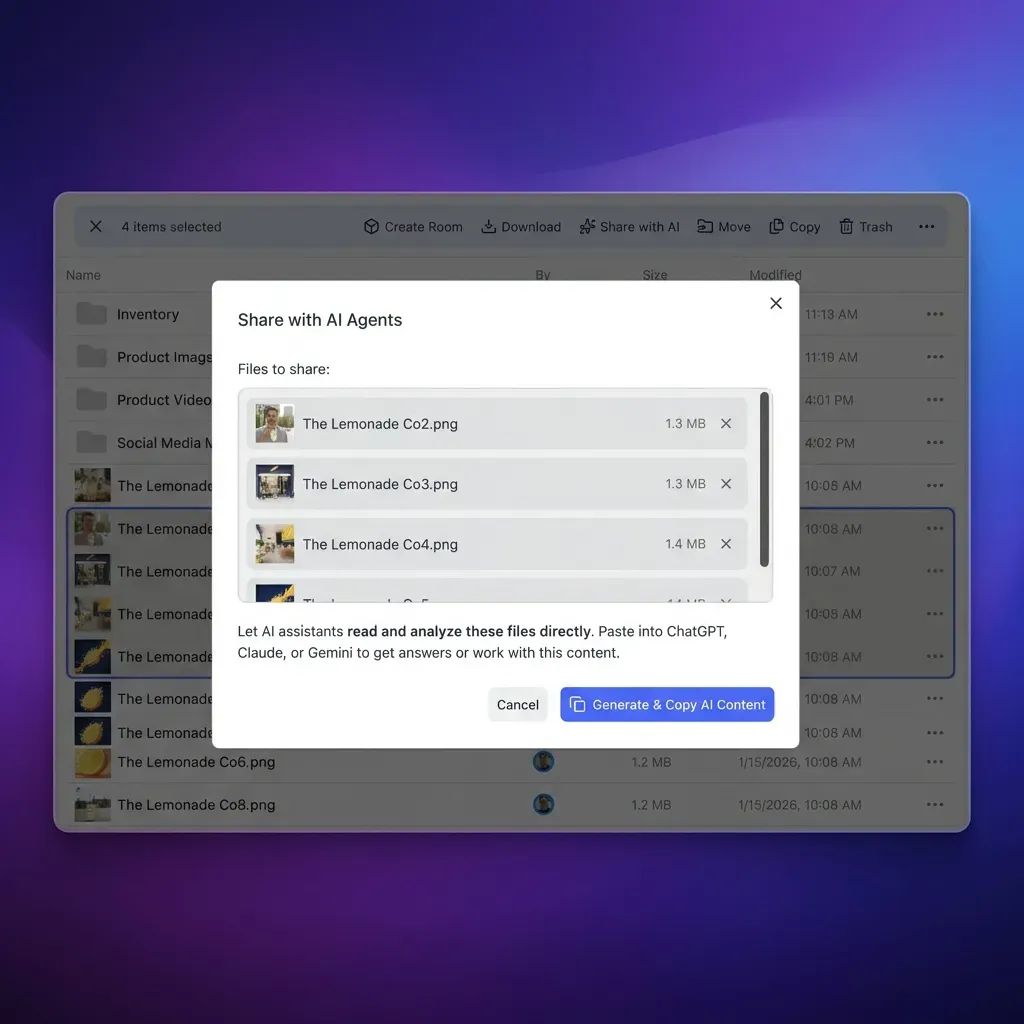


Give your CrewAI agents persistent storage for crewai tools
Stop relying on local files. Use Fastio's Business Trial to let your crews store, organize, and deliver professional assets to humans.
Best Practices for Tool Development
A few principles will save you hours of debugging when your agents call tools incorrectly.
1. Type Hint Everything
LLMs rely on type hints (e.g., query: str, limit: int) to form correct inputs. Always include them in your function signatures.
2. Write Detailed Docstrings The docstring is how the LLM decides whether to call your tool. Explain what it does, what the inputs should look like, and what the output will be. * Bad: "Searches the web."
- Good: "Useful for searching the internet for current events. Input should be a specific search query string. Returns a list of relevant URL snippets."
3. Handle Errors Gracefully If your API call fails, don't crash the agent. Catch the exception and return a descriptive error string (e.g., "Error: API timeout, please try again"). This lets the agent self-correct and retry.
4. Keep Outputs Concise Agents have context windows. If your tool returns large amounts of raw HTML, you will crash the agent or burn through your token budget. Truncate or summarize data before returning it from the tool.
Sources
References used to verify factual claims in this guide.
-
DALL-E tool connects agents to OpenAI DALL-E 3 API for image generation in workflows
Frequently Asked Questions
What tools does CrewAI support?
CrewAI supports any tool compatible with LangChain, as well as its own native tools. This includes web search (Serper), file operations, web scraping, code execution, and any custom Python function you define using the @tool decorator.
How do I create a custom tool in CrewAI?
You can create a custom tool by defining a Python function and decorating it with `@tool('Tool Name')`. For more complex logic, you can subclass `BaseTool` and define an input schema using Pydantic models.
Can CrewAI agents save files permanently?
By default, CrewAI's FileWriteTool saves files to the local disk, which may be temporary in cloud environments. To save files permanently, use a cloud storage tool like the Fastio MCP integration, which allows agents to upload files to a persistent cloud workspace.
Related Resources

Give your CrewAI agents persistent storage for crewai tools
Stop relying on local files. Use Fastio's Business Trial to let your crews store, organize, and deliver professional assets to humans.