How to Build Event-Driven AI Agent Architectures
Event-driven architecture allows AI agents to react instantly to changes instead of wasting resources on polling. This guide explores how to build reactive agent systems that scale, reducing latency by up to 90% while handling complex file and data workflows.
What Is Event-Driven Architecture for AI Agents?
Event-driven architecture (EDA) for AI agents is a design pattern where autonomous agents react to events (file uploads, messages, or state changes) rather than polling for work. In this model, an "event producer" broadcasts a signal that something has happened, and interested "event consumers" (the agents) react to it immediately.
This approach fundamentally changes how agents interact with their environment. Instead of an agent asking "Is there new work?" every few seconds, it sleeps until the system wakes it up with a specific task. This shift is essential for building scalable systems where multiple agents might need to process the same data in different ways, such as one agent summarizing a document while another extracts financial data from it. For a broader look at how agents handle files, see our guide on AI agent file storage. If you're specifically interested in how agents receive webhook notifications, our webhook integration guide covers the setup in detail.
Why Choose Events Over Polling?
The primary reason to adopt an event-driven model is efficiency. In a traditional polling architecture, agents waste valid compute cycles checking for updates that often haven't happened. As the number of agents and data sources grows, this polling traffic can overwhelm your infrastructure.
According to Confluent, event-driven architectures can reduce system latency by 70-90% compared to polling-based systems. By removing the wait time between an event occurring and the next poll interval, agents can respond in near real-time. This is particularly valuable for workflows like fraud detection or immediate customer support, where every millisecond counts.
Polling vs. Event-Driven Comparison | Feature | Polling Architecture | Event-Driven Architecture |
| :--- | :--- | :--- | | Trigger Mechanism | Scheduled checks (e.g., every 5s) | Instant push notification | | Latency | High (average = 1/2 poll interval) | Low (near real-time) | | Resource Usage | Wastes CPU on empty checks | Uses CPU only when work exists | | Scalability | Linear cost increase | Decoupled and highly scalable | | Complexity | Low (easy to implement) | Moderate (requires event bus) |
The Impact on Agent Costs
For agents running on usage-based LLMs, polling is expensive. An agent that wakes up to check a folder, sees nothing, and goes back to sleep still consumes tokens and compute time. Event-driven agents remain dormant and incur zero cost until a relevant event triggers them.
Core Components of an Event-Driven Agent System
Building an event-driven system requires three main components that work together to route information from source to agent.
1. Event Producers These are the sources of your data. A producer could be a file system, a user interface, or an external API. For example, when a user uploads a file to a Fast.io workspace, the storage engine acts as the producer, generating a "file.created" event.
2. The Event Bus This is the central nervous system. It receives events from producers and routes them to the correct consumers. In complex setups, you might use Kafka or RabbitMQ. For simpler agent workflows, webhooks often serve this purpose directly, delivering the event payload to an HTTP endpoint where the agent lives.
3. Event Consumers ( The Agents) The agents sit at the end of the line. They subscribe to specific topics or event types. An "Analyzer Agent" might subscribe to PDF uploads, while a "Transcriber Agent" listens only for MP3 files. This filtering ensures agents only process data relevant to their specific skills.
Key Patterns for Reactive Agents
There are several ways to structure the communication between your events and agents. Choosing the right pattern depends on the volume of events and the complexity of the processing required.
Webhooks are the simplest pattern. The source system sends an HTTP POST request to your agent's URL whenever an event occurs. This works well for straightforward workflows, such as triggering a classification agent whenever a new document lands in a shared folder.
Event Streaming involves a continuous log of events that agents can read from. This is useful for high-throughput systems or when you need to replay history. Agents can "rewind" the stream to process past events, which is helpful for training or debugging.
The Choreography Pattern allows agents to react to each other. Agent A finishes a task and emits a "task.completed" event, which Agent B listens for. This creates a decentralized workflow where complex behaviors emerge from simple interactions, without a central controller telling everyone what to do.


Give Your AI Agents Persistent Storage
Stop polling and start reacting. Use Fast.io's webhooks and MCP server to build event-driven agent workflows with 50GB of free storage.
Implementing Event-Driven Workflows with Fast.io
Fast.io provides the infrastructure to make your file storage event-driven. Instead of building your own file watchers, you can configure webhooks to notify your agents instantly when files change.
Setting Up File Events You can register a webhook endpoint for your workspace. Fast.io will send a JSON payload whenever a file is uploaded, updated, or deleted. This payload includes the file's path, metadata, and type. Your agent receives this, parses the JSON, and decides if it needs to act.
Using the MCP Server For agents using the Model Context Protocol (MCP), Fast.io's MCP server supports Server-Sent Events (SSE). This allows a local agent (like one running in Claude Desktop or Cursor) to maintain an open connection and receive updates in real-time, effectively bringing event-driven capabilities to your local development environment.
Example: The Auto-Ingest Workflow
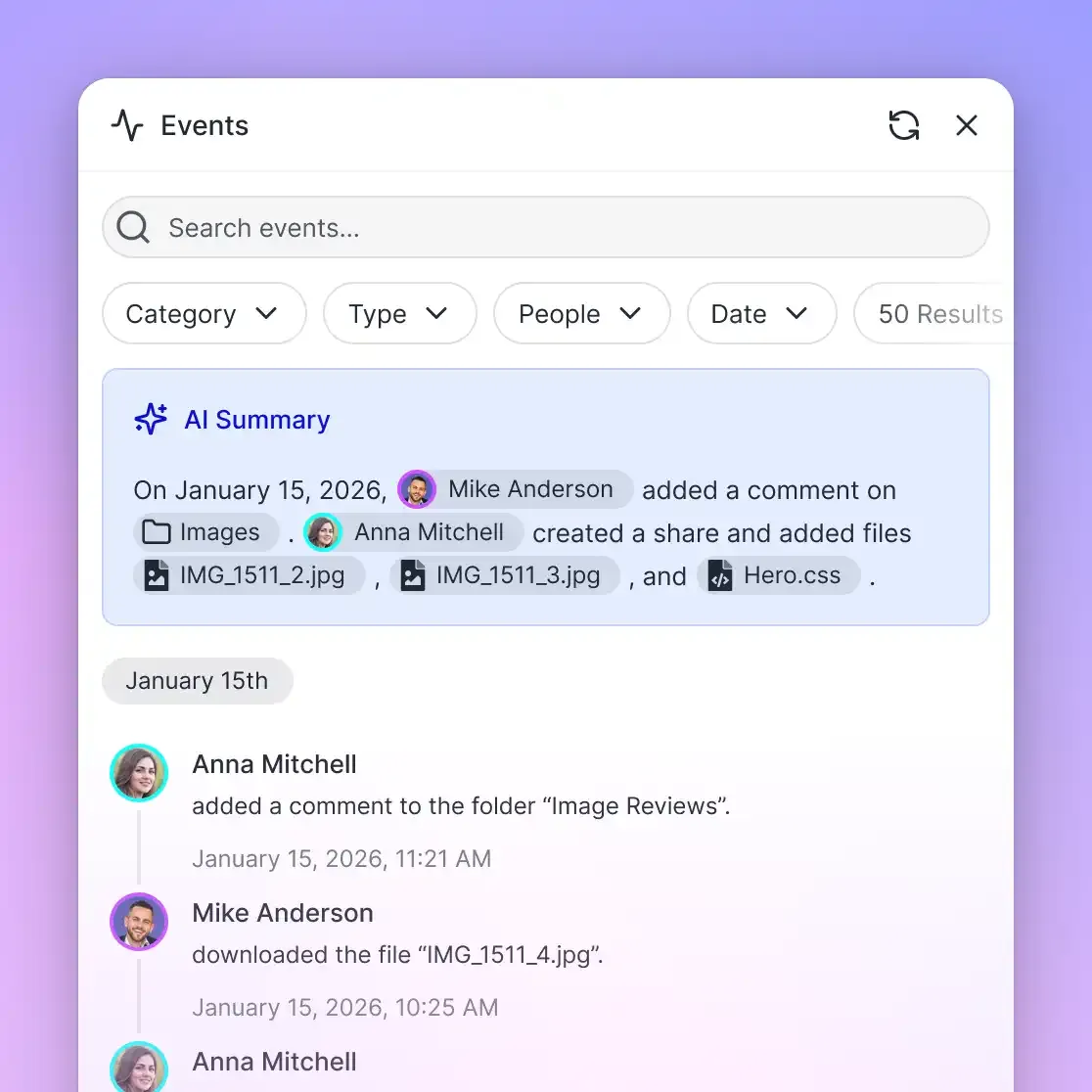
Imagine a legal firm where thousands of contracts are uploaded weekly. In an event-driven setup, a "Router Agent" listens for file.created events. When a PDF arrives, the agent immediately checks the file name. If it matches a contract pattern, it triggers an "Extraction Agent" to pull key dates and values. If it's an invoice, it triggers a "Billing Agent" instead. This happens instantly, without any human intervention or scheduled batches.
Frequently Asked Questions
What is the difference between polling and event-driven architecture?
Polling involves an agent repeatedly checking a source for new data (e.g., 'Is there a file yet?'), which wastes resources. Event-driven architecture pushes a notification to the agent only when an event actually occurs, which is more efficient and faster.
How do webhooks work for AI agents?
A webhook is a way for a system to send data to an AI agent automatically. When an event happens (like a file upload), the system sends an HTTP POST request with details to the agent's URL, triggering the agent to start its work immediately.
Can I use event-driven architecture with local LLMs?
Yes. You can use tools like ngrok to expose your local agent's port to the internet to receive webhooks, or use protocols like Server-Sent Events (SSE) via MCP to stream events directly to your local model without opening public ports.
What happens if an agent is offline when an event occurs?
In a well-designed event-driven system, the event bus (like Kafka) stores the message until the agent comes back online. For simpler webhook-based systems, you may need to implement a retry mechanism to ensure events aren't lost.
Is event-driven architecture harder to debug?
It can be. Because components are decoupled and run asynchronously, tracing the path of a request is more complex than in a linear script. Using centralized logging and assigning a correlation ID to each event chain helps track activity across different agents.
Related Resources

Give Your AI Agents Persistent Storage
Stop polling and start reacting. Use Fast.io's webhooks and MCP server to build event-driven agent workflows with 50GB of free storage.