How to Automate Document Processing with AI Agents
AI agent document processing uses autonomous agents to extract, analyze, and transform information from documents without manual intervention. Unlike traditional OCR, these agents can reason about content, handle unstructured data, and execute complex workflows. This guide shows you how to build agent pipelines that process documents quickly and accurately.

What is AI Agent Document Processing?
AI agent document processing uses autonomous software agents to ingest, read, understand, and act on document data. Traditional Intelligent Document Processing (IDP) relies on rigid templates and OCR. AI agents use Large Language Models (LLMs) to understand context, which means they can handle unstructured documents like emails, contracts, and creative briefs.
Core capabilities include:
- Contextual Extraction: Understanding that a date is a "due date" based on surrounding text, not just its format.
- Multi-Step Reasoning: Deciding to flag a contract for review only if specific clauses are missing.
- Autonomous Action: Moving files to specific folders, updating databases, or emailing stakeholders based on document content. Agent-based systems can reduce processing time compared to manual workflows.
Helpful references: Fast.io Workspaces, Fast.io Collaboration, and Fast.io AI.
Why Traditional OCR Isn't Enough
Optical Character Recognition (OCR) converts images to text, but it doesn't understand meaning. You get a text file, but you still need a human (or a complex script) to find the "Invoice Total."
AI agents bridge this gap by combining OCR with semantic understanding.
For teams dealing with variable layouts, like invoices from different vendors, agents keep working even when a logo moves three pixels to the left.
How the Agentic Processing Pipeline Works
Building a document processing pipeline needs more than just an LLM. You need a system that can handle file storage, retrieval, and state management.
The 5-Step Pipeline:
- Ingestion: Agents monitor a "Watch Folder" or receive files via API/Webhooks.
- Classification: The agent reads the file header or content to determine if it's an invoice, contract, or resume.
- Extraction: Using tools like the Model Context Protocol (MCP), the agent extracts specific fields into a structured format.
- Validation: The extracted data is checked against business rules (e.g., "Total must equal sum of line items").
- Action: The file is moved to a "Processed" folder, and data is pushed to an ERP or CRM.



Give Your AI Agents Persistent Storage
Stop struggling with ephemeral storage. Get 50GB of persistent, cloud-native storage for your AI agents, completely free.
Tools for Building Document Agents
To build these agents, developers need three main components: an LLM (the brain), a framework (the body), and storage (the memory).
The Brain (LLM)
- Claude 3.5 Sonnet: Excellent for visual document understanding and complex reasoning.
- GPT-4o: Strong performance on structured data extraction and JSON formatting.
- Gemini 1.5 Pro: Massive context window (2M tokens) allows processing hundreds of documents in a single pass.
The Framework
- LangChain/LangGraph: Popular for orchestrating complex, multi-step agent flows.
- OpenClaw: Great for autonomous agents that need to interact with files and tools naturally.
The Storage (Fast.io)
Agents need a place to read and write files that isn't just ephemeral RAM. Fast.io provides a cloud-native filesystem built for agents.
- MCP Server: Connects your agent to storage with 251 pre-built tools for file manipulation.
- Persistent Storage: Agents get 50GB free to store processed documents and archives.
- Webhooks: Trigger your agent immediately when a new file arrives.
Step-by-Step: Setting Up a Processing Agent
Here's a practical workflow for setting up a document processing agent using Fast.io and an MCP-compatible client (like Claude Desktop or a custom LangChain script).
Step One: Create an Agent Account Sign up for a free Fast.io agent account. You get 50GB of storage and API access without a credit card.
Step Two: Connect via MCP
Configure your agent to use the Fast.io MCP server. This gives it tools like read_file, write_file, list_directory, and search.
Step Three: Define the Prompt Give your agent a system prompt:
"You are a document processing agent. Monitor the 'Inbox' folder. When a file appears, read it, classify it, extract the [Date, Vendor, Amount], save the metadata as a JSON file in the 'Data' folder, and move the original file to 'Archive'."
Step Four: Enable Intelligence Mode Turn on Intelligence Mode for your workspace. This automatically indexes files for semantic search, so your agent can query documents using natural language.
Best Practices for Accuracy
Even the best AI models can hallucinate. Implement these guardrails for high accuracy.
Human-in-the-Loop (HITL) Design your workflow so that low-confidence extractions are flagged for human review. Fast.io's "Ownership Transfer" feature lets an agent create a review workspace and hand it off to a human manager when needed.
Schema Validation Force your agent to output data in a strict JSON schema (using Pydantic or Zod). If the output doesn't match the schema, the agent should automatically retry or flag an error.
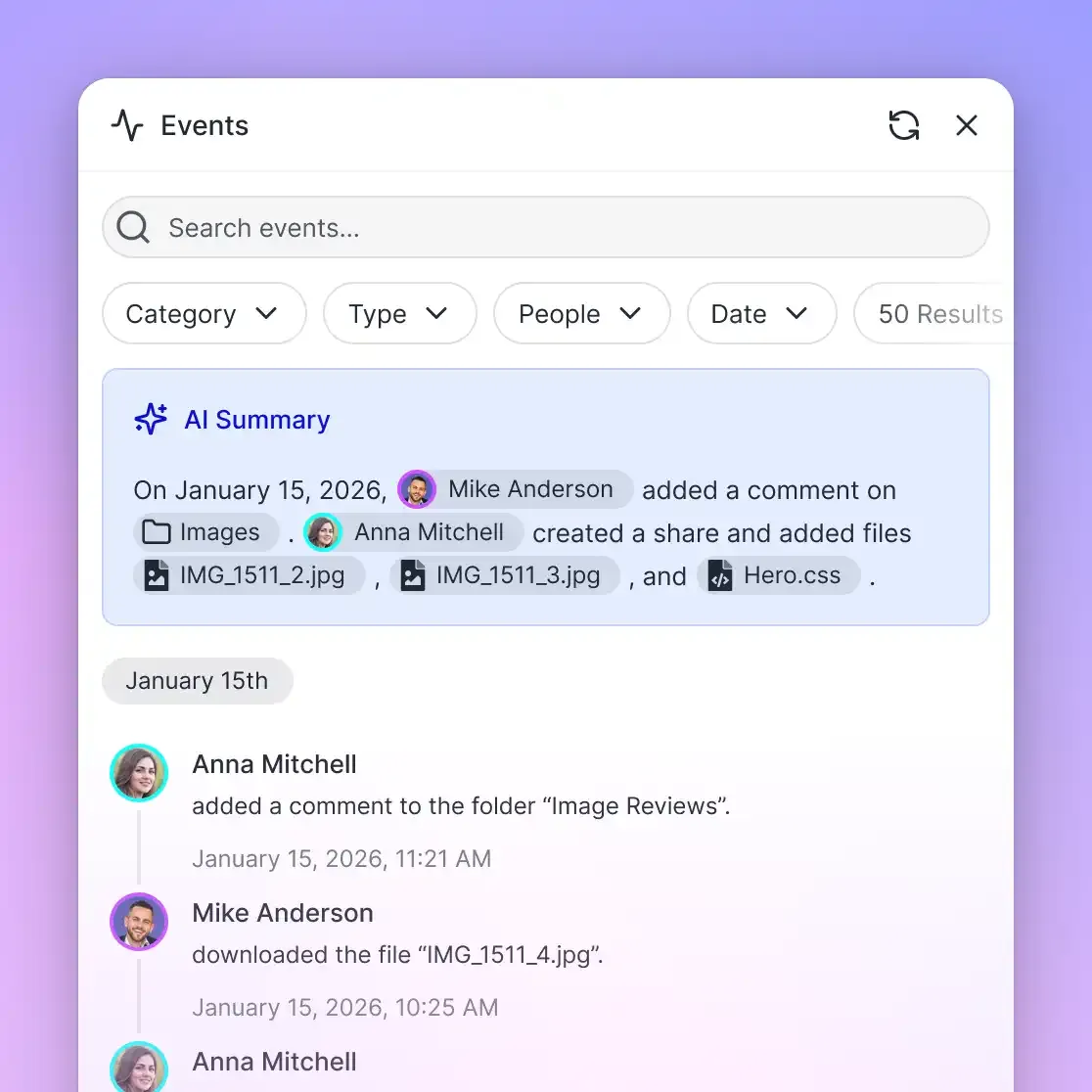
Audit Trails Keep a log of every action. Fast.io automatically maintains a detailed audit log of every file read, write, and move operation. This is critical for compliance in legal and financial use cases.
Frequently Asked Questions
Can AI agents read PDFs?
Yes, AI agents can read PDFs. Modern multimodal LLMs like Claude 3.5 Sonnet and GPT-4o can visually process PDF documents, understanding layout, charts, and text just like a human, without needing a separate OCR step.
How do AI agents extract data from documents?
Agents use Large Language Models to parse text and identify specific information based on context. They can be instructed to find specific fields (like 'Invoice Number') and format them into structured data like JSON or CSV, even if the document layout varies.
What is intelligent document processing (IDP)?
Intelligent Document Processing (IDP) is the automation of data extraction from unstructured documents. AI agents represent the next evolution of IDP, adding autonomous decision-making and the ability to handle complex, non-standard document types without rigid templates.
How much does AI document processing cost?
Cost depends on the volume and tools used. Fast.io offers a free tier for agents with 50GB of storage and 5,000 monthly credits. The primary cost driver is usually LLM token usage, which varies by provider (OpenAI, Anthropic, Google).
Related Resources

Give Your AI Agents Persistent Storage
Stop struggling with ephemeral storage. Get 50GB of persistent, cloud-native storage for your AI agents, completely free.