How to Build Agentic AI Workflow Automation for Complex Tasks
Agentic AI workflow automation uses autonomous AI agents to execute multi-step business processes with minimal human intervention. Unlike simple rule-based automation, agentic systems can reason, make decisions, and adapt to changing conditions while handling complex file operations and data workflows. This guide covers implementation patterns, practical examples, and how to build workflows that agents and humans can share.

What Is Agentic AI Workflow Automation?
Agentic AI workflow automation is the practice of using autonomous AI agents to execute complex, multi-step business processes with minimal human oversight. Unlike traditional automation that follows rigid if-then rules, agentic workflows combine large language models with tool access to make decisions, solve problems, and adapt to changing conditions in real time.
The key distinction lies in autonomy. Traditional automation handles predictable, linear tasks: when X happens, do Y. Agentic workflows handle scenarios where the path isn't predetermined. An agent might start with a goal like "process all new vendor invoices," then independently locate the invoices in email attachments, extract data using OCR, validate against purchase orders, flag discrepancies, and route approved payments to accounting systems.
According to McKinsey research, agentic workflows now handle approximately 85% of routine tasks autonomously, with human intervention reserved for exceptions and edge cases. This shift represents a fundamental change in how organizations approach process automation.
The architecture typically involves three core components: the reasoning engine (usually an LLM), a set of tools the agent can invoke (APIs, databases, file systems), and memory systems that let the agent maintain context across multiple steps. The Model Context Protocol (MCP) has emerged as a standard way for agents to discover and use tools. Fast.io's MCP server offers 251 standardized tools for file operations, workspace management, and collaboration.
Real-world applications span industries. Financial services use agentic workflows for loan processing and compliance checks. Healthcare organizations deploy them for prior authorization and claims processing. Marketing teams automate campaign optimization across multiple channels. Gartner projects that by 2028, 33% of enterprise software applications will incorporate agentic AI capabilities. In each case, the common thread is handling complexity that would require dozens of traditional automation rules.
How Agentic AI Differs From Traditional Automation
Understanding the difference between agentic AI and traditional automation helps clarify when to use each approach. Traditional automation excels at predictable, rule-based tasks. Agentic AI handles ambiguity, variation, and complexity.
Decision Making
Traditional automation follows explicit programming. If condition A is met, execute action B. Every scenario must be anticipated and coded. Agentic systems use reasoning to handle novel situations. An invoice processing agent encountering an unfamiliar vendor format can adapt its extraction strategy rather than failing.
Context Awareness
Rule-based systems operate on isolated data points. An agentic workflow maintains context across the entire process. When reviewing a contract, the agent remembers previous clauses, compares against standard templates, and flags deviations based on cumulative understanding rather than simple keyword matching.
Tool Use
Traditional automation typically connects to predefined APIs with fixed parameters. Agentic workflows dynamically select and combine tools based on the task at hand. The same agent might use OCR for document scanning, a calculator for financial validation, a database for lookups, and an email API for notifications, choosing the right tool sequence for each unique situation.
Error Handling
When traditional automation encounters an exception, it usually stops and alerts a human. Agentic systems attempt self-correction. If a data extraction fails, the agent might try an alternative approach, request clarification through a structured form, or escalate with detailed context about what was attempted.
Multi-Step Complexity
The most significant difference appears in complex, branching workflows. Traditional automation requires explicit paths for every possibility. Agentic workflows navigate complexity organically. A customer onboarding agent can handle variations in required documentation, background check results, and approval workflows without explicit programming for each permutation.
The ROI increases with workflow complexity. Simple tasks show modest gains while intricate multi-step processes demonstrate dramatic improvements.
Traditional automation remains the right choice for high-volume, predictable tasks: data entry, form submissions, scheduled reports. Agentic AI becomes essential when processes involve judgment, variation, and multi-file coordination that would otherwise require human intelligence.


Ready to automate complex workflows with AI agents?
Fast.io provides 251 MCP tools, persistent storage, and shared workspaces where agents and humans collaborate. Start free with 50GB storage, 5,000 monthly credits, and no credit card required.
Core Components of Agentic Workflow Systems
Building effective agentic workflows requires understanding the architectural components that enable autonomous operation. Each element plays a specific role in creating systems that can handle complex tasks reliably.
The Reasoning Engine
At the center of every agentic workflow is a language model that interprets goals, plans steps, and makes decisions. Modern implementations use models like GPT, Claude, or Gemini, though specialized fine-tuned models are emerging for specific domains. The model doesn't just generate text. It reasons about the task, breaks it into sub-steps, and determines which actions to take.
The reasoning quality directly impacts workflow reliability. Simple prompts yield inconsistent results. Production systems use structured reasoning frameworks like ReAct (Reasoning + Acting) where the model explicitly thinks through steps before acting, or chain-of-thought prompting that requires the model to show its work.
Tool Ecosystem
Agents accomplish real work through tools, external capabilities they can invoke. A typical enterprise agent might have access to 20-50 tools: database queries, API calls, file operations, calculation functions, and communication channels. The Model Context Protocol (MCP) standardizes how agents discover and use tools, with servers providing standardized interfaces.
Fast.io's MCP server offers 251 tools specifically designed for file-centric workflows. Agents can create workspaces, upload files, extract text, search across documents, generate summaries, and manage sharing permissions. This comprehensive toolset enables complex document workflows without custom API integration.
Memory and Context
Unlike stateless API calls, agents need memory to handle multi-step tasks. Short-term memory maintains context within a single conversation or workflow session. Long-term memory stores information across sessions, letting agents learn from previous interactions and reference historical data.
Persistent storage is critical for file-based workflows. When an agent processes a contract, generates a report, or compiles research materials, those files must remain accessible. Cloud storage solutions with API access and webhook notifications enable reactive workflows where agents respond to file changes automatically.
Orchestration Layer
Complex workflows often involve multiple specialized agents working together. An orchestration layer manages handoffs, coordinates parallel execution, and handles dependencies. Frameworks like LangGraph implement this as state machines where each node represents an agent or tool, and edges define transition conditions.
The orchestration layer also manages error recovery. When an agent fails or produces unexpected results, the orchestrator decides whether to retry, escalate to a different agent, or request human intervention. This resilience distinguishes production systems from prototypes.
Human-in-the-Loop Interfaces
Even autonomous workflows need human oversight points. Approval workflows, exception handling, and quality assurance require clean handoff mechanisms. Modern systems use structured forms for data collection, approval queues for sensitive operations, and feedback loops that let humans correct agent mistakes to improve future performance.
Building Multi-Step Workflows With File Operations
File-centric workflows represent some of the most practical agentic AI applications. Documents, spreadsheets, media files, and structured data form the backbone of business processes, and agents can now manipulate these files with human-level competence.
Document Processing Workflows
Consider a legal contract review workflow. The agent receives a new contract via email attachment, saves it to a secure workspace, extracts key terms using OCR and NLP, compares against standard templates, identifies missing clauses or unfavorable terms, generates a risk assessment report, and routes flagged sections to the legal team for review.
Each step involves file operations: ingestion, text extraction, comparison document creation, report generation. The agent maintains context across these operations, understanding that a missing indemnification clause relates to the liability limits discussed elsewhere in the agreement.
Data Pipeline Automation
Marketing teams often struggle with data scattered across platforms. An agentic workflow can standardize this: pull campaign data from ad platforms via API, combine with CRM records, generate performance reports in Excel format, create executive summaries in PDF, save everything to a shared workspace, and notify stakeholders with context-aware summaries highlighting anomalies.
The workflow handles file format conversions, data validation, and version control automatically. When the source data updates, webhooks trigger the agent to regenerate reports, ensuring everyone works from current information.
Media Asset Management
Creative workflows benefit from agents that understand media files. An agent monitoring a project folder can auto-transcribe video files, generate thumbnail previews, extract key frames for review, create subtitle files, and organize assets by project phase. When editors upload new versions, the agent updates associated files and notifies team members of changes.
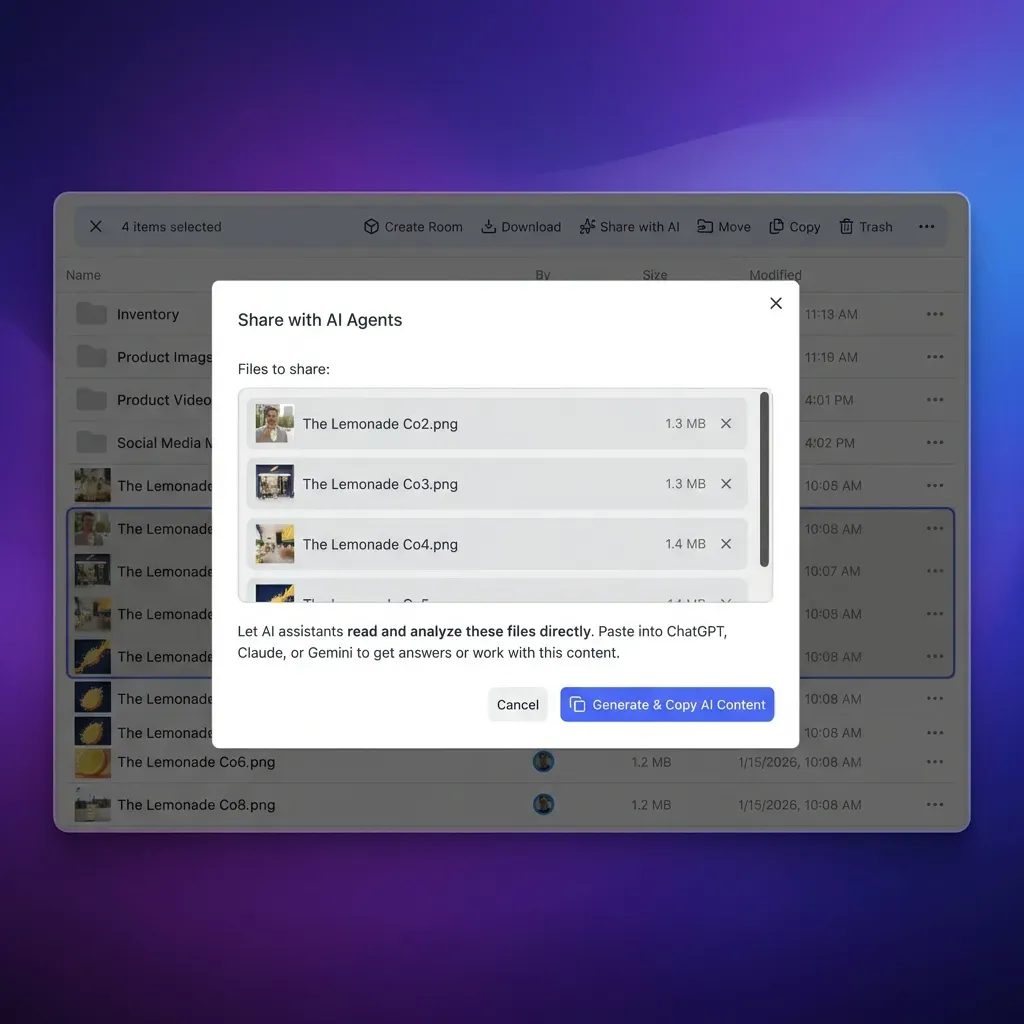
Fast.io's platform supports these workflows through automatic file indexing. When agents upload files to an Intelligence Mode workspace, the system automatically extracts searchable metadata, generates summaries, and enables semantic search. Agents can query "find the Q3 campaign video with the beach scene" and locate the right asset without manual tagging.
Cross-System File Coordination
Modern workflows span multiple platforms. An agent might pull documents from SharePoint, enrich with data from Salesforce, process through a custom analysis tool, and deliver results via Slack. URL Import capabilities let agents fetch files from Google Drive, OneDrive, Box, and Dropbox without downloading locally, streaming directly into the workflow.
File locks prevent conflicts when multiple agents or humans access the same documents. Before editing a shared spreadsheet, an agent acquires a lock, makes changes, and releases the lock, preventing the version conflicts that plague multi-user document workflows.
Audit and Compliance
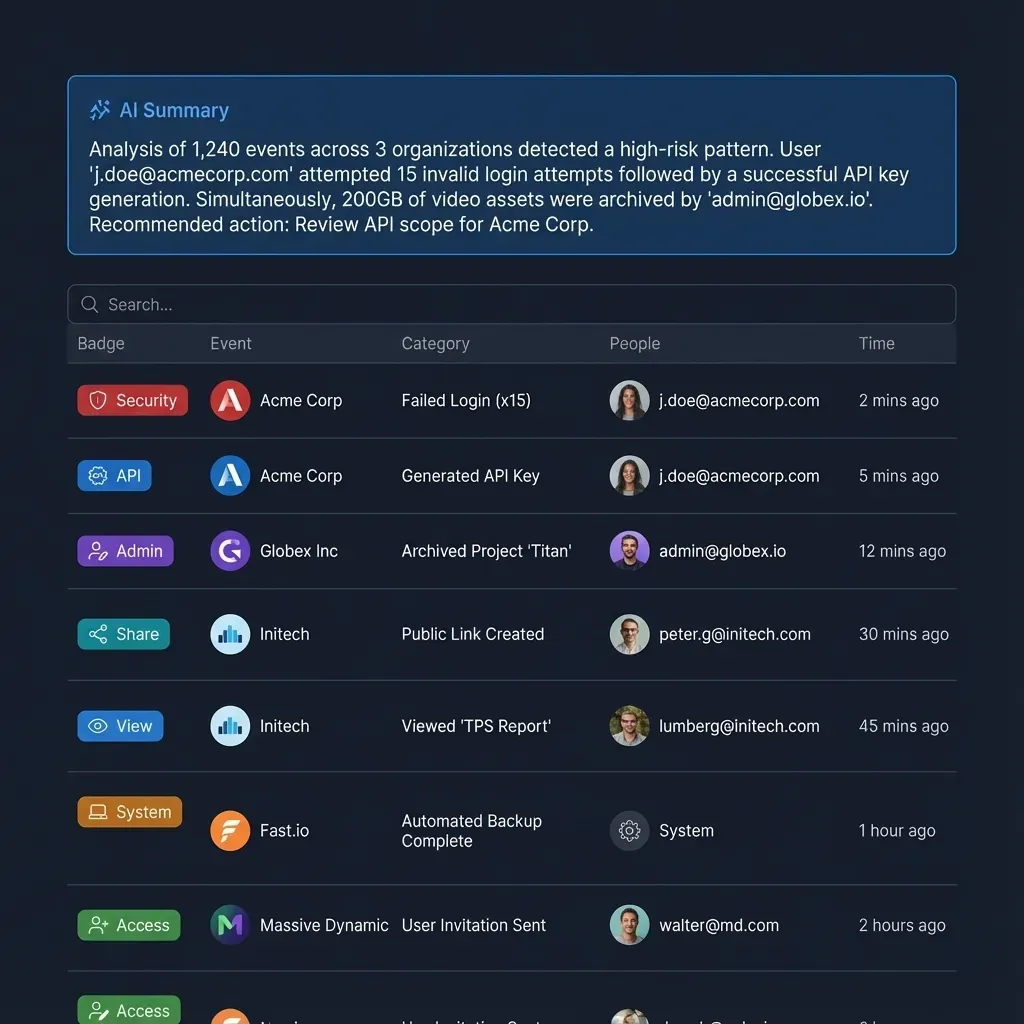
File operations require accountability. Comprehensive audit logs track every upload, download, modification, and sharing action. For regulated industries, this creates the documentation trail needed for compliance. Agents can generate activity reports showing who accessed what files when, with automated redaction of sensitive information.
Practical Implementation Patterns
Moving from concept to production requires proven patterns that handle real-world complexity. These implementation approaches have emerged from successful deployments across industries.
The State Machine Pattern
Model complex workflows as state machines where each state represents a specific phase, and transitions occur based on agent decisions or external events. A loan application workflow might have states for: Document Collection, Data Extraction, Credit Check, Underwriting Review, Approval, and Funding. The agent moves applications through states, handling different document types and edge cases at each phase.
LangGraph implements this pattern explicitly, letting developers define nodes (agents or tools) and edges (transition conditions). The state machine approach makes workflows observable. You can see exactly which state an application is in and what transitions are possible.
Multi-Agent Collaboration
Complex tasks often require specialized agents working together. A research workflow might use: a Data Collection Agent that gathers sources, an Analysis Agent that extracts insights, a Writing Agent that drafts reports, and a Review Agent that checks for accuracy and completeness.
These agents share a common workspace where they deposit intermediate files. The Analysis Agent saves structured data, the Writing Agent reads it to generate narratives, and the Review Agent compares outputs against source materials. Fast.io's shared workspaces enable this collaboration, with file locking preventing conflicts when multiple agents write to the same directory.
Reactive Event-Driven Workflows
Instead of polling for work, agents respond to events. Webhooks notify agents when files are uploaded, permissions change, or external systems trigger actions. A compliance monitoring agent might watch for new contract uploads, automatically process them, and alert legal teams only when issues are found.
This approach scales efficiently. Agents remain idle until work arrives, then activate to process tasks. Event-driven architectures handle burst workloads gracefully, spinning up agent instances as needed without constant resource consumption. For more on event-driven agent patterns, see the LangGraph documentation.
Human-Agent Handoffs
Design explicit handoff points where humans take over from agents or vice versa. Approval workflows are common handoffs: the agent prepares a contract amendment, routes it to the legal team, waits for approval, then executes the final filing. Human-in-the-loop systems use structured handoff protocols that preserve context. Humans see not just the file but the agent's reasoning and any flags or concerns.
Ownership transfer takes this further. An AI agent can build an entire data room, upload due diligence materials, configure permissions, and then transfer ownership to a human deal lead. The agent retains admin access for ongoing maintenance while the human controls the primary relationship.
Iterative Refinement
Start simple and add complexity based on real usage patterns. Begin with a single agent handling one document type. Once reliable, expand to additional formats. Add multi-agent collaboration only after single-agent workflows prove stable. This iterative approach prevents the brittleness that plagues complex systems built all at once.
Monitor agent decisions and outcomes. When agents make mistakes, analyze whether the issue is in the reasoning, tool use, or handoff protocols. Use these insights to refine prompts, add edge case handling, and improve human oversight points.
Getting Started With Agentic Workflow Automation
Implementing agentic workflows requires infrastructure that supports autonomous file operations, persistent storage, and smooth human-agent collaboration. The right foundation determines whether your agents operate as isolated tools or integrated team members.
Infrastructure Requirements
Agents need reliable storage that persists across sessions. Unlike chat-based interactions where context disappears when the conversation ends, workflow agents maintain state through files and structured data. Cloud-native storage with API access, webhook support, and granular permissions provides this foundation.
The storage solution must handle the file types your workflows use: documents for contract review, spreadsheets for data analysis, media files for creative workflows, structured data for reporting. Preview capabilities let humans verify agent outputs without downloading files, speeding up review cycles.
MCP Integration
The Model Context Protocol has become the standard for agent tool access. MCP servers provide agents with structured tool definitions they can discover and invoke dynamically. Instead of hardcoding API calls, agents use natural language reasoning to select the right tools for each task.
Fast.io's MCP server provides 251 tools covering file operations, workspace management, sharing, and AI features. Agents can create workspaces for new projects, upload files, search across documents, generate summaries, and manage permissions, all through standardized MCP calls. The server supports Streamable HTTP and SSE transport with session state managed in Durable Objects.
Workspace Design
Organize agent work in shared workspaces that humans can access. Structure workspaces around projects, clients, or workflow phases. Use granular permissions to control access. Agents might have full access to processing workspaces while clients only see final deliverables in shared folders.
Intelligence Mode workspaces add AI capabilities automatically. When enabled, files are indexed for semantic search, agents can query documents using natural language, and the system generates summaries and extracts metadata. This built-in RAG eliminates the need for separate vector databases and embedding pipelines.
Development and Testing
Start with sandbox workspaces where agents can experiment without affecting production data. Test workflows with sample documents that represent the variety your agents will encounter. Include edge cases: malformed files, unexpected formats, corrupted data. Agents that handle the test suite gracefully will perform better in production.
Implement monitoring that tracks agent activity, file operations, and handoff events. Review logs regularly to identify failure patterns and optimization opportunities. Unlike traditional software with fixed code paths, agentic systems evolve based on the prompts and examples you provide, making continuous monitoring essential.
Scaling Considerations
As workflows mature, scaling becomes critical. Event-driven architectures handle increased volume by processing files as they arrive rather than on fixed schedules. Workspace templates let you spin up consistent environments for each new project or client. File locks prevent conflicts as multiple agents work concurrently.
Cost management matters at scale. Usage-based pricing models align costs with actual activity rather than requiring per-seat licenses for every agent and human collaborator. This approach keeps costs predictable while supporting growth.
The most successful implementations treat agents as team members rather than tools. They get their own accounts, participate in shared workspaces, and have defined roles and responsibilities. This integration enables the complex, file-heavy workflows that deliver the full promise of agentic AI.
Frequently Asked Questions
What is agentic AI?
Agentic AI refers to artificial intelligence systems that can act autonomously to achieve goals with minimal human intervention. Unlike traditional AI that responds to individual prompts, agentic AI can plan multi-step tasks, make decisions, use tools, and adapt to changing conditions. These systems combine large language models with memory, tool access, and reasoning capabilities to handle complex workflows that would normally require human judgment and coordination.
How is agentic AI different from traditional automation?
Traditional automation follows rigid, pre-programmed rules: if X happens, do Y. Every scenario must be anticipated and coded explicitly. Agentic AI handles ambiguity and variation through reasoning. When encountering an unfamiliar situation, traditional automation typically fails or requires human intervention, while agentic systems adapt their approach dynamically. Agentic workflows also maintain context across multiple steps, use tools selectively based on the task at hand, and can handle complex branching logic without explicit programming for every possible path.
What workflows can AI agents automate?
AI agents excel at complex, multi-step workflows involving documents, data, and decision-making. Common applications include contract review and legal document processing, invoice handling and accounts payable automation, customer onboarding with document collection and verification, content creation pipelines with drafting, editing, and approval stages, data analysis and report generation across multiple sources, compliance monitoring and audit preparation, research synthesis from multiple documents, and media asset management with transcription and tagging. The best use cases involve variation and judgment that would otherwise require human intelligence.
What infrastructure do I need for agentic workflows?
Agentic workflows require persistent storage with API access, webhook support for event-driven processing, and granular permission controls. Cloud-native solutions work best, providing scalability without infrastructure management. Key capabilities include support for your file types (documents, media, data), preview functionality for human review, MCP server integration for standardized tool access, and shared workspaces that both agents and humans can access. Usage-based pricing models align costs with actual activity rather than requiring per-seat licenses for every participant.
How do agents handle file operations in workflows?
Agents perform file operations through API calls or MCP tools, enabling them to upload, download, read, write, and manipulate files programmatically. For complex workflows, agents use file locks to prevent conflicts when multiple users access the same documents. They can extract text from documents using OCR, generate summaries, search across file contents, and convert between formats. Webhooks notify agents of file changes, enabling reactive workflows where processing triggers automatically when new files arrive. Modern platforms index files automatically, allowing agents to search by meaning rather than just filenames.
Related Resources

Ready to automate complex workflows with AI agents?
Fast.io provides 251 MCP tools, persistent storage, and shared workspaces where agents and humans collaborate. Start free with 50GB storage, 5,000 monthly credits, and no credit card required.