How to Choose and Set Up Supplier Portal Software
Supplier portal software gives procurement teams a central place to exchange documents, onboard vendors, and track orders without drowning in email threads. This guide covers what supplier portals actually do, the features that matter most for mid-market companies, and how to get one running without a six-month implementation project.

What Is Supplier Portal Software?
A supplier portal is a secure online platform where organizations and their vendors exchange documents, manage orders, and collaborate on procurement workflows. Suppliers log in to submit invoices, check payment status, review purchase orders, and upload compliance documents. The buying organization gets a single dashboard for tracking every vendor interaction.
Think of it as the digital front door between your company and its suppliers. Instead of scattering purchase orders across email, storing contracts in shared drives, and tracking compliance certificates in spreadsheets, the portal puts everything in one structured location with proper access controls.
Supplier portals are not the same thing as procurement systems. A procurement system (like SAP Ariba or Coupa) handles end-to-end purchasing: sourcing, bidding, spend analytics, contract negotiation, and supplier management. A supplier portal focuses specifically on the communication and document exchange layer. Some procurement suites include a portal component, but many mid-market companies need the portal without the full ERP integration.
The distinction matters because most guides on this topic default to enterprise procurement platforms that cost $5,000 to $15,000 per month and take three to six months to implement. If you have 50 to 500 suppliers and need faster setup, a standalone portal often makes more sense.
Why Procurement Teams Invest in Supplier Portals
The core problem is visibility. When supplier documents live in email inboxes, nobody has a clear picture of what has been received, what is pending, and what has expired. Compliance certificates lapse without anyone noticing. Invoice disputes drag on because nobody can find the original PO.
Companies with supplier portals reduce procurement cycle times by up to 30%, according to procurement industry research. That number comes from eliminating manual handoffs: instead of emailing a PO, waiting for confirmation, then emailing again when the confirmation does not arrive, the portal handles the workflow automatically.
Here are the specific pain points that push teams to adopt portal software:
Document chaos. 65% of supply chain leaders cite document exchange as their top collaboration challenge. Tax forms, insurance certificates, quality reports, and shipping documents all need to flow between buyer and supplier. Email is not built for this.
Slow onboarding. Bringing a new supplier into your system manually can take weeks of back-and-forth: collecting W-9s, verifying insurance, setting up payment information. A self-service portal cuts this to days.
Compliance gaps. When certifications expire and nobody notices, you are exposed. Portals with document expiration alerts flag these automatically.
Invoice processing delays. Manual invoice review creates bottlenecks. Portals let suppliers submit invoices directly against purchase orders, reducing errors and speeding up approval.
Audit trail gaps. If a dispute arises about what was ordered, delivered, or agreed to, you need records. Email threads are not defensible audit trails. Portal activity logs are.
Features That Matter for Mid-Market Companies
Enterprise procurement suites pack hundreds of features. Mid-market teams need a shorter list that actually gets used. Here is what to prioritize when evaluating supplier portal software.
Document Management and Version Control
At minimum, the portal needs structured folders for each supplier, version history on every file, and the ability to set access permissions at the folder level. Suppliers should be able to upload documents without emailing them to you, and your team should be able to see exactly which version is current.
Supplier Self-Service Onboarding
New suppliers should be able to register themselves, fill out required forms, and upload compliance documents through a guided process. This eliminates the back-and-forth of collecting information manually. Look for portals that let you define which documents are required and flag incomplete submissions.
Role-Based Access Controls
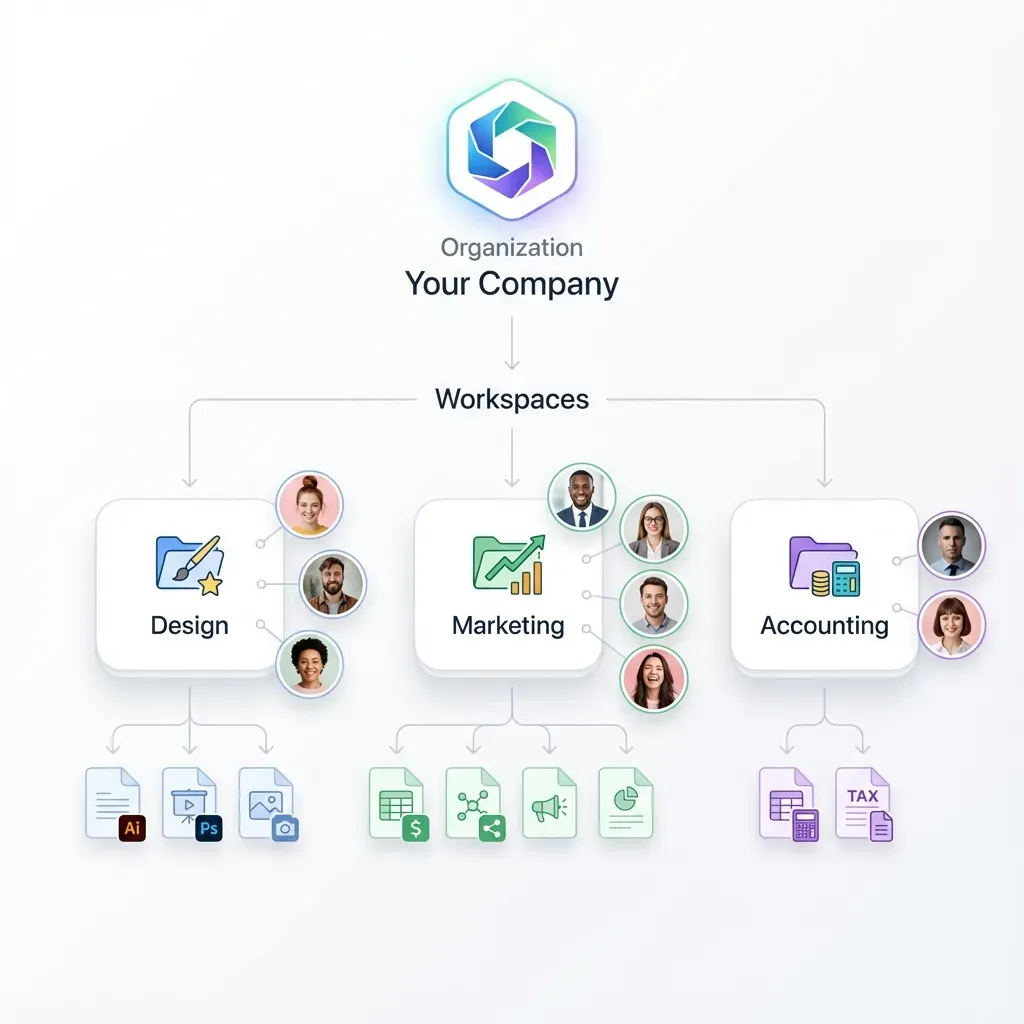
Not every supplier should see the same information. Your raw materials vendor does not need access to your logistics partner's documents. Granular permissions at the organization, workspace, and folder level keep information compartmentalized.
Activity Logs and Audit Trails
Every file upload, download, comment, and permission change should be logged with timestamps and user attribution. This is not just for compliance. It is how you resolve disputes and track whether suppliers are actually engaging with the portal.
Branded Experience
Your portal should look like your company, not like a generic file-sharing tool. Custom logos, colors, and vanity URLs make the portal feel professional. This matters more than you might think for supplier adoption. If the portal looks like a consumer tool, suppliers treat it like one.
Search and AI-Powered Retrieval
Once you have hundreds of supplier documents, finding the right one becomes its own challenge. Full-text search is the baseline. Semantic search that understands what you are looking for, not just keyword matching, is increasingly common.
Notifications and Workflow Automation
The portal should notify your team when a supplier uploads a document, and notify suppliers when a PO is ready for review. Basic workflow automation (like routing invoices to the right approver based on amount) saves significant time.


Simplify Supplier Document Exchange
Set up a branded supplier portal with granular permissions, audit trails, and AI-powered search. Free plan includes 50 GB of storage, no credit card required.
How Supplier Portals Compare to Other Tools
Supplier portals overlap with several adjacent tool categories. Understanding the boundaries helps you avoid buying more software than you need.
Supplier Portal vs. Procurement System
A procurement system (SAP Ariba, Coupa, Jaggaer) handles the full purchase-to-pay lifecycle: sourcing, bidding, contract management, spend analytics, and supplier performance tracking. A supplier portal handles the communication and document exchange part. If you already have a procurement system, check whether its built-in portal module meets your needs before buying a standalone tool.
If you do not have a procurement system and your primary need is document exchange and vendor onboarding, a standalone portal is faster to deploy and far less expensive. You can always add procurement capabilities later.
Supplier Portal vs. Shared Drive
Google Drive, SharePoint, and Dropbox can technically share files with suppliers. The problems show up quickly: no structured onboarding flow, no document expiration tracking, no branded experience, and no audit trail designed for procurement workflows. Shared drives work for internal teams. They break down when you need structured collaboration with dozens of external partners.
Supplier Portal vs. Email
Email is where supplier collaboration goes to die. Attachments get lost, version control is nonexistent, and there is no central view of what has been sent and received. The shift from email to a portal is the single biggest efficiency gain most procurement teams make.
Supplier Portal vs. Client Portal
Client portals and supplier portals are architecturally similar: both provide secure external access to documents with branded experiences and access controls. The difference is the workflow direction. Client portals typically push deliverables outward (you share files with clients). Supplier portals pull documents inward (vendors submit files to you). Some platforms handle both use cases with the same underlying technology.
Setting Up a Supplier Portal Step by Step
Implementation does not need to be a multi-month project. Here is a practical setup sequence that works for mid-market teams.
Step 1: Map Your Current Supplier Workflows
Before choosing software, document how supplier documents currently flow through your organization. Which documents do you collect from suppliers? Who reviews them? Where do they end up? This audit typically reveals that 70% to 80% of your supplier interactions follow the same basic pattern, and the portal should optimize for that pattern first.
Step 2: Define Your Folder Structure
Create a consistent folder hierarchy for every supplier. A typical structure looks like this:
- Compliance (W-9, insurance certificates, quality certifications)
- Purchase Orders (active POs, historical POs)
- Invoices (pending, approved, paid)
- Contracts (master agreements, amendments)
- Shipping (tracking documents, delivery confirmations)
Consistency matters. If every supplier folder follows the same structure, your team can find documents without guessing where they might be filed.
Step 3: Set Permissions and Access Levels
Decide who sees what. At minimum, you need three access tiers:
- Supplier contacts who can upload and view only their own company's documents
- Procurement team members who can view and manage documents across all suppliers
- Administrators who can modify portal settings, add new suppliers, and manage permissions
Fast.io handles this with granular permissions at the organization, workspace, folder, and file level. You can create a workspace per supplier category (raw materials, logistics, professional services) and control access at each layer.
Step 4: Build a Branded Portal Experience
Upload your logo, set your brand colors, and configure a custom URL. The portal should feel like an extension of your company. Fast.io's content portals let you customize the look and feel so suppliers interact with your brand, not a generic tool.
Step 5: Onboard Suppliers in Batches
Do not try to move all suppliers at once. Start with your top 10 to 20 suppliers by transaction volume. Send them a clear invitation explaining what the portal is, why you are using it, and what they need to do. Include a short guide or video walkthrough.
Once the first batch is running smoothly, expand to the next tier. Most companies complete full supplier migration in 8 to 12 weeks using this phased approach.
Step 6: Monitor Adoption and Iterate
Track which suppliers are actively using the portal and which are still sending documents by email. Follow up with non-adopters directly. Common barriers include login confusion, unclear instructions, and suppliers who simply forgot. A quick phone call or email reminder usually solves it.
What to Look for When Evaluating Options
The supplier portal market ranges from full procurement suites to lightweight document-sharing platforms. Here is how to narrow the field.
Enterprise Procurement Suites
SAP
Ariba dominates with roughly 29% market share and a network of over 5 million suppliers. Coupa and Jaggaer are strong alternatives with better usability ratings. These platforms make sense if you need end-to-end procurement management and have the budget ($5,000 to $15,000+ per month) and IT resources for a 3 to 6 month implementation.
Mid-Market Supplier Portals
Tipalti, Basware, and Precoro offer supplier portal functionality without the full ERP weight. Pricing typically runs $2,000 to $5,000 per month. Implementation is measured in weeks, not months. These work well if your primary need is invoice management and document exchange.
Lightweight Portal Platforms
For teams that need secure document exchange, branded portals, and structured permissions without procurement-specific features, platforms like Fast.io provide the collaboration layer without the procurement overhead. Fast.io's workspace model gives each supplier their own branded portal with granular folder permissions, version control, audit trails, and AI-powered search across all uploaded documents.
This approach works especially well for companies that already have accounting or ERP software handling the financial side of procurement and just need a better way to exchange and organize supplier documents.
No-Code Portal Builders
Knack, Softr, and Blaze.tech let you build custom supplier portals from scratch. The upside is total customization. The downside is that you are building and maintaining the portal yourself, which means ongoing development work as your needs change.
Evaluation Checklist
When comparing options, score each platform on these criteria:
- Time to first supplier onboarded: Can you have a working portal in days, not months?
- Supplier experience: Is the portal intuitive enough that suppliers will actually use it?
- Permission granularity: Can you control access at the folder level, not just the portal level?
- Audit trail completeness: Does every action get logged with user attribution?
- Search capability: Can you find a specific document across hundreds of suppliers in seconds?
- Branding: Does the portal represent your company professionally?
- Cost structure: Are you paying per seat, per supplier, or per usage?
Fast.io uses a usage-based credit model instead of per-seat pricing, which means you are not paying extra for each supplier you onboard. The free plan includes 50 GB of storage and works for teams evaluating the platform with a smaller supplier base.
Frequently Asked Questions
What is a supplier portal?
A supplier portal is a secure online platform where organizations and their vendors exchange documents, manage orders, and collaborate on procurement workflows. Suppliers use it to submit invoices, upload compliance documents, check payment status, and review purchase orders, all in one central location instead of through scattered email chains.
What features should supplier portal software have?
The essential features are document management with version control, role-based access permissions, supplier self-service onboarding, audit trails that log every action, branded portal experiences, search functionality, and workflow notifications. Mid-market companies should prioritize ease of setup and supplier adoption over advanced procurement features they may not need.
How do you set up a vendor portal?
Start by mapping your current supplier document workflows to identify what needs to move into the portal. Define a consistent folder structure (compliance, POs, invoices, contracts, shipping). Set up permissions so each supplier only sees their own documents. Brand the portal with your logo and colors. Then onboard suppliers in batches of 10 to 20, starting with your highest-volume vendors, and expand from there.
What is the difference between a supplier portal and a procurement system?
A procurement system handles the full purchase-to-pay lifecycle: sourcing, bidding, contract management, spend analytics, and supplier performance tracking. A supplier portal focuses specifically on document exchange and vendor communication. Many companies use a standalone portal for document collaboration while keeping their existing accounting or ERP software for financial processing.
How much does supplier portal software cost?
Costs vary widely by category. Enterprise procurement suites like SAP Ariba run $5,000 to $15,000+ per month. Mid-market tools like Tipalti and Precoro cost $2,000 to $5,000 per month. Lightweight portal platforms that focus on document exchange and collaboration start with free tiers. Fast.io offers a free plan with 50 GB of storage and usage-based pricing that scales with your actual usage.
Can a supplier portal replace email for vendor communication?
For document exchange, yes. Portals eliminate the problems of lost attachments, version confusion, and missing audit trails that come with email-based workflows. Most companies keep email for ad-hoc communication but move all document submission, approvals, and compliance tracking into the portal. The result is a clear record of every document exchanged and every action taken.
Related Resources

Simplify Supplier Document Exchange
Set up a branded supplier portal with granular permissions, audit trails, and AI-powered search. Free plan includes 50 GB of storage, no credit card required.