Best OpenClaw Integrations for Productivity
OpenClaw integrations connect autonomous agents to human collaboration tools. By connecting your local AI agent to apps like Slack, Google Workspace, and Fast.io, you can automate tasks that save hours every week. This guide covers the top OpenClaw skills to install now.
What Are OpenClaw Integrations?
OpenClaw is a local-first AI agent framework that runs on your machine. Its value comes from its "Skills System." Integrations (or skills) allow your agent to interact with the outside world. They send emails, manage files, and update tickets.
Without integrations, an agent is just a chatbot. It is a "brain in a jar" that can think but not act. With integrations, it becomes an autonomous employee capable of running complete workflows. Whether you install them via clawhub or configure local bridges, these tools define what your agent can do.
These tools change how teams work. According to Salesforce, workers who use AI daily are 64% more productive than those who don't. McKinsey reports that 62% of organizations are already deploying AI agents to automate complex workflows. By giving your agent the right tools, you move from simple chat to true automation.
1. Gog (Google Workspace)
The gog skill is a Google Workspace CLI for Gmail, Calendar, Drive, Contacts, Sheets, and Docs. It is often the first integration productivity-focused users install because it handles the entire administrative layer of knowledge work — scheduling, email, and document management — through a single CLI.
Key Capabilities:
- Smart Scheduling: "Find a slot next Tuesday for a sync with Sarah."
- Email Management: Search and send Gmail from agent prompts.
- Sheets & Docs: Read and write Google Sheets rows; export Docs as PDFs.
Configuration Tips: Set up a Google Cloud Project and enable the Gmail and Calendar APIs, then install via Homebrew:
brew install steipete/tap/gogcli
Note: OpenClaw's security analysis rates this "suspicious" due to OAuth credential handling — use a dedicated Google account rather than your primary credentials.
Best For: Executive assistants and administrative automation.
ClawHub Page: clawhub.ai/steipete/gog
2. Fast.io (dbalve/fast-io)
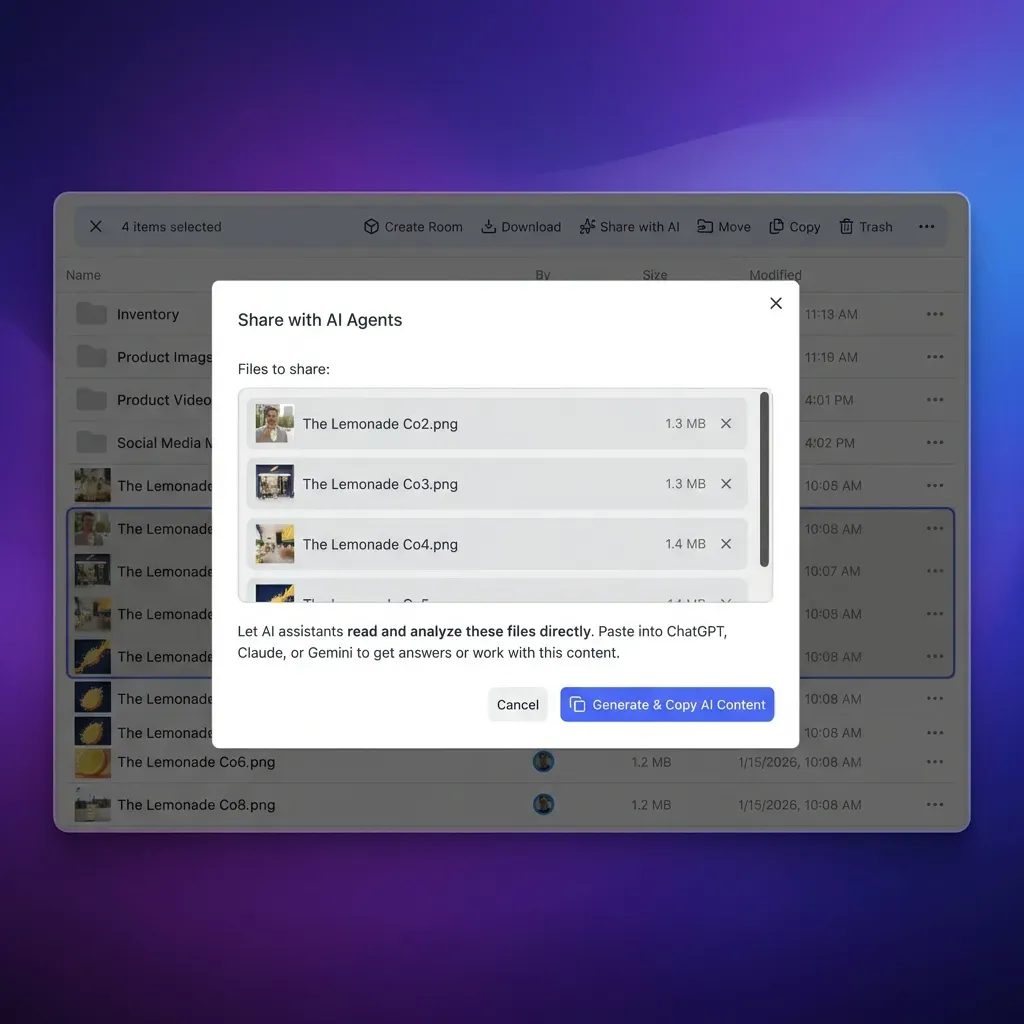
While OpenClaw runs locally, your agent needs a way to share its work. The Fast.io integration provides shared cloud storage that works as "long-term memory" for your agents. Unlike local storage, Fast.io allows you to share agent outputs instantly with your team. The skill exposes 19 tools covering the full Fast.io API surface.
Key Capabilities:
- Shared Workspace: Agents upload reports to a shared folder that humans can access instantly.
- Intelligence Mode: Files uploaded are automatically indexed for RAG (Retrieval-Augmented Generation), allowing other agents to query them.
- Instant Handover: An agent can build a project in a Fast.io workspace and transfer full ownership to a human client.
- Universal File Access: Works with any file type, from PDFs to 4K video.
How to Use: Install the skill directly from ClawHub:
clawhub install dbalve/fast-io
You can then use natural language commands like "Upload the quarterly report to the Finance workspace" or "Search for the latest brand guidelines in Fast.io."
The Fast.io Agent Storage tier provides 50GB of free storage, making it a strong backend for autonomous agents.
Best For: Teams needing a shared file layer between agents and humans.
ClawHub Page: clawhub.ai/dbalve/fast-io


Give Your Agents a Shared Brain
Stop keeping your agents trapped on your local machine. Connect them to Fast.io for shared storage, intelligence, and collaboration.
3. Slack (Team Communication)
The Slack integration lets your agent work where your team works. Instead of checking a terminal, you can have the agent monitor channels for specific triggers, react to messages, pin important updates, and post daily briefings. This shifts the agent from a tool you use to a teammate you talk to.
Key Capabilities:
- Channel Monitoring: Watch
#supportfor urgent tickets and draft initial responses. - Daily Briefings: Post a summary of completed tasks to
#standupat 9 AM. - Message Reactions & Pinning: React to messages with emojis or pin important announcements.
Best Practices:
- Use Threading: Configure your agent to reply in threads to keep channels clean.
- Set Permissions: Ensure your agent only has access to relevant channels to maintain security.
Best For: DevOps teams and general business ops.
ClawHub Page: clawhub.ai/steipete/slack
4. AgentMail (Email Automation)
For email-centric workflows, AgentMail is purpose-built for agents. It provides programmatic inbox management, rich message sending with attachments, real-time webhook notifications for incoming messages, and semantic search across email history — without the rate limits and OAuth complexity of standard email providers.
Key Capabilities:
- Dedicated Inboxes: Create agent-owned inboxes for specific workflows (e.g.,
invoices@yourdomain.com). - Automated Outreach: Send structured emails with attachments on a schedule.
- Feedback Ingestion: Incoming replies trigger webhooks the agent processes automatically.
Install:
pip install agentmail python-dotenv
Note: Implement an allowlist for incoming senders to reduce prompt injection risk from untrusted email sources.
Best For: Agents that communicate with external parties who aren't on Slack.
ClawHub Page: clawhub.ai/adboio/agentmail
5. GitHub (Code & Project Management)
For teams building software, the GitHub skill uses the gh CLI so agents can manage issues, monitor CI runs, review PRs, and perform advanced API queries. Keeping the issue tracker updated is tedious — this integration handles it autonomously.
Key Capabilities:
- Auto-Triage: Analyze bug reports, assign them to the right team member, and add correct labels.
- Status Updates: Move tickets to "Done" when a PR is merged.
- CI Monitoring:
gh run listandgh run viewgive real-time pipeline visibility.
Best For: Engineering teams and product managers.
ClawHub Page: clawhub.ai/steipete/github
6. Agent Browser (Web Automation)
Sometimes an API doesn't exist. Agent Browser is a fast Rust-based headless browser CLI that gives your agent access to the web — navigating websites, filling forms, taking screenshots, and extracting structured data from rendered pages. This works well for research, legacy portals, and visual QA.
Key Capabilities:
- Research: Navigate to pages, extract content as structured data, and summarize findings.
- Legacy Systems: Interact with old corporate portals that lack APIs.
- Visual QA: Take screenshots of staging environments to verify deployments.
Note: Agent Browser is flagged by security scanners due to its high-capability nature — review source before installing and always verify agent actions in sensitive environments.
Best For: Research tasks and interacting with legacy web apps.
ClawHub Page: clawhub.ai/TheSethRose/agent-browser
7. Filesystem Management & Clawdbot Docs (Knowledge Management)
Productivity isn't just about doing tasks — it's about organizing knowledge. The Filesystem Management skill lets agents maintain an organized local knowledge base with smart filtering, content search, and directory analysis. The Clawdbot Docs skill adds navigational assistance for Clawdbot documentation with decision tree search.
Key Capabilities:
- Meeting Notes: Agents save raw transcript text to an organized directory structure, searchable by date and topic.
- Knowledge Search: Full-text content search with regex matching across your notes vault.
- Documentation Navigation: Clawdbot Docs uses keyword-based indexing to surface the right configuration snippets.
By connecting your AI Agent to your knowledge base, you stop insights from getting lost in the chat window.
Best For: Knowledge workers, researchers, and technical writers.
ClawHub Pages: clawhub.ai/gtrusler/clawdbot-filesystem | clawhub.ai/NicholasSpisak/clawddocs
How to Chain Integrations Together
OpenClaw works best when you combine skills. Instead of single tasks, you can build complex "Agent Chains."
Example Workflow: The Automated Researcher
- Trigger (Slack): You DM the agent: "Research the new competitor X."
- Action (Agent Browser): The agent visits the competitor's website and extracts pricing data.
- Action (Fast.io): It saves a PDF of the pricing page to a shared "Market Research" workspace.
- Action (Gog): It updates a competitive analysis row in Google Sheets with the new data.
- Notify (Slack): It replies to your original DM: "Done. I've updated the Sheet."
This entire flow happens without human intervention. To get started with these advanced workflows, check out the Fast.io Pricing page to see how our agent plans support heavy automation.
Comparing Top Integration Types
Not all integrations do the same thing. Here is how the top categories compare for productivity workflows.
Verdict: Start with Fast.io for storage/memory, then add a communication layer like Slack or AgentMail.
How to Install Integrations via ClawHub
Developers can install OpenClaw skills quickly. Most validated skills are available via the clawhub registry.
Step-by-Step Process:
- Search: Run
clawhub search [keyword]to find the package name. - Install: Execute
clawhub install [package-name]. For Fast.io, useclawhub install dbalve/fast-io. - Configure: Edit your
agent.configfile to add necessary API keys (e.g.,FASTIO_API_KEY). - Restart: Restart your OpenClaw instance to load the new skill.
Always verify the publisher on ClawHub to ensure you are installing the official version of the skill.
Frequently Asked Questions
What is the most important OpenClaw integration?
For most users, the Fast.io integration is the main starting point. It fixes the 'local-only' problem by giving your agent a cloud drive to store artifacts, share files with humans, and maintain long-term memory across sessions.
Can OpenClaw integrations run on a server?
Yes, while OpenClaw is local-first, it can be deployed on a VPS or server. Integrations like Slack and Fast.io work well in headless environments, allowing your agent to run 24/7 background tasks.
Are OpenClaw skills safe to use?
Yes, but you should audit the code of any third-party skill. Official skills (like the Fast.io integration) are verified for security. Always practice least privilege when managing API keys for your agents.
How do I update an OpenClaw skill?
Run `clawhub update [package-name]` in your terminal. Check the changelog first, as major updates to skills can sometimes change the prompt syntax your agent relies on.
Related Resources

Give Your Agents a Shared Brain
Stop keeping your agents trapped on your local machine. Connect them to Fast.io for shared storage, intelligence, and collaboration.