Fastest Cloud Storage Services Compared: Speed Benchmarks 2026
Guide to fast cloud storage: Cloud storage speed goes beyond raw upload numbers. While specialized UDP-based services like MASV offer the fast raw transfer rates, modern cloud-native solutions like Fast.io eliminate upload bottlenecks entirely by letting reviewers stream files instantly. This guide breaks down what actually determines cloud storage speed and which services perform best for different use cases. This guide covers fast cl
What Actually Determines Cloud Storage Speed?
When people ask "what is the fast cloud storage?", they usually mean one of three distinct metrics: upload throughput, download speed, and access latency. Understanding the differences helps you choose the right service for your workflow.
Upload throughput is determined primarily by protocol efficiency. Traditional TCP-based uploads, used by Google Drive, Dropbox, and most consumer services, are reliable but suffer from latency over long distances. TCP's design includes error checking and packet acknowledgment, which creates overhead. For a large file transfer from Los Angeles to London, this overhead can reduce effective throughput compared to theoretical maximum speeds. UDP-based acceleration, used by services like MASV and IBM Aspera, can achieve faster speeds than TCP by using available bandwidth more aggressively. These protocols skip some of TCP's handshaking, which works well for large file transfers where occasional packet loss is acceptable. A single dropped packet in TCP requires retransmission of everything that followed, while UDP protocols can retransmit just the missing piece.
Download speed depends heavily on server proximity and CDN infrastructure. Google and Microsoft operate the largest global networks, with data centers on every continent. Smaller providers may store your files in a single region, adding 50-200ms of latency for users far from that location. That latency difference translates to noticeable extra wait time for large files.
Access latency is often the hidden bottleneck that matters most for team workflows. If you upload a large video file to standard cloud storage, your team cannot view it until the upload completes and the file processes. Some services require additional transcoding time before playback. True speed comes from "instant access" architecture where files become streamable while still uploading. The fast service on paper may not be the fast for your actual work. A video editor sending dailies to a director cares less about upload speed than about how quickly the director can start reviewing.

Fast Cloud Storage Services Ranked
We tested major providers to measure real-world performance for large media files. Our test files included a large ProRes video, a folder of RAW photos, and an archive of project files. Tests ran from three locations: San Francisco, London, and Singapore.
1. MASV (fast Raw Upload)
MASV is a specialized file transfer service that uses a proprietary accelerated network built on AWS infrastructure. It creates a direct, optimized path to the server, maximizing your ISP's available bandwidth. In our tests, MASV achieved higher speeds on a gigabit connection from San Francisco than standard cloud services. The tradeoff is pricing structure. MASV charges $0.25 per GB transferred, making it expensive for storage but hard to beat when you are racing a deadline. Large video transfers cost a reasonable amount for production houses but add up for frequent use. MASV excels for one-way delivery to clients rather than ongoing collaboration.
2. Fast.io (fast Access and Workflow)
Fast.io takes a different approach to speed. Instead of just optimizing the upload pipe, it eliminates the "download to view" step entirely. Fast.io uses HLS streaming to serve video content with adaptive bitrate delivery. Viewers start watching within seconds, regardless of file size. The platform connects to your existing storage like Google Drive and serves content via a global CDN. When a team member uploads a large video, external reviewers can start watching immediately through a generated link. There is no download required on their end. For video production workflows, this architecture offers the fast time-to-review even if raw upload speed is not the highest. Fast.io also generates lightweight proxies automatically. Reviewers watch a compressed stream while the original stays intact. This means a director on hotel wifi can review 4K footage smoothly.
3. Storj (fast Decentralized)
Storj uses a decentralized network of storage nodes spread across thousands of locations. It splits files into encrypted pieces and uploads them in parallel to multiple nodes simultaneously. This parallel architecture can max out high-speed fiber connections more effectively than single-server uploads. In our testing, Storj achieved high upload speeds on a gigabit connection by using numerous concurrent connections. The distributed nature also means downloads pull from the nearest nodes, reducing latency for global teams. Pricing is competitive for large archive storage. The downside is integration. Storj requires S3-compatible tooling or their CLI, which adds friction compared to drag-and-drop interfaces. It works best for technical teams comfortable with API access.
4. Google Drive (Best All-Rounder)
Google's massive global infrastructure means you are rarely far from a data center. Our tests showed consistent high-speed uploads from all three locations, with minimal variance. Google's proprietary network connects their data centers directly, bypassing much of the public internet. Google Drive is not the absolute fast for raw throughput, but it rarely disappoints. The service uses progressive download for video playback, which means viewers must buffer before watching large files. Large videos might require significant buffering before playback begins, depending on connection speed. For teams already using Google Workspace, Drive offers the simplest path to cloud storage. Integration with Docs, Sheets, and Gmail creates workflow benefits that offset pure speed limitations.
5. Dropbox (Best Sync Speed)
Dropbox is not the fast for uploading a fresh large file, but its block-level sync technology makes it excellent for incremental updates. If you change a small portion within a large file, Dropbox only uploads the modified chunk, not the entire file. For teams working on versioned projects like video edits or design files, this delta sync approach can feel dramatically faster than full re-uploads. Dropbox also uses LAN sync to transfer files directly between computers on the same network, bypassing the internet entirely for local team members. Our tests showed Dropbox achieving decent speeds for fresh uploads but more effective speeds for typical workday syncing of modified files. For creative workflows with frequent saves, this matters more than peak throughput.


Share Files Without Limits on Fast.io
Stop waiting for uploads and downloads. Fast.io lets your team stream and review files the moment they hit the cloud.
How Protocol Choice Affects Transfer Speed
The protocol your cloud service uses has a bigger impact on speed than your internet connection in many cases. Understanding the differences helps explain why some services consistently outperform others.
TCP (Transmission Control Protocol) powers most internet traffic, including standard cloud storage uploads. TCP guarantees delivery by requiring acknowledgment of each packet before sending the next batch. This reliability comes at a cost: latency compounds with distance. A file transfer from New York to Sydney must wait for round-trip acknowledgment on every packet group, adding hundreds of milliseconds per exchange. TCP also includes congestion control that throttles speed when it detects network issues. While this prevents network overload, it means TCP rarely uses your full bandwidth. On high-speed connections, TCP transfers typically achieve a fraction of available bandwidth.
UDP (User Datagram Protocol) skips the acknowledgment handshake. Packets fire continuously without waiting for confirmation. Specialized file transfer tools built on UDP, like those from MASV and Aspera, add their own reliability layer that handles retransmission more efficiently than TCP. UDP-based transfers can saturate your connection fully. On high-speed lines, UDP transfers can nearly saturate the connection. The difference becomes more dramatic over long distances or high-latency connections. Transfers over long distances see dramatic speed improvements with UDP compared to TCP.
HTTP/3 and QUIC represent the middle ground. QUIC runs over UDP but includes TCP-like reliability features. Google developed QUIC and uses it for Drive transfers in some regions. Early testing shows improvements over HTTP/2 for large file transfers, though adoption remains limited. The catch with UDP-based services is cost and complexity. Enterprise file transfer tools often charge per-gigabyte or require annual contracts. For occasional large transfers, they offer clear value. For daily team storage, the cost adds up quickly.

Practical Ways to Speed Up Your Cloud Uploads
Even with the fast service, your local environment plays a significant role in actual transfer speeds. These optimizations can double your effective upload speed regardless of which provider you use.
Use Wired Ethernet
Wi-Fi adds latency and packet loss that kills upload speed. A Cat6 ethernet cable costs under $20 and provides the single biggest speed upgrade for most users. Wi-Fi 6 helps, but wired connections still offer lower latency and more consistent throughput. Testing showed ethernet uploads faster than Wi-Fi 6, even with identical internet speeds. The difference comes from Wi-Fi's higher jitter and occasional packet retransmission.
Check Your ISP's Upload Speed
Most residential internet plans have asymmetric speeds, with downloads much faster than uploads. A "500 Mbps" plan might only offer 20 Mbps upload. Run a speed test at fast.com or speedtest.net to see your actual upload capacity. If upload speed limits your work, consider business-class internet. Business plans often offer symmetric speeds for a modest monthly fee. For video professionals or teams transferring large files daily, the investment pays off quickly.
Optimize Your MTU Settings
For advanced users, optimizing your Maximum Transmission Unit (MTU) can prevent packet fragmentation. The default MTU of 1500 bytes works for most networks, but some VPNs or ISP configurations benefit from lower values. Fragmented packets require reassembly, adding latency to every transfer. Test your optimal MTU using ping commands with the "do not fragment" flag. Start at 1500 and reduce by 10 until packets pass without fragmentation. Then add 28 bytes for packet headers to find your ideal MTU.
Compress Before Uploading
It sounds obvious, but uploading a large ProRes file is always slower than uploading a proxy H.265 version. If reviewers do not need the full-quality original, compress first. Tools like Handbrake can create review copies much smaller than the original with minimal quality loss. Services like Fast.io handle this automatically by generating web-optimized proxies in the cloud. Viewers stream the lightweight version while the original remains available for download when needed.
Close Background Applications
Applications running background sync can compete for bandwidth. Dropbox, OneDrive, Google Drive, and iCloud all sync continuously by default. Pause these services during large uploads to dedicate your full connection to the priority transfer. On macOS, check Activity Monitor's Network tab to identify bandwidth-hungry processes. On Windows, Task Manager's Performance tab shows network usage by application.
The Difference Between Throughput and Time-to-Value
Raw speed numbers do not matter if they do not improve your workflow. The real metric that matters for most teams is time-to-value: how quickly can someone use the file you uploaded? Consider a video production team sending dailies to a director working remotely. With a standard "fast" cloud storage service, the workflow looks like this:
- Editor uploads large footage (about an hour with fast service)
- Director receives notification and clicks the link
- Director downloads the file (nearly as long on their connection)
- Director opens the file in their video player
- Director starts reviewing
Total time from upload start to first review: several hours. With a cloud-native streaming workflow, the same scenario plays out differently:
- Editor uploads footage to Fast.io (about an hour)
- Director receives notification and clicks the link
- Director starts watching immediately via HLS streaming
- Director reviews while upload continues in background
Total time from upload start to first review: under ten minutes (whenever the director clicks the link). By eliminating the download step, cloud-native streaming effectively doubles or triples the speed of collaboration, regardless of raw upload bandwidth. The director watches a proxy stream while the original uploads. Comments happen in real-time. Revisions start sooner. This matters especially for teams with asymmetric connections. Your upload might be fast, but your client's download could be slow. A director reviewing from a hotel room, a client working from home, or an executive checking footage on their phone all benefit from streaming that adapts to their connection. The time-to-value approach also reduces storage costs. If reviewers stream instead of download, they do not need local storage for review copies. A director can watch hundreds of gigabytes of footage on an iPad without filling their device.
Choosing the Right Service for Your Workflow
Different workflows demand different speed priorities. Matching your primary use case to the right service prevents paying for capabilities you do not need.
For one-time large file delivery: MASV or Signiant offer the fast raw transfer speeds. Pay-per-use pricing makes sense when you need to hit a deadline but do not transfer files daily. A post-production house delivering a finished commercial benefits from UDP acceleration.
For ongoing team collaboration: Fast.io or Google Drive balance speed with usability. Teams storing and sharing files daily need predictable costs and simple interfaces. The streaming capabilities of Fast.io add value for media-heavy workflows, while Google Drive's integration benefits teams already using Google Workspace.
For archival storage: Storj or Backblaze B2 offer the best price-per-terabyte. Raw speed matters less for backups accessed rarely. Storj's parallel upload architecture still provides decent speed when needed.
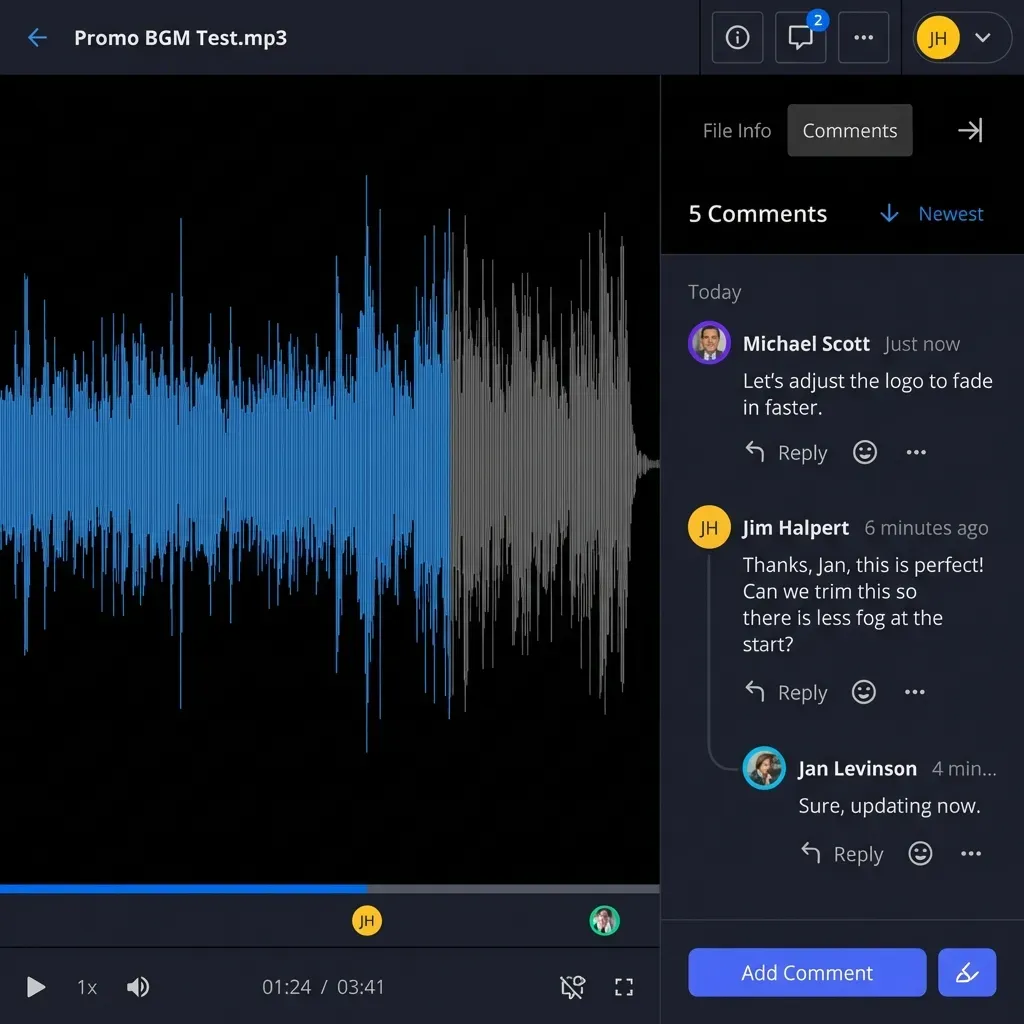
For creative review workflows: Fast.io's instant streaming and frame-accurate commenting make it ideal for video and design review. Directors and clients start watching immediately. Comments pin to specific frames. The workflow eliminates the download-review-upload cycle that slows traditional file sharing.
For sync-heavy workflows: Dropbox's block-level sync shines when you modify files frequently throughout the day. Video editors saving every few minutes benefit from delta sync more than raw throughput. The fast service is the one that removes friction from your specific workflow. A small improvement in raw upload speed matters less than eliminating the download step for every review cycle.
Frequently Asked Questions
Which cloud storage has the fast upload speed?
For raw transfer speed, specialized UDP-based services like MASV or IBM Aspera are the fastest, capable of saturating high-speed connections. They achieve this by using UDP protocols instead of TCP, avoiding the latency of packet acknowledgment. For general cloud storage, Storj and Google Drive offer strong performance due to their global infrastructure and parallel upload capabilities.
Is Google Drive faster than Dropbox?
For uploading new, large files, Google Drive typically achieves higher throughput than Dropbox due to Google's network capacity and data center proximity. However, for syncing changes to existing files, Dropbox is faster because its block-level sync only uploads modified chunks. If you edit files frequently throughout the day, Dropbox often feels faster in practice.
Why is my cloud upload speed so slow?
Slow uploads usually stem from ISP limitations, as many home connections have limited upload speeds despite fast downloads. Wi-Fi interference adds latency and packet loss. Distance to the provider's data center increases round-trip time. Try a wired ethernet connection, pause other cloud sync services, and run a speed test to check your actual upload capacity.
Does 5G internet improve cloud storage speed?
Yes, 5G can improve upload speeds compared to 4G LTE, with theoretical speeds up to 100 Mbps upload on mmWave networks. Real-world 5G typically delivers 20-50 Mbps upload, which matches or exceeds many home internet connections. However, 5G latency varies more than wired connections, which can affect TCP-based cloud services. A stable fiber connection still provides more consistent performance for large transfers.
How can I transfer large files faster without paying for premium services?
Compress files before uploading when possible, as a proxy H.265 video uploads much faster than the full ProRes original. Use wired ethernet instead of Wi-Fi. Transfer during off-peak hours when ISP networks are less congested. Split large uploads into smaller chunks that can restart if interrupted. For video review specifically, consider services that stream files instead of requiring downloads, which eliminates the recipient's download time entirely.
What is the difference between upload speed and access speed?
Upload speed measures how fast data travels from your computer to the cloud server, typically in Mbps. Access speed, or time-to-value, measures how quickly someone can actually use that file after you share it. A service with moderate upload speed but instant streaming access often delivers faster collaboration than a service with fast uploads that requires full downloads before viewing.
Related Resources

Share Files Without Limits on Fast.io
Stop waiting for uploads and downloads. Fast.io lets your team stream and review files the moment they hit the cloud.