How to Manage AI Agent File Versions
Version management lets AI agents track, compare, and restore files they create. This guide covers how to handle agent outputs, from simple timestamps to automated cloud storage, so you never lose data from your automated workflows. This guide covers ai agent version management files with practical examples.

Why Agents Need File Version Management: ai agent version management files
AI agents generate multiple file versions per project, from code snippets to image assets. Without a reliable system to manage these versions, you risk overwriting valuable outputs or losing the context of an agent's decisions.
File version management tracks and stores multiple iterations of a file. This lets you revert to previous states or compare changes over time. For autonomous agents, this is key because they often work in loops, refining outputs through multiple passes. If an agent hallucinates or makes an error in a later step, versioning lets you roll back to the last known good state without restarting the whole workflow.
Imagine an agent generating a legal contract. It might go through dozens of iterations, refining clauses based on specific constraints. If the agent crashes or produces a bad final draft, intermediate versions let human reviewers salvage valid parts of the work. History also serves as a learning tool, helping developers analyze how an agent's output evolved and find exactly where logic drifted.
Helpful references: Fast.io Workspaces, Fast.io Collaboration, and Fast.io AI.

What to check before scaling ai agent version management files
There are several ways to implement version control for files generated by AI agents. The right choice depends on your infrastructure and workflow complexity.
Timestamp-Based Naming: The simplest method appends a timestamp to every filename (e.g., report_YYYY-MM-DD_HHMM.pdf). While easy to implement, it creates clutter and makes it hard to identify the "latest" version programmatically. At scale, this requires complex logic to filter files and reconstruct the sequence of events. It breaks if timestamps overlap or formats change.
Hash-Based Deduplication: This approach renames files based on the hash of their content. It saves storage because identical files are not duplicated, but it strips human-readable context from filenames.
Semantic Versioning: For agents generating code or structured data, semantic versioning (e.g., v1.0.0, v1.0.1) works well. This requires the agent to understand the nature of the changes it is making, distinguishing between patches, minor updates, and major overhauls. It adds complexity but gives a clear hierarchy that developers understand.
Object Storage Versioning: Modern cloud storage platforms often support bucket versioning. The system keeps a history of changes to a file key. This allows agents to write to report.pdf repeatedly, while the storage layer preserves the history. This is the most reliable method for production agents as it separates storage management from the agent's logic, keeping the codebase clean.
Implementing Automatic Version Control
The most efficient way to handle agent file versions is to let the storage layer handle it. Instead of writing complex logic into your agent's code to manage filenames, use a storage provider that handles versioning automatically.
Fast.io offers a specialized storage solution for AI agents with automatic versioning. When an agent uploads a file to the same path, the previous version stays in the history. Your agent can "save" its work, and the platform ensures no data is lost. By using a version-aware storage backend, you also get metadata association. Each version can be tagged with specific metadata, such as the agent ID, the prompt used, or the model version. This turns your storage into a searchable database of agent activity. You can retrieve past versions and understand the conditions under which they were created. Version control reduces the risk of accidental data loss in automated workflows by maintaining a complete history of changes.


Run Manage AI Agent File Versions workflows on Fast.io
Give your AI agents persistent storage with automatic versioning and audit trails. Get 50GB free.
Handling Concurrent Agent Writes
In multi-agent systems, two agents might try to modify the same file at once. This race condition can corrupt data or lose updates. Imagine a team of agents building a shared knowledge base. One agent is summarizing news articles while another is categorizing them. If both try to update the main index file at the exact same millisecond, standard file systems might overwrite one agent's work with the other's.
To solve this, use a file locking mechanism. Before an agent starts a write operation, it should acquire a lock on the target file. Once the write is complete, the lock is released. This ensures only one agent writes to the file at a time. If a file is locked, the second agent waits for a defined backoff period before retrying. Fast.io provides API endpoints for acquiring and releasing file locks, ensuring concurrent operations are serialized safely. This is key for teams where multiple agents or humans interact with the same datasets.
Audit Trails for Agent Actions
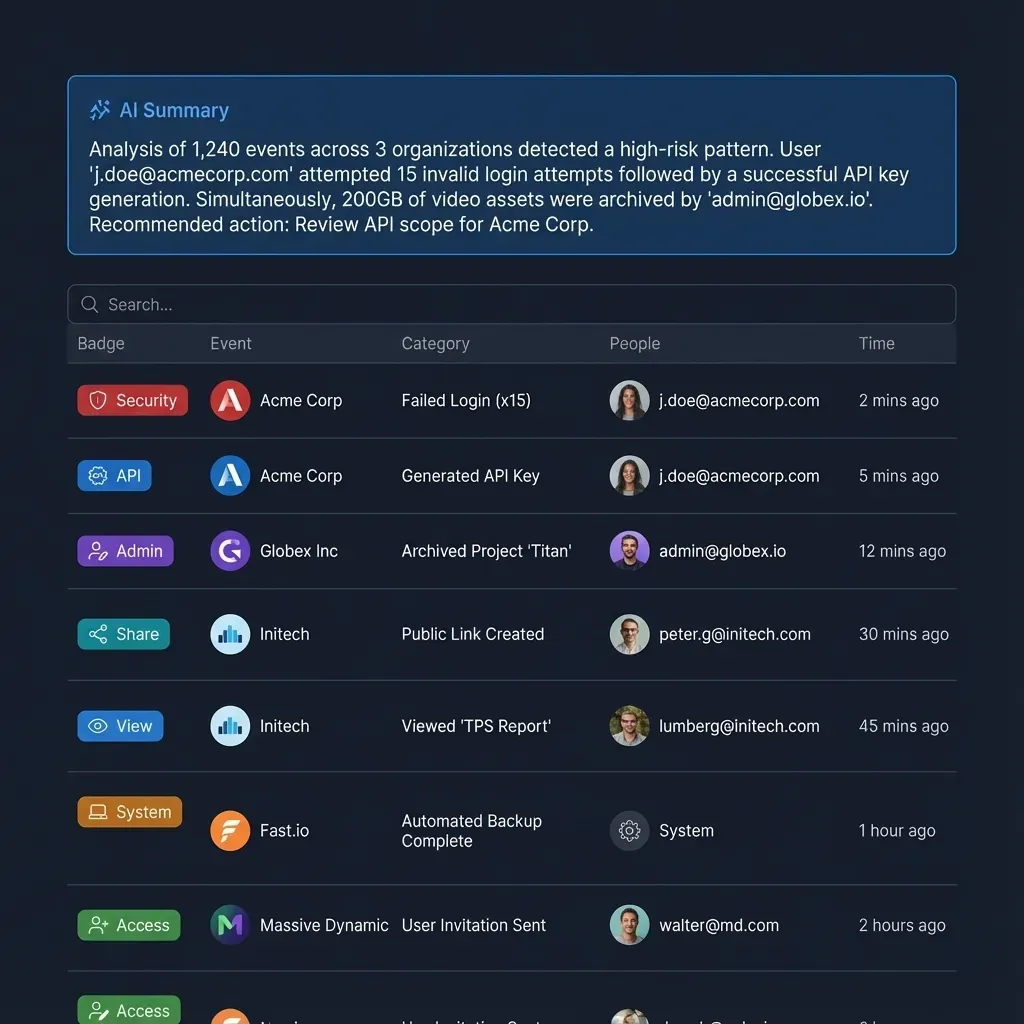
Beyond just saving file versions, it is important to know why a change occurred. An audit trail records which agent (or human) modified a file and when.
Who: Identity of the agent or user. When: Precise timestamp of the modification. What: The specific action taken (create, update, delete).
Audit logs are key for debugging agent behaviors. If an agent produces an incorrect output, you can trace back through the version history and logs to find exactly when the error started and which prompt caused it. In regulated industries like finance or healthcare, these audit trails are mandatory. You must be able to prove how a document was created, who modified it, and when. An immutable audit log provides this chain of custody, ensuring every artifact generated by your AI workforce is traceable. This transparency builds trust in autonomous systems and makes integration into enterprise workflows smoother.
Frequently Asked Questions
Do AI agents need version control for files?
Yes. AI agents need version control to prevent data loss when overwriting files, to enable rollback to previous good states, and to maintain a history of their work for debugging.
How does Fast.io handle file versioning for agents?
Fast.io automatically versions files when they are updated. Every time an agent uploads a file to an existing path, the new file becomes the current version, and the old file is saved in the history.
Can I restore a previous version of an agent-generated file?
Yes. With a version-aware storage system like Fast.io, you can list all versions of a file and restore any previous iteration. This helps you recover from agent errors or unwanted changes.
What is the best way to name agent output files?
For systems with built-in versioning, use consistent, semantic names (e.g., `quarterly-report.pdf`) and let the storage layer handle the history. For manual versioning, append ISO 8601 timestamps to filenames.
Related Resources

Run Manage AI Agent File Versions workflows on Fast.io
Give your AI agents persistent storage with automatic versioning and audit trails. Get 50GB free.