How to Set Up a Virtual Data Room for Your Next Deal
A virtual data room (VDR) is a secure online repository used for storing and sharing confidential documents during M&A transactions, due diligence, and other business-critical processes. This guide covers what VDRs do, who needs them, how to set one up, and what features matter most when comparing providers.
What Is a Virtual Data Room?
A virtual data room (VDR) is a secure online repository used for storing and sharing confidential documents during M&A transactions, due diligence, and other business-critical processes. Before VDRs, companies conducting mergers or acquisitions rented actual rooms. Lawyers, accountants, and analysts flew in, sat in windowless conference rooms, and reviewed paper documents while security guards watched. Copying was restricted. Notes were monitored. The process took weeks. Virtual data rooms moved this process online. Instead of a physical room, you get an encrypted cloud workspace with permission controls that determine who sees what, when they can access it, and whether they can download or print. The core function hasn't changed: provide controlled access to sensitive information for a specific purpose, then revoke that access when the purpose is complete.
Key characteristics of a VDR
- Security-first architecture: Encryption at rest and in transit, fine-grained permissions, audit trails
- Built for transactions: Designed for temporary, high-stakes access rather than everyday storage
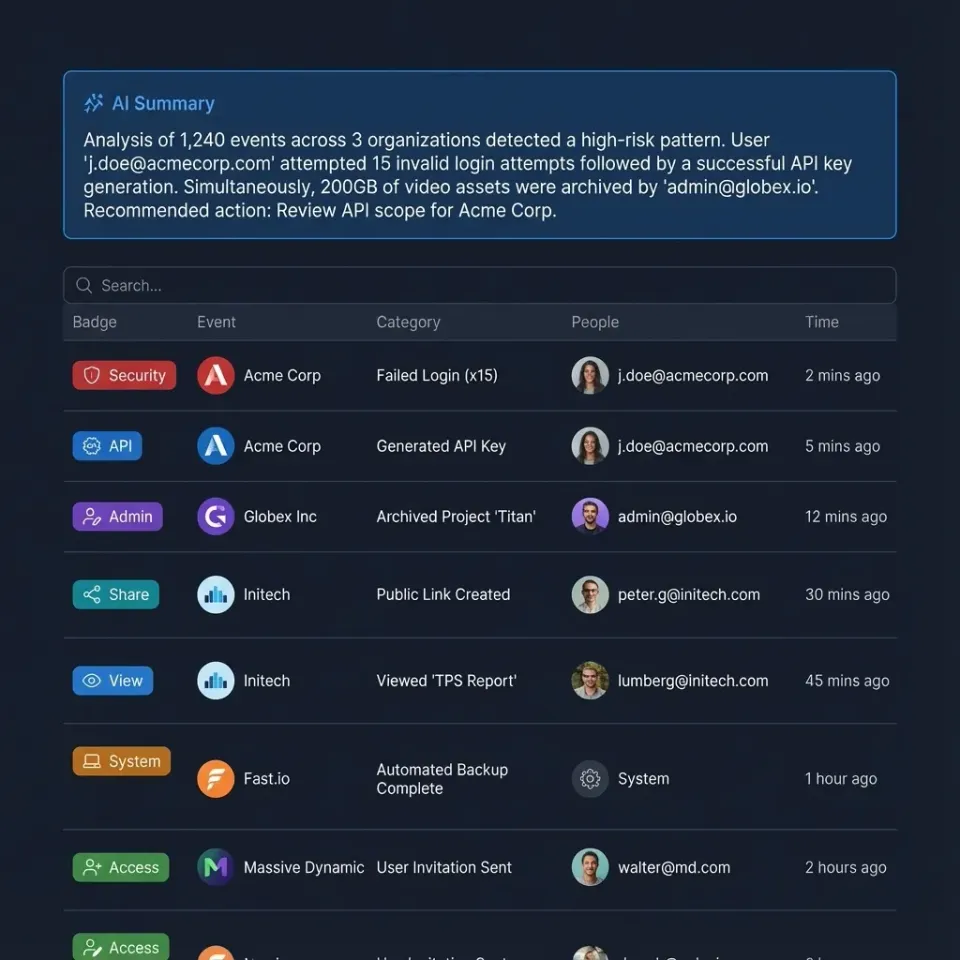
- Document tracking: See who viewed which documents, how long they spent, and what they downloaded
- Access revocation: Cut off all access with one click when a deal closes or falls through
VDRs aren't just secure file storage. They're transaction infrastructure that creates accountability around document access.
Helpful references: Fast.io Workspaces, Fast.io Collaboration, and Fast.io AI.
Who Uses Virtual Data Rooms?
VDRs originated in M&A but have expanded to any scenario requiring controlled document disclosure. Here's who uses them and why:
M&A buyers and sellers
M&A deal volume exceeded $3.2 trillion globally in 2024. Each deal involves extensive due diligence where buyers examine the seller's financials, contracts, intellectual property, litigation history, and more. Sellers need to share sensitive information without losing control of it. The average due diligence process involves 500+ documents. Managing this through email or basic cloud storage creates chaos and leaves security holes.
Investment banks and advisors
Banks managing transactions use VDRs to control information flow between parties. They need to know which potential buyers are actively reviewing materials (a signal of serious interest) versus those who requested access but never logged in.
Private equity and venture capital
PE firms conducting portfolio company acquisitions and VC investors reviewing term sheets both rely on VDRs. For fundraising, startups use VDRs to share pitch decks, financials, and cap tables with potential investors.
Legal teams
Law firms use VDRs for litigation document production, contract negotiations, and client matter management. E-discovery processes often require secure document sharing with opposing counsel under strict access controls.
Real estate transactions
Commercial real estate deals involve property documents, lease agreements, environmental reports, and tenant information. VDRs keep this organized and accessible to multiple parties: buyers, sellers, lenders, and inspectors.
Life sciences and biotech
Pharmaceutical companies share clinical trial data, regulatory filings, and intellectual property during licensing deals or acquisitions. A leak in this industry can tank stock prices or trigger regulatory action.
Boards and investors
Board members need secure access to meeting materials, financial reports, and strategic documents. VDRs provide a controlled environment that's more secure than email and more organized than shared drives.
Virtual Data Room vs. Cloud Storage
Every VDR is cloud storage, but not every cloud storage is a VDR. The difference comes down to purpose and features:
When cloud storage is enough
If you're sharing files with your team for ongoing collaboration, standard cloud storage works fine. You need easy access, version control, and search capabilities more than granular permissions.
When you need a VDR
Switch to a VDR when:
- External parties need temporary access to sensitive documents
- You need to prove who saw what and when
- Documents require different permission levels (some view-only, some downloadable)
- The stakes are high enough that a security breach would be catastrophic
- You're running a process with multiple bidders who shouldn't see each other's activity
The line blurs with modern platforms that offer data room functionality alongside everyday storage. You don't always need a separate system.
Essential VDR Features
VDRs vary widely in capability. When comparing providers, these features separate useful tools from expensive filing cabinets:
Document security
Encryption: Strong encryption at rest and modern TLS in transit. Industry baseline.
Watermarking: Dynamic watermarks that include the viewer's name, email, and timestamp on every page they view. If a document leaks, you know who leaked it.
View-only mode: Let users view documents in the browser without downloading. This keeps files off local machines where they're harder to control.
Print restrictions: Prevent printing for specific documents or users. Useful when you need people to review but not create paper copies.
Access control
Fine-grained permissions: Set different access levels per user, per folder, and per document. One investor might get full access while another only sees the executive summary.
Time-based access: Automatically expire access after a certain date. When a deal closes, access ends without manual revocation.
Domain restrictions: Only allow access from specific email domains. Useful when working with large organizations where you can't vet every individual.
Two-factor authentication: Require a second verification step beyond passwords. Some VDRs works alongside enterprise identity providers for SSO.
Activity tracking
Detailed audit logs: Record every login, document view, download, and print. Know who accessed what, when, and from where.
Viewer analytics: See how long each user spent on each document. A buyer who spent three hours on your financials is probably serious. One who skimmed for five minutes may not be.
Report generation: Export activity reports for your records or to share with stakeholders.
Deal workflow
Q&A functionality: Built-in question and answer workflows let potential buyers ask questions about documents. Answers are logged and can be shared with all parties or kept private.
Index numbering: Automatic hierarchical numbering that updates when reorganized. Crucial for referencing documents.
Bulk operations: Upload hundreds of documents at once while maintaining folder structure. Nobody wants to upload files one at a time.


Share Files Securely with Fast.io
Fast.io data rooms give you enterprise security features without enterprise pricing. Unlimited guests, detailed analytics, and one-click access control.
How to Set Up a Virtual Data Room
Setting up a VDR well takes preparation. Rushing leads to disorganized rooms, confused users, and security problems. Here's how to do it right:
Step 1: Define the purpose and timeline
Before touching any software, answer these questions:
- What's this data room for? (M&A, fundraising, litigation, board materials)
- Who needs access? (Internal team, buyers, advisors, legal)
- How long will access be needed?
- What's the sensitivity level of different documents? Your answers shape your structure and permissions. A fundraising data room for a Series A looks different from an M&A sell-side process with multiple bidders.
Step 2: Plan your folder structure
Map out your folder hierarchy before uploading anything. A typical M&A data room might look like:
1. Corporate Documents
   1.1 Charter and Bylaws
   1.2 Board Minutes
   1.3 Stockholder Agreements
2. Financial Information
   2.1 Audited Financials
   2.2 Tax Returns
   2.3 Budget and Projections
3. Contracts
   3.1 Customer Agreements
   3.2 Vendor Agreements
   3.3 Employment Agreements
4. Intellectual Property
   4.1 Patents
   4.2 Trademarks
   4.3 Licenses
5. Legal Matters
   5.1 Litigation
   5.2 Regulatory Compliance
Number your folders. It makes referencing specific documents in Q&A and negotiations much easier.
Step 3: Prepare and upload documents
Gather all documents before uploading. Check for:
- Consistent naming conventions (no "Final_v2_REAL_final.pdf")
- Redaction of sensitive information (Social Security numbers, personal data not relevant to the deal)
- Current versions only (old drafts create confusion)
- Searchable PDFs (scanned documents should be OCR'd)
Upload in bulk to maintain structure. Most VDRs let you drag entire folder hierarchies.
Step 4: Set up permissions and user groups
Create user groups based on access needs:
- Full access: Your internal team and advisors
- Bidder Group A: First potential buyer
- Bidder Group B: Second potential buyer
- Limited access: Parties who only need specific sections
Never give all bidders the same view. You may want to release information in stages or share different materials with different parties.
Step 5: Configure security settings
Enable these before inviting anyone:
- Two-factor authentication (required for all external users)
- Watermarking on sensitive documents
- View-only restrictions where appropriate
- Download permissions only where necessary
- Session timeouts for inactive users
Step 6: Invite users and provide instructions
Send clear instructions with invitations:
- How to log in and set up 2FA
- Overview of the folder structure
- How to use the Q&A feature
- Who to contact with technical issues
Don't assume users know how VDRs work. Many will be using one for the first time.
Step 7: Monitor and manage access
Once the room is live:
- Check activity logs daily
- Respond to Q&A promptly
- Add documents as they become available
- Revoke access immediately when needed
- Export final activity reports when the deal closes

VDR Pricing Models Explained
VDR pricing is notoriously opaque. Providers use different models that make comparison difficult. Here's what you'll see:
Per-page pricing
You pay based on the number of pages uploaded. Common among providers, charging based on document volume. Costs scale linearly with page count.
Pros: Predictable for known volumes.
Cons: Discourages adding materials to comprehensive rooms.
Per-user pricing
Monthly fees per active user. Enterprise plans cost more.
Pros: Simple.
Cons: Guests can inflate costs quickly in competitive processes.
Flat monthly fee
Fixed rate regardless of usage. Suitable for mid-market deals.
Pros: Budget predictability. No disincentive to add documents or users.
Cons: May pay for unused capacity.
Storage-based pricing
Pay for the amount of data stored, similar to standard cloud storage. Often combined with other metrics.
Project-based pricing
One-time fee for the deal lifecycle, based on complexity.
Pros: Fixed total cost upfront.
Cons: Hard to compare providers.
The hidden costs
Watch for additional charges:
- Setup fees
- Training fees
- Per-GB overage charges
- Q&A module fees
- Custom branding fees
- Archive access fees after deal completion
- Support tier upgrades
Mid-market reality check
Most VDR marketing focuses on large enterprises because that's where margins are highest. But mid-market companies running smaller deals face a problem: dedicated VDRs are overkill, but consumer tools lack the features. The VDR market is expected to reach $3.7 billion by 2028. Much of that growth will come from mid-market adoption as more companies realize they need data room features without paying enterprise rates.
How Fast.io Data Rooms Work
Fast.io takes a different approach than traditional VDR providers. Instead of a separate product for transactions, data room features are built into the core platform.
Data room features
Fast.io data rooms include:
- Deal Intelligence: Analytics showing who accessed which documents and how long they spent
- Branded portals: Your logo, colors, and custom URL for a polished presentation
- One-click revocation: Kill all access instantly when a deal closes
- Layered permissions: Control access at the organization, workspace, folder, and file level
- Password protection: Add passwords to shared links
- Expiration dates: Set automatic access cutoffs
- Watermarking: Dynamic watermarks on documents
- Domain restrictions: Limit access to specific email domains
Key differences from traditional VDRs
Usage-based pricing: Instead of per-page or high per-seat costs, Fast.io uses credits-based pricing. Pro plans include 25 seats; Business plans include 100 seats. Extra seats cost published pricing each. Adding external reviewers costs a fraction of what traditional VDRs charge.
No separate product: Data rooms are a feature of the platform, not a separate purchase. Use the same workspace for everyday collaboration, then configure a folder as a data room when a deal comes up.
Unlimited guest access: External users viewing your data room don't count against your seat limits. Share with as many potential buyers, investors, or partners as you need.
Modern interface: Traditional VDRs often have outdated designs. Fast.io prioritizes usability with browser streaming via HLS, no downloads needed.
What Fast.io data rooms don't have
To be clear about limitations: Fast.io doesn't have built-in Q&A workflows like dedicated VDR platforms. If you need structured Q&A with numbered responses and workflow routing, you may need a specialized VDR. The security features are there (encryption, audit logs, SSO, layered permissions), but if your deal requires certified compliance for regulatory reasons, check whether the platform meets your requirements.
Best Practices for Running a Secure Data Room
Having the right software is only part of it. Running a secure process takes ongoing discipline:
Minimize what you share
Include only the documents needed for the transaction. Every extra document increases exposure risk. For M&A, your legal advisors can help determine what's standard due diligence versus over-sharing.
Stage your disclosure
Don't give everyone everything on day one. Release documents in phases:
- Phase 1: High-level overview (teaser, executive summary)
- Phase 2: Core materials (financials, key contracts)
- Phase 3: Detailed documents (full contract library, technical specs)
This lets you gauge buyer interest before sharing your most sensitive information.
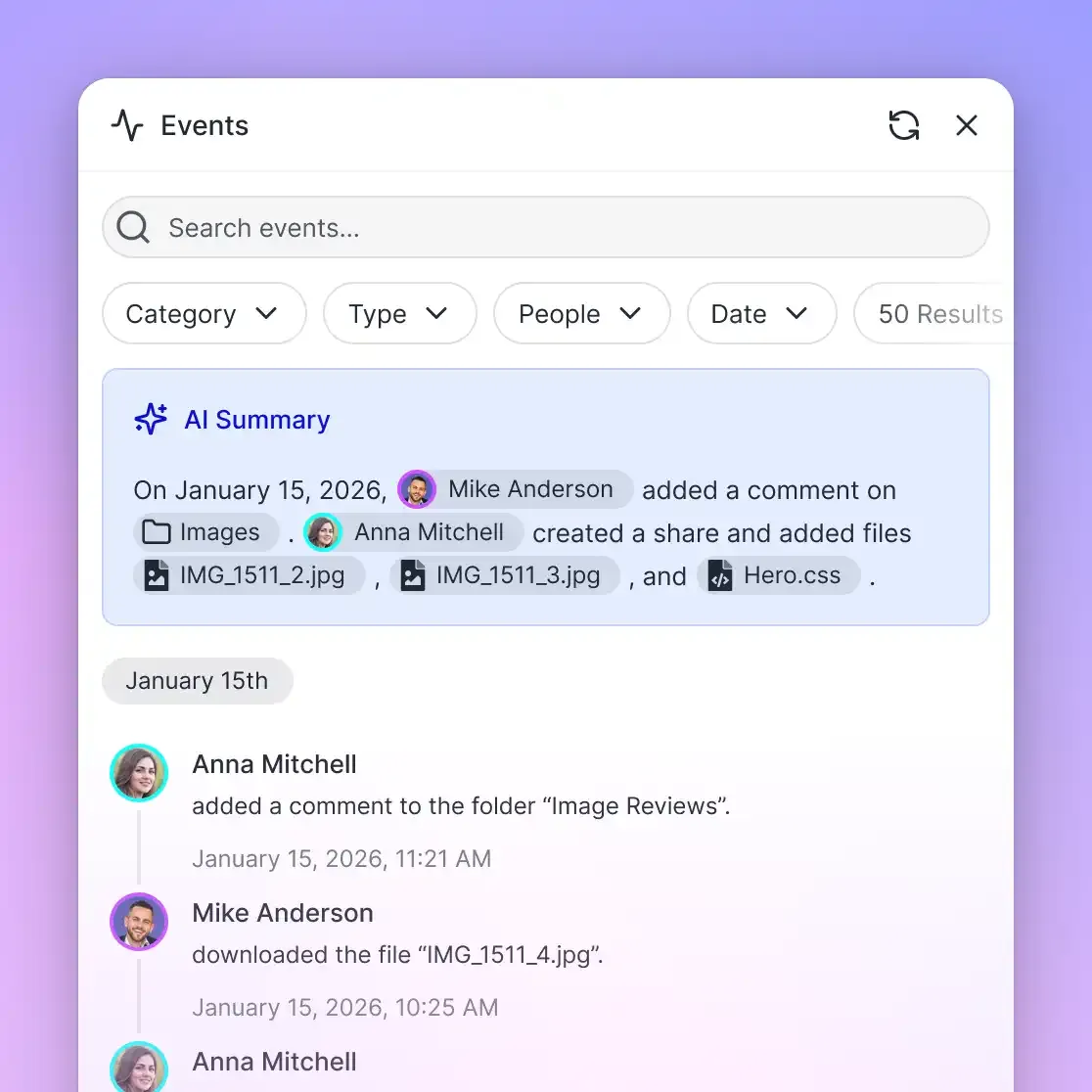
Monitor activity patterns
Check activity logs regularly. Look for:
- Users who requested access but never logged in (follow up or revoke)
- Unusual access times (could indicate credential sharing)
- Download spikes (might signal a bidder is preparing final due diligence)
- Lack of activity from a bidder (they may have lost interest)
Activity data reveals where your deal actually stands.
Respond to Q&A promptly
Slow responses frustrate buyers and extend timelines. Designate someone to monitor and respond to questions daily. Establish who can answer what: legal questions to lawyers, financial questions to CFO, technical questions to CTO.
Document your security practices
Keep records of:
- Who was granted access and when
- What permissions each party received
- When access was modified or revoked
- Any security incidents and how they were handled
This creates a defensible paper trail if questions arise later.
Close the room properly
When the deal ends:
- Revoke all external access immediately
- Export final activity reports
- Archive the room with all documents and logs
- Determine retention requirements (some industries require keeping deal records for years)
Don't leave old data rooms accessible. Forgotten access is a security liability.
Common VDR Mistakes to Avoid
Experienced deal teams see the same mistakes repeatedly. Here's what to avoid:
Disorganized structure
A data room with hundreds of files in a few folders is useless. If buyers can't find what they need, they'll request items that are already there, wasting everyone's time. Invest in organization upfront.
Inconsistent naming
"Q3 Financials Final v2 (John's edits).xlsx" tells buyers nothing. Use consistent naming like "Financial_Q3_2024_Statements.xlsx" matching folder structure.
Too many permissions
Complexity creates confusion. Use a few permission categories instead of many. Simpler structures reduce errors.
Sharing too early
Don't open your data room until it's ready. First impressions matter. A half-populated, disorganized room signals a disorganized company.
Not testing access
Before inviting external users, test the experience yourself. Log in as a guest. Can you find key documents? Is the structure intuitive? Do watermarks appear correctly?
Ignoring activity data
Activity logs aren't just for security. They're intelligence. A bidder spending substantial time reviewing documents shows serious interest compared to casual logins. Use this data to prioritize your engagement.
Forgetting about mobile
Reviewers often access data rooms from phones and tablets, especially busy executives reviewing materials between meetings. Verify your VDR works well on mobile before launch.
No backup plan
Technology fails. Have a contingency for providing critical documents if your VDR goes down during a important phase. This shouldn't be your primary approach, but know what you'd do in an emergency.
Frequently Asked Questions
What is a virtual data room used for?
A virtual data room is used for securely storing and sharing confidential documents during business transactions. Common uses include M&A due diligence, fundraising, legal proceedings, real estate transactions, board communications, and any situation where multiple external parties need controlled access to sensitive documents.
How much does a virtual data room cost?
VDR pricing varies widely by provider and model. Pricing varies by model. Per-page, per-user, flat monthly, and project-based options exist. Costs scale with usage, users, and deal complexity.
What is the difference between a data room and a virtual data room?
A traditional data room is a physical location where paper documents are stored for in-person review. A virtual data room is the digital equivalent: a secure online repository that provides the same controlled access through the internet. VDRs offer advantages including remote access, detailed activity tracking, instant access revocation, and no geographic constraints.
Who uses virtual data rooms?
VDRs are used by M&A buyers and sellers, investment banks, private equity and venture capital firms, legal teams, real estate professionals, life sciences companies, and corporate boards. Anyone managing a transaction or process that requires secure, temporary, auditable access to sensitive documents benefits from VDR functionality.
How do I choose a virtual data room provider?
Evaluate providers on security features (encryption, watermarking, access controls), activity tracking capabilities, ease of use, pricing model fit for your needs, and customer support quality. Consider whether you need dedicated VDR software or whether a platform with data room functionality built into broader file sharing meets your requirements.
Are virtual data rooms secure?
Quality VDRs offer strong security through encryption at rest and in transit, granular permission controls, two-factor authentication, watermarking, audit logs, and access revocation capabilities. Security varies by provider, so evaluate specific features rather than assuming all VDRs offer equivalent protection.
Can I use regular cloud storage as a data room?
Standard cloud storage lacks the granular permissions, detailed activity tracking, watermarking, and transaction-focused features of a true VDR. For low-stakes document sharing it may suffice, but for M&A, fundraising, or litigation, the security and audit capabilities of a proper VDR are worth the investment.
Related Resources

Share Files Securely with Fast.io
Fast.io data rooms give you enterprise security features without enterprise pricing. Unlimited guests, detailed analytics, and one-click access control.