How to Build a Custom ChatGPT Knowledge Base with External Files
A ChatGPT knowledge base allows custom GPTs to answer questions using your specific business data. While OpenAI allows uploading up to 20 static files, enterprise needs require dynamic solutions that scale. This guide shows how to build a knowledge base using external file storage that updates in real-time.

What is a ChatGPT Knowledge Base?
A ChatGPT knowledge base is a collection of specific documents (PDFs, spreadsheets, text files) that a custom GPT uses as its primary source of truth. Instead of relying on its general training data, the model "reads" your provided files to answer questions with accuracy specific to your organization. For developers and businesses, the challenge isn't just creating a knowledge base but maintaining it. Static uploads to OpenAI become outdated the moment a file changes. A dynamic knowledge base connects ChatGPT to a live file system, so answers always reflect the latest versions of your documents without manual re-uploading. The biggest benefit of this approach is fewer "hallucinations," where AI confidently invents facts. By grounding the model in your proprietary data, you constrain it to answer based only on the information provided. If the answer isn't in your files, a well-configured agent can admit it doesn't know rather than guessing. This matters for business reliability and trust.

Method 1: Using OpenAI's Native File Uploads
The simplest way to create a knowledge base is through OpenAI's "Create a GPT" interface. This method works well for personal use, quick prototypes, or small projects where the data rarely changes.
How to set it up: 1.
Open ChatGPT and navigate to "Explore GPTs" > "Create". 2.
Configure the GPT's name, description, and custom instructions. 3.
Upload Files: Click the "Upload files" button in the "Knowledge" section. You can select PDFs, Word documents, text files, or spreadsheets. Note there's a limit of 20 files per GPT, and large files may fail to process. 4.
Test the GPT to make sure it cites your documents correctly. Ask it specific questions found only in your uploaded docs to verify it's using the knowledge base. While easy to start, this method has big limitations for professional use. You cannot programmatically update files, meaning every time a document changes, you must manually log in, delete the old file, and upload the new one. The 20-file limit is also restrictive for detailed documentation, and file processing can be slow or time out with complex datasets. For professional workflows that need reliability or scale, you'll want external storage.
Method 2: Connecting External Storage via APIs
To get past the limits of static uploads, developers can connect ChatGPT to external storage using APIs. This approach allows the AI to access thousands of files and retrieve only the relevant context when needed.
Understanding Retrieval-Augmented Generation (RAG) At the core of this method is a process called RAG. When a user asks a question, the system doesn't send all your files to the AI at once (that would be too expensive and exceed token limits). Instead, it performs a "semantic search" to find the specific paragraphs or data points relevant to the question. It then sends only those snippets to ChatGPT along with the user's prompt. This means the model has the exact context it needs to answer accurately and efficiently.
Fast.io provides specialized infrastructure for this. By using Fast.io as your storage backend, you can create a knowledge base that is:
- Live: Updates to files in your Fast.io workspace are immediately available to the AI. * Scalable: Store terabytes of data, not just 20 files. * Intelligent: Built-in RAG automatically indexes content for retrieval. With the Fast.io MCP (Model Context Protocol) server, you can connect your file system directly to AI agents without building custom integrations.
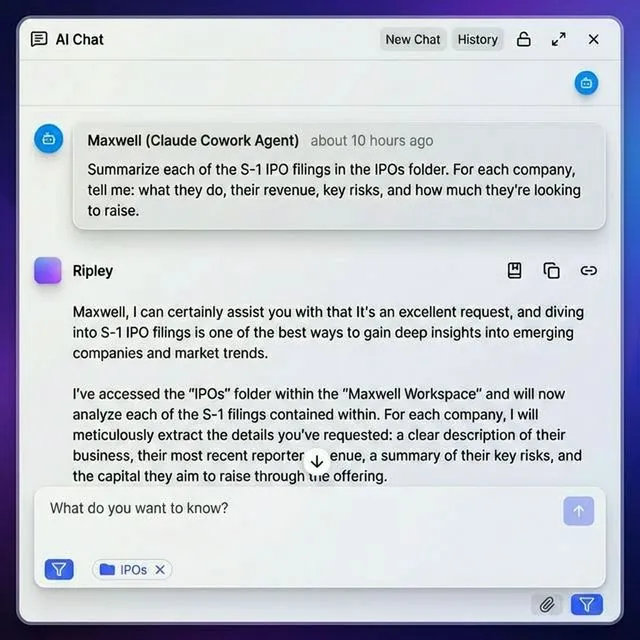
Comparison: Static Uploads vs. Dynamic Knowledge Base
Choosing the right approach depends on your scale and update frequency. Here's how native uploads compare to a dynamic solution like Fast.io.
| Feature | Native ChatGPT Uploads | Fast.io Dynamic Storage |
|---|---|---|
| File Limit | 20 files | Unlimited (50GB Free) |
| Update Mechanism | Manual delete & re-upload | Instant sync (Drag & drop or API) |
| File Types | Standard text/PDF | Any file type (Video, CAD, Code) |
| Search Method | OpenAI internal search | Semantic Search + RAG |
| Access Control | All or nothing | Granular permissions & file locks |
| Best For | Personal experiments | Enterprise & automated workflows |
Verdict: Use native uploads for one-off tasks where data is static. Use a dynamic backend for business processes where data changes often or exceeds simple file counts.
Common Use Cases for Dynamic Knowledge Bases
A live knowledge base changes how different departments operate. Here are the scenarios where dynamic storage beats static uploads:
Customer Support Automation Support teams deal with constantly changing product details, troubleshooting guides, and feature releases. A static GPT becomes outdated weeks after creation. By connecting to a live folder of support articles, your AI agent can always provide current answers to customer queries, reducing ticket volume and response times.
Internal HR and Policy Assistants Employee handbooks, benefits documentation, and compliance policies are living documents. An internal HR bot connected to a secure, updated file repository makes sure staff always get accurate information about holidays, insurance, or remote work policies. HR staff don't need to answer repetitive questions manually.
Technical Documentation for Developers For engineering teams, API documentation and system architecture diagrams evolve daily. A coding assistant with access to the latest repository of technical specs lets developers ask questions like "How do I authenticate with the new v2 endpoint?" and get answers based on code written yesterday, not last month.
Legal and Contract Review Legal teams manage large libraries of templates and past contracts. An AI agent with secure access to these archives can draft new clauses based on approved precedents or quickly summarize the obligations in a new 50-page agreement, strictly following the firm's established language and risk parameters.
Best Practices for Formatting Knowledge Base Files
Regardless of the storage method, how you format your data affects ChatGPT's performance. Poorly structured files lead to hallucinations or missed information.
Optimization Tips:
- Use Markdown (.md): AI models parse Markdown structure (headers, lists) more accurately than PDFs. * Chunk Content: Break massive manuals into smaller, topic-specific files to improve retrieval accuracy. * Clear Headings: Use H1 and H2 tags to label sections clearly. The AI uses these as "signposts" to find data. * Remove Noise: Strip out headers, footers, and page numbers from text exports to save context tokens. * Think About Security: Not all data should be accessible to every user. When building a knowledge base, make sure your storage backend supports permissions. You don't want an intern's AI assistant pulling up executive salary spreadsheets. Dynamic storage solutions often let you restrict which folders the AI agent can "see". According to internal benchmarks, converting complex PDFs to clean Markdown can improve retrieval accuracy by up to 30% for technical queries. Making your file names descriptive and consistent also helps the retrieval system identify the most relevant documents before even opening them.
Frequently Asked Questions
How many files can I upload to a custom GPT?
OpenAI currently limits custom GPTs to 20 files per GPT for native knowledge bases. For unlimited file access, you need to connect an external storage solution like Fast.io via API or MCP.
Does ChatGPT automatically update its knowledge base?
No, native custom GPTs do not auto-update. You must manually upload new versions of files. However, using an external knowledge base connected via API allows the AI to always access the live version of your documents.
Can ChatGPT read files from Google Drive?
ChatGPT cannot directly access Google Drive files unless you use an integration tool or middleware. Fast.io allows you to import files from Google Drive via URL and then expose them to AI agents securely.
Related Resources

Give Your AI Unlimited Knowledge
Stop hitting file limits. Create a dynamic, live-updating knowledge base for your AI agents with Fast.io's free tier.