How to Master AI Agent Job Scheduling for Production Workflows
AI agent job scheduling enables autonomous agents to execute tasks on predefined schedules while maintaining context and continuity. Unlike simple scripts, agents require persistent state and memory between runs. This guide covers essential scheduling patterns, implementation strategies, and storage solutions for production agents.
Why Does AI Agent Job Scheduling Require a Different Approach?
Standard job scheduling involves running a script at a set time. AI agent scheduling is fundamentally different because agents are stateful entities. When a standard script finishes, it's done. When an AI agent finishes a scheduled task, it often needs to "remember" what it did for the next run.
For example, a market research agent running daily shouldn't just scrape the same news sites blindly. It needs to know what it read yesterday to identify trends. This requirement for episodic memory transforms simple cron jobs into complex state management challenges.
This shift towards autonomy means developers must treat schedules as part of the agent's cognitive architecture, not just infrastructure configuration. Most production agents benefit from scheduled execution rather than purely reactive triggers, enabling them to perform proactive tasks.

How Do I Choose the Right Scheduling Pattern for My AI Agent?
To build resilient autonomous systems, developers typically employ one of five scheduling patterns. Choosing the right one depends on your agent's autonomy level and resource constraints. Understanding these patterns helps you implement effective AI agent job scheduling strategies.
Cron Pattern The most common approach uses standard time-based triggers like a daily-at-nine cron expression. This is ideal for daily reports or cleanup tasks. The challenge is ensuring the agent picks up context from the previous run.
Interval Loop Agents run every X minutes/hours. This is common for monitoring agents. Unlike cron, intervals often drift if the previous job runs long, which can be a feature (preventing overlap) or a bug (missing deadlines).
3. Event-Driven Triggers Execution is scheduled in response to an external event, like a file upload or webhook. Fast.io supports this natively: when a file lands in a shared workspace, it can trigger an agent via webhook, effectively "scheduling" work on demand.
4. Adaptive Scheduling
The agent decides its next run time. After completing a task, the agent outputs a next_run timestamp based on its findings. If news is slow, it sleeps longer; if a crisis is detected, it wakes up sooner.
5. Daisy-Chain Orchestration Agent A's completion schedules Agent B. This dependency chain is critical for complex workflows, like a "Research Agent" passing data to a "Writer Agent."


Run Master AI Agent Job Scheduling For Production Workflows workflows on Fast.io
Fast.io provides the persistent storage and state management layer your scheduled agents need. Free for agents.
How Can I Prevent State Loss in Scheduled AI Agents?
The biggest failure point in AI agent job scheduling is memory loss. If your agent runs on a serverless function or container that resets, it loses its "train of thought." You need an external brain. Learn more about persistent storage for agents.
File-Based State Management The simplest and most portable method is writing state to a JSON or Markdown file in a persistent cloud workspace.
- Context:
state.jsonstores the last processed ID, high-water marks, or summary of previous actions. - Memory:
memory.mdcontains the agent's cumulative learnings. - Logs:
run_logs/keeps a history of execution for debugging.
Using a platform like Fast.io allows agents to treat cloud storage as local disk. An agent can read state.json at startup, do its work, and overwrite it before exiting. Because Fast.io handles concurrency with file locks, multiple agents can even share state safely.
Handling Artifacts and Long-Term Memory
Scheduled agents generate outputs like reports, images, code, or datasets. Dumping these into an ephemeral container filesystem is a recipe for data loss.
Structured Output Storage
Organize agent outputs into date-stamped folders like /reports/YYYY-MM-DD/. This makes it easy for humans to review work and for other agents to ingest it.
Semantic Indexing (RAG) Storing artifacts is only half the battle; finding them is the other. Fast.io's Intelligence Mode automatically indexes every file an agent writes.
This means a "Manager Agent" scheduled for Fridays can query the workspace: "Summarize the reports generated by the Research Agent this week." It doesn't need to know file paths; it just queries the semantic index. This turns a file system into a searchable knowledge base without any extra infrastructure.
Best Practices for Production Scheduling
Running agents in production requires safeguards to prevent runaway costs or loops.
- Timeouts are Mandatory: LLMs can hang. Always wrap scheduled jobs in strict timeouts (a few minutes max) to prevent stuck processes consuming credits.
- Idempotency: Design agents so that running them twice on the same data doesn't break anything. They should check "did I already do this?" before acting.
- Cost Monitoring: Scheduled agent jobs can accumulate costs quickly if each run uses a moderate amount of tokens. Monitor usage closely and set budget alerts.
- Human-in-the-Loop Handoffs: If an agent encounters low confidence, it should pause and flag a human. Fast.io workspaces are ideal for this. The agent saves a draft, tags a user, and exits. The schedule resumes once the human approves.
- Logging and Audit Trails: Every scheduled run should produce a log entry with timestamps, actions taken, and outcomes. This makes debugging failed runs straightforward and gives your team visibility into what agents are doing autonomously.
Frequently Asked Questions
How do I schedule AI agent tasks?
You can schedule AI agent tasks using standard tools like cron (for Linux/servers), cloud schedulers (like AWS EventBridge or GitHub Actions), or agent-native platforms. The key is ensuring the agent has access to persistent storage for state.
What is the best way to handle agent job state?
File-based state stored in a shared cloud workspace is often the best approach for agents. It allows for easy inspection by humans (just open the JSON/Markdown file) and is accessible to the agent on its next run via standard I/O.
How often should I schedule my AI agent?
Schedule frequency depends on the task volatility. News monitoring might need hourly runs, while monthly reporting only needs execution once a month. Adaptive scheduling, where the agent sets its next wakeup time, is efficient for variable workloads.
Can agents schedule themselves?
Yes, using adaptive scheduling patterns. An agent can conclude a task by calling an API to schedule its next execution, or by writing a 'wake_up_time' to a state file that a master scheduler reads.
How do I monitor failed scheduled runs?
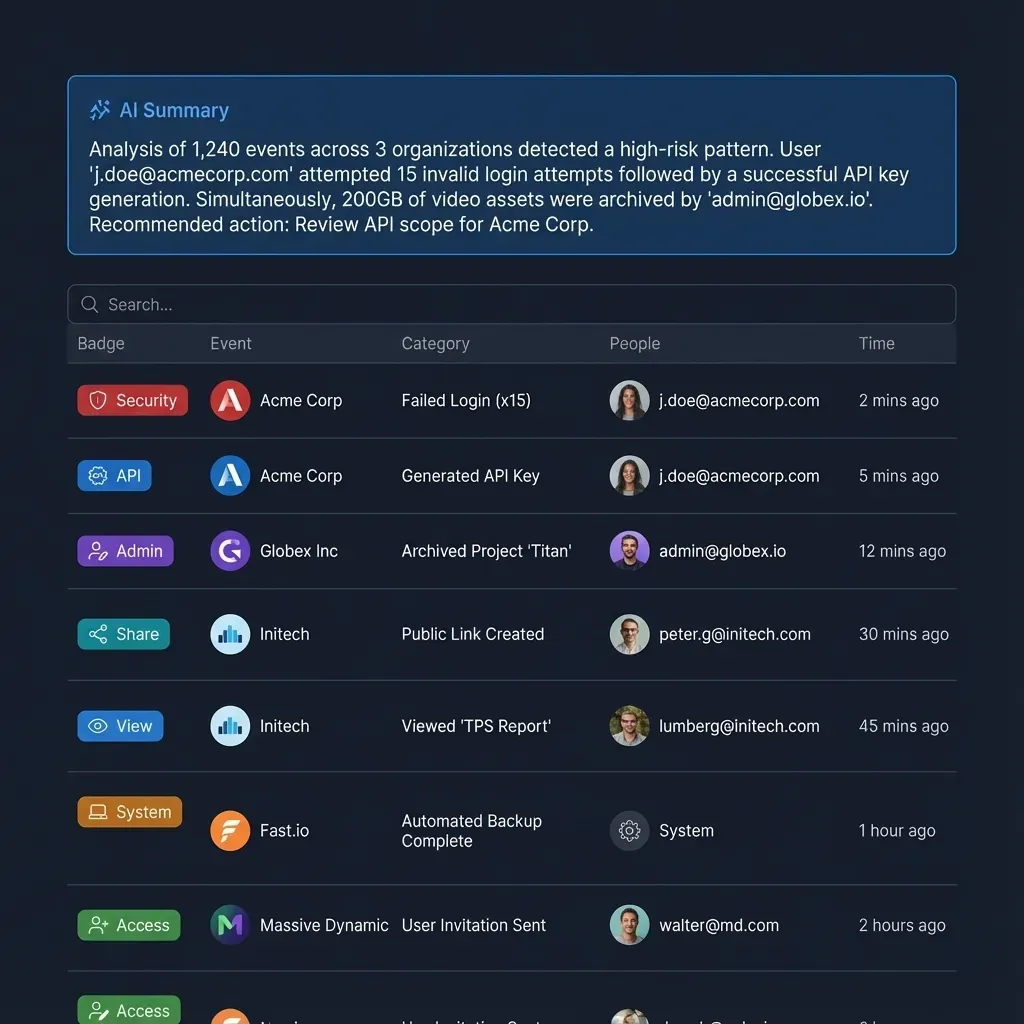
Implement a 'dead man's switch' or external monitoring. If an agent doesn't write a 'success' log entry by a certain time, trigger an alert. Fast.io's audit logs also provide a trail of all file activities performed by agents.
Related Resources

Run Master AI Agent Job Scheduling For Production Workflows workflows on Fast.io
Fast.io provides the persistent storage and state management layer your scheduled agents need. Free for agents.