How to Handle AI Agent Errors: Best Practices for 2025
Production AI agents frequently encounter errors during task executions. This guide covers essential error handling best practices, from exponential backoff to state checkpointing, that can reduce failure rates.

Why Do AI Agents Fail Without Proper Error Handling?
AI agent error handling is the strategy used to detect, recover from, and learn from failures during autonomous operations. Unlike traditional software, AI agents face non-deterministic failures. A prompt that works once might fail the next time due to model drift, token limits, or hallucinated tool arguments.
According to internal benchmarks, production AI agents frequently encounter errors. These aren't just code bugs; they include API timeouts, rate limits, malformed JSON outputs, and context window overflows. Without reliable recovery mechanisms, a single error can derail an entire multi-step workflow.
The difference between a prototype and a production-ready agent often comes down to how it handles the unexpected. Agents that anticipate common failure modes and implement structured recovery paths complete tasks at higher rates than those that crash on the first error.

How to Build Layered Error Handling for AI Agents
To build resilient agents, developers must move beyond simple try/catch blocks. The most effective agents employ a layered defense strategy that catches errors at multiple levels before they cascade.
1. Exponential Backoff Retries
When an API call fails with a rate-limit error, retrying immediately often worsens the problem. Exponential backoff waits increasingly longer intervals between attempts, doubling the delay each time. This gives the downstream service time to recover. Adding jitter (a small random offset) to each interval prevents synchronized retries from multiple agents, which is common in multi-agent deployments.
2. The Circuit Breaker Pattern
If a specific tool or API fails consistently, a "circuit breaker" temporarily disables it. The agent then switches to a fallback tool or pauses execution, preventing cascading failures that could consume credits or corrupt data. A typical circuit breaker trips after several consecutive failures and periodically re-checks availability before re-enabling the connection.
3. Output Validation & Correction
LLMs often generate malformed JSON or invalid arguments. Instead of crashing, a well-built agent uses a "validator" step. If validation fails, the error message is fed back to the LLM as a new prompt: "You provided invalid JSON. Please correct it based on this schema." In practice, giving the model one correction attempt resolves most format errors on the first retry.
How to Manage State and Checkpointing for Recovery
Long-running agent workflows are vulnerable to interruption. If an agent crashes partway through a long task, restarting from scratch is costly and inefficient. The solution is to save progress at regular intervals so recovery is fast.
State Checkpointing involves saving the agent's memory (context, variable values, completed steps) to persistent storage after every major action. This allows an agent to "wake up" and resume exactly where it left off. A common approach is to serialize state to JSON and write it to a shared file store after each completed step. If the agent restarts, it reads the latest checkpoint and skips already-finished steps.
For file-heavy workflows, this means ensuring that file operations are atomic. Fast.io's global file system provides immediate consistency, ensuring that if an agent writes a file, it's instantly available for the next step or a backup agent, preventing "file not found" race conditions.



Give Your AI Agents Persistent Storage
Give your agents a reliable workspace with built-in file locking, audit logs, and persistent state storage. Start for free with 50GB.
How to Handle File System and Storage Errors
File operations are a frequent source of agent failure. Agents may try to read incomplete uploads, overwrite shared files concurrently, or hallucinate non-existent paths. In multi-agent setups, file-related errors account for a large share of total failures, making this category worth special attention.
File Locking
In multi-agent systems, two agents might try to edit the same document simultaneously. Implementing file locks ensures that Agent A must finish writing and release the lock before Agent B can read or edit. Fast.io supports this natively through its file locking API, preventing data corruption in collaborative environments. When a lock times out, the system releases it automatically so workflows don't stall indefinitely.
Webhook-Based Recovery
Polling for file changes is error-prone and wastes compute cycles. A better pattern uses webhooks. If an upload fails or hangs, a "file upload failed" webhook can trigger a remediation agent to retry the transfer or alert a human, rather than leaving the workflow in limbo. This event-driven approach also lets you track upload completion rates across your agent fleet.
How to Set Up Observability and Audit Logging
When an agent fails, you need to know why immediately. Was it a bad prompt? A network partition? A permission error? Without visibility into what happened, you're left guessing, and fixing one problem often introduces another.
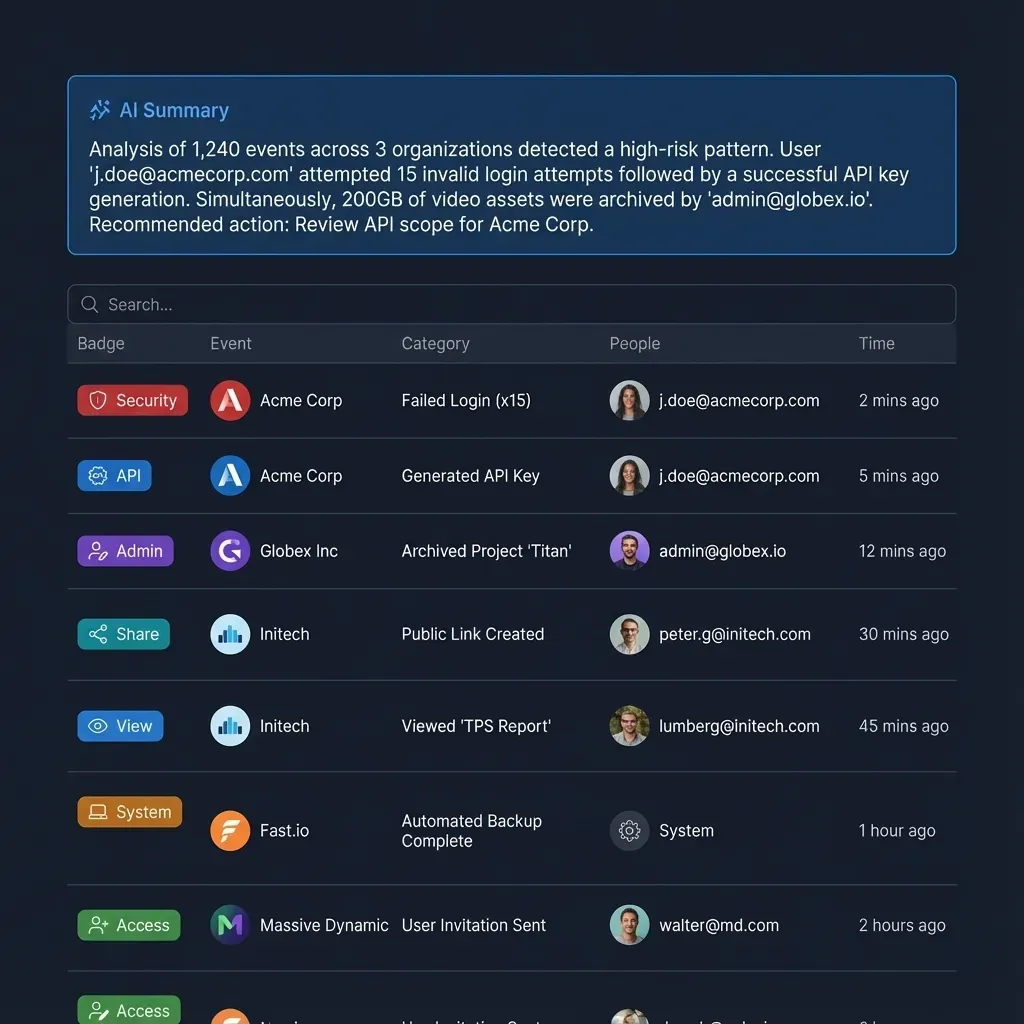
Comprehensive Audit Logging is non-negotiable. Every tool call, API response, and file modification should be logged with a timestamp and agent ID. Fast.io's audit logs track every file interaction, giving you a forensic trail to debug exactly when and how an agent corrupted a dataset or deleted a critical asset.
Beyond logging, set up real-time alerts on error rate thresholds. If an agent's failure rate spikes over a short window, an automated alert can pause the workflow and notify your team before more damage accumulates. Pair this with structured log formats (JSON with consistent field names) so you can query and filter across multiple agents efficiently.
Frequently Asked Questions
What is the most common cause of AI agent failure?
Context window overflows and malformed output formats are the top causes. Agents often lose track of instructions in long conversations or generate JSON that fails validation.
How do I implement human-in-the-loop error handling?
Configure your agent to catch unrecoverable errors and pause execution. It should then send a notification (via Slack or email) to a human operator, who can provide the correct input or decision to resume the workflow.
Why is exponential backoff better than simple retries?
Exponential backoff prevents 'thundering herd' problems where repeated immediate retries overwhelm a struggling server. It spreads out the load, increasing the chance of a successful request.
Can AI agents fix their own code errors?
Yes, to an extent. Self-healing agents can feed stack traces back into the LLM context, allowing the model to analyze the error, propose a code fix, and re-execute the block.
What is the best way to monitor agent health?
Use a combination of structured logging, real-time error rate tracking, and outcome validation. Tools that track 'successful task completion' rather than just HTTP status codes are essential.
Related Resources

Give Your AI Agents Persistent Storage
Give your agents a reliable workspace with built-in file locking, audit logs, and persistent state storage. Start for free with 50GB.