How to Implement an AI Agent Audit Trail for Compliance
An AI agent audit trail provides the accountability required by modern regulations. Learn how to track autonomous decisions, file operations, and API calls to ensure your agentic workflows remain transparent and compliant.

What Is an AI Agent Audit Trail?
An AI agent audit trail is a chronological record of every action an autonomous agent takes, including file operations, API calls, and reasoning steps, providing accountability and compliance documentation. Unlike standard application logs, agent audit trails must capture the "why" behind an action, including the prompt, the context, and the decision logic, alongside the "what."
For enterprises deploying autonomous agents, these logs serve two critical functions: compliance with regulations like the EU AI Act and operational debugging. When an agent deletes a file or approves a transaction, you need a definitive record of which agent acted, what permissions it held, and what data triggered the decision.
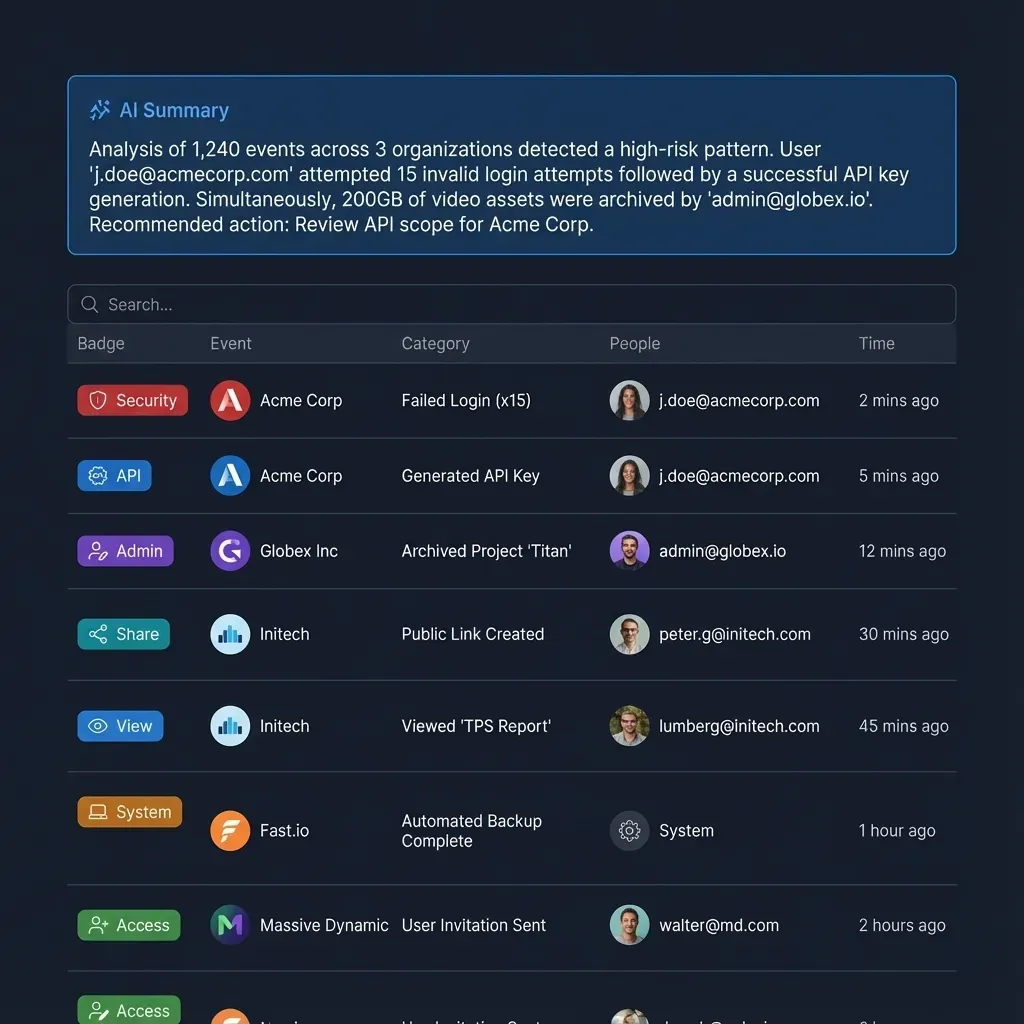
Why Audit Logs Are Critical for Compliance
Regulatory frameworks are rapidly evolving to address autonomous systems. The EU AI Act, for instance, mandates traceability for high-risk AI systems to ensuring that outcomes can be verified and challenged.
Key Compliance Drivers:
- Accountability: You must be able to attribute every system action to a specific agent identity.
- Transparency: Stakeholders need to understand how decisions were reached, not just the final output.
- Security: Detecting anomalous behavior requires a baseline of logged normal activity.
According to the European Commission, high-risk AI systems must automatically generate logs for a duration appropriate to the risks, ensuring traceability of the system's functioning throughout its lifecycle.
The Cost of Invisibility
Without granular audit trails, organizations face significant risks. If an agent hallucinates and modifies a critical contract, a lack of logs makes root cause analysis impossible. You cannot correct a prompt or adjust a temperature setting if you don't know which interaction caused the error. In regulated industries, this gap can result in fines, failed audits, or loss of customer trust. See our guide on AI agent observability for a broader look at monitoring agent behavior.
The Five Layers of a Complete Agent Audit Trail
A thorough audit trail requires capturing data at five distinct layers. Most observability tools focus only on the LLM layer, leaving gaps in the actual execution and side effects. Covering all five layers gives you the full picture from trigger to outcome.
- Identity Layer: Who acted? (Agent ID, Model Version, Auth Token)
- Input Layer: What triggered it? (User prompt, Webhook event, File change)
- Reasoning Layer: Why did it decide? (Chain-of-thought, Prompt context, Confidence score)
- Action Layer: What did it do? (File upload, API POST, Database write)
- Outcome Layer: What was the result? (Success/Fail status, New file hash, Response time)
The most common gap is between the Reasoning and Action layers. An agent may log its chain-of-thought but fail to record the actual API call it made, making it impossible to verify that the action matched the intent.
How to Implement Traceability in Agent Workflows
Building an effective audit system involves integrating logging at the infrastructure level. You cannot rely on the agent to "self-report" its actions reliably.
Step 1: Assign Unique Identities
Every agent instance must have a unique API key or service account. Never share credentials between human users and agents. This ensures that the "Actor" field in your logs clearly distinguishes between User: Sarah and Agent: InvoiceBot-v2.
Step 2: Centralize Storage Events
Agents primarily interact with the world by reading and writing files. Your storage layer must automatically log every read, write, delete, and share event.
Step 3: Correlate Traces with Actions
Use a trace_id that persists across the LLM inference (the "thought") and the subsequent API call (the "action"). This allows you to map a specific file deletion back to the specific user prompt that authorized it. For a deeper look at how agents interact with storage systems, see how to connect an AI agent to file storage.
Fast.io: The Action Layer Audit Log
While tools like LangSmith or Arize handle the LLM reasoning traces, Fast.io provides the critical "Action Layer" audit trail for file operations. When your agent uses the Fast.io MCP server or API to manage workspace files, every interaction is secured and logged.
Built-in Agent Observability:
- Granular Permissions: See exactly which files an agent accessed.
- Version History: Track every modification an agent makes to a document.
- Identity Management: Agents operate with distinct credentials, keeping their actions separate from human team members.
Fast.io's workspaces are designed for human-agent collaboration. You can view the audit log to see that Agent-Alpha uploaded a report in the afternoon, and User: Mike reviewed it minutes later, creating a clear chain of custody.
Best Practices for Log Retention
Data retention policies should balance compliance requirements with storage costs. Getting this balance wrong can expose you to regulatory penalties or inflate your infrastructure budget unnecessarily.
- Retention Period: The EU AI Act suggests retaining logs for at least six months for high-risk systems. For financial or healthcare related agents, 7 years is often the standard depending on the applicable regulation.
- Immutability: Audit logs should be "write-once, read-many" (WORM) to prevent tampering. If an agent is compromised, it should not be able to erase its own tracks.
- Accessibility: Logs must be searchable. In the event of an audit, you need to quickly filter by
Agent_IDorFile_Nameto reconstruct a sequence of events. - Separation of Concerns: Store audit logs in a separate system from the agents being monitored. This prevents a compromised agent from accessing or modifying its own logs.
Frequently Asked Questions
What should an AI agent audit trail include?
An effective trail includes the agent's identity, the input prompt, the reasoning (chain-of-thought), the specific tools or APIs called, and the final output or side effect (like a file change).
How long should AI agent logs be kept?
For high-risk AI systems under the EU AI Act, logs should be kept for at least six months. Industry best practices and sector-specific regulations often dictate longer retention periods of 1 to 7 years depending on the data type and jurisdiction.
Is an audit trail required for AI agents?
Yes, for many enterprise and regulated use cases. The EU AI Act specifically mandates automatic logging for high-risk AI systems to ensuring traceability and accountability.
How do you track file changes by agents?
Use a storage platform like Fast.io that offers native audit logging. This automatically records every file upload, edit, download, and delete operation performed by an agent, linked to its specific identity.
Related Resources

Secure Your Agent Workflows
Get comprehensive file audit logs for your AI agents with Fast.io's intelligent workspaces.