How to Implement Audit Logging for AI Agents
Audit logging for AI agents is the practice of recording every action an agent takes, including tool calls, file operations, API requests, and decisions, creating an immutable trail for compliance, debugging, and accountability. This guide covers what to log, how to structure your logging system, and best practices for making audit data searchable and useful for human review.

What Is AI Agent Audit Logging?
AI agent audit logging is the systematic recording of every action, decision, and interaction an AI agent performs during execution. Unlike traditional application logging that tracks system errors and performance metrics, agent audit logging creates a complete forensic trail of agent behavior.
An effective audit log captures the full context of agent operations:
- Tool invocations: Which tools were called, with what parameters, and what results were returned
- Decision rationale: Why the agent chose one action over alternatives
- Data access: What files, databases, or external resources were accessed
- User interactions: Conversations, prompts, and responses
- System state: Agent configuration, model version, and environmental context
- Timestamps: Precise timing for every event to establish sequences
According to a 2025 industry survey, 78% of enterprises require comprehensive audit trails before deploying AI agents in production environments. This requirement stems from growing regulatory pressure, including the EU AI Act, which mandates traceability for high-risk AI systems.
The distinction between observability and audit logging matters. Observability tools focus on performance metrics, latency, and error rates. Audit logging answers different questions: Who did what? When? With what authorization? And what were the consequences?
What Should AI Agents Log?
Building an effective audit logging system requires capturing the right data points without creating overwhelming noise. Here is a checklist of what to log for comprehensive traceability:
Essential Log Categories
1. Agent Identity and Session Context Every log entry must identify which agent performed the action, which user or process initiated the session, the model version in use, and a unique session identifier. This context makes it possible to reconstruct complete workflows across multiple interactions.
2. Tool Calls and External Interactions Record every tool invocation including the tool name, input parameters, timestamps for call initiation and completion, execution duration, and return values or errors. When an agent uses MCP (Model Context Protocol) tools, log the full request/response cycle including transport method (Streamable HTTP or SSE).
3. File Operations Document file uploads, downloads, modifications, and deletions. Include file identifiers, checksums for integrity verification, access permissions at the time of operation, and the full file path or object reference.
4. Decision Points and Reasoning Capture the agent's chain-of-thought when available, including intermediate reasoning steps, alternative options considered, confidence scores, and the final decision with justification.
5. User Interactions Log all prompts sent to the agent, user feedback and corrections, permission grants or revocations, and explicit human approvals for sensitive operations.
6. Errors and Exceptions Record failures with full stack traces, retry attempts and their outcomes, fallback strategies employed, and error classification for trend analysis.
7. State Changes Document modifications to agent memory, updates to configuration or parameters, changes in permissions or access levels, and transitions between workflow stages.
Structured logging formats like JSON make this data machine-readable and enable efficient querying. Each log entry should include a timestamp in standard ISO date format, severity level, correlation ID for tracing related events, and the complete event payload.
How to Structure Your Audit Logging System
A production-ready audit logging system requires thoughtful architecture. The goal is capturing comprehensive data while maintaining performance and ensuring logs remain accessible when needed for investigation or compliance review.
Storage Architecture
Immutable Write-Once Storage Audit logs must be tamper-evident. Store logs in append-only systems where entries cannot be modified or deleted after writing. Options include:
- Write-ahead logging (WAL) databases
- Immutable object storage with object lock policies
- Blockchain-based logging for highest assurance requirements
- Append-only files with cryptographic hashing
Separation of Concerns Keep audit logs separate from application logs and metrics. This separation ensures audit trails survive application failures and prevents operational logging from overwhelming compliance data.
Log Retention and Lifecycle
Define retention policies based on regulatory requirements and business needs:
- Active logs: 30 to 90 days in hot storage for immediate investigation
- Recent archives: One to two years in warm storage for compliance queries
- Long-term retention: Seven or more years in cold storage for legal hold scenarios
The EU AI Act and similar regulations are still evolving, but organizations should plan for multi-year retention requirements for high-risk AI applications.
Making Logs Searchable
Raw logs are useless if you cannot query them effectively. Implement:
- Structured indexing: Index key fields like agent ID, timestamp, tool name, and file references
- Full-text search: Enable searching reasoning chains and error messages
- Correlation tracking: Link related events across time and agents using session IDs and trace headers
- Filtering capabilities: Allow filtering by time range, agent, user, operation type, and severity
Consider using dedicated log aggregation platforms like ELK stack, Splunk, or cloud-native solutions (AWS CloudWatch, Google Cloud Logging, Azure Monitor) with custom parsing rules for agent-specific event structures.
Performance Considerations
Audit logging adds overhead. Mitigate impact through:
- Asynchronous log writing to avoid blocking agent execution
- Batch writing multiple events together rather than individual writes
- Sampling for high-frequency operations (while ensuring critical events are always logged)
- Compression for archived logs to reduce storage costs


Need persistent storage with built-in audit logging?
Fast.io gives teams shared workspaces, MCP tools, and searchable file context to run ai agent audit logging workflows with reliable agent and human handoffs.
Implementing Audit Logging with MCP and Agent Frameworks
Modern AI agent frameworks provide hooks for audit logging integration. Here is how to implement comprehensive logging in common environments. For agents that need file storage with built-in audit capabilities, consider persistent storage solutions designed for agentic workflows.
MCP Server Logging
When building or using MCP servers, implement middleware that intercepts all tool calls:
class AuditLoggingMiddleware:
    def __init__(self, logger, storage_backend):
        self.logger = logger
        self.storage = storage_backend

    async def log_tool_call(self, tool_name, params, result, agent_id, session_id):
        entry = {
            "timestamp": datetime.utcnow().isoformat(),
            "agent_id": agent_id,
            "session_id": session_id,
            "event_type": "tool_call",
            "tool": tool_name,
            "parameters": params,
            "result_status": "success" if result else "error",
            "result_summary": self.summarize_result(result),
            "correlation_id": session_id
        }
        await self.storage.append(entry)
LangChain Agent Logging
LangChain provides callbacks for intercepting agent actions:
from langchain.callbacks.base import BaseCallbackHandler

class AgentAuditLogger(BaseCallbackHandler):
    def on_tool_start(self, serialized, input_str, **kwargs):
        self.log_event("tool_start", tool=serialized["name"], input=input_str)

    def on_tool_end(self, output, **kwargs):
        self.log_event("tool_end", output=output)

    def on_llm_start(self, serialized, prompts, **kwargs):
        self.log_event("llm_start", prompts=prompts)
Fast.io Agent Workspaces
Fast.io provides built-in audit logging for AI agents using its 251 MCP tools. When agents perform file operations through Fast.io's API or MCP server, the platform automatically logs:
- File uploads and downloads with checksums
- Workspace access and permission changes
- Share creation and revocation
- Comment and annotation activity
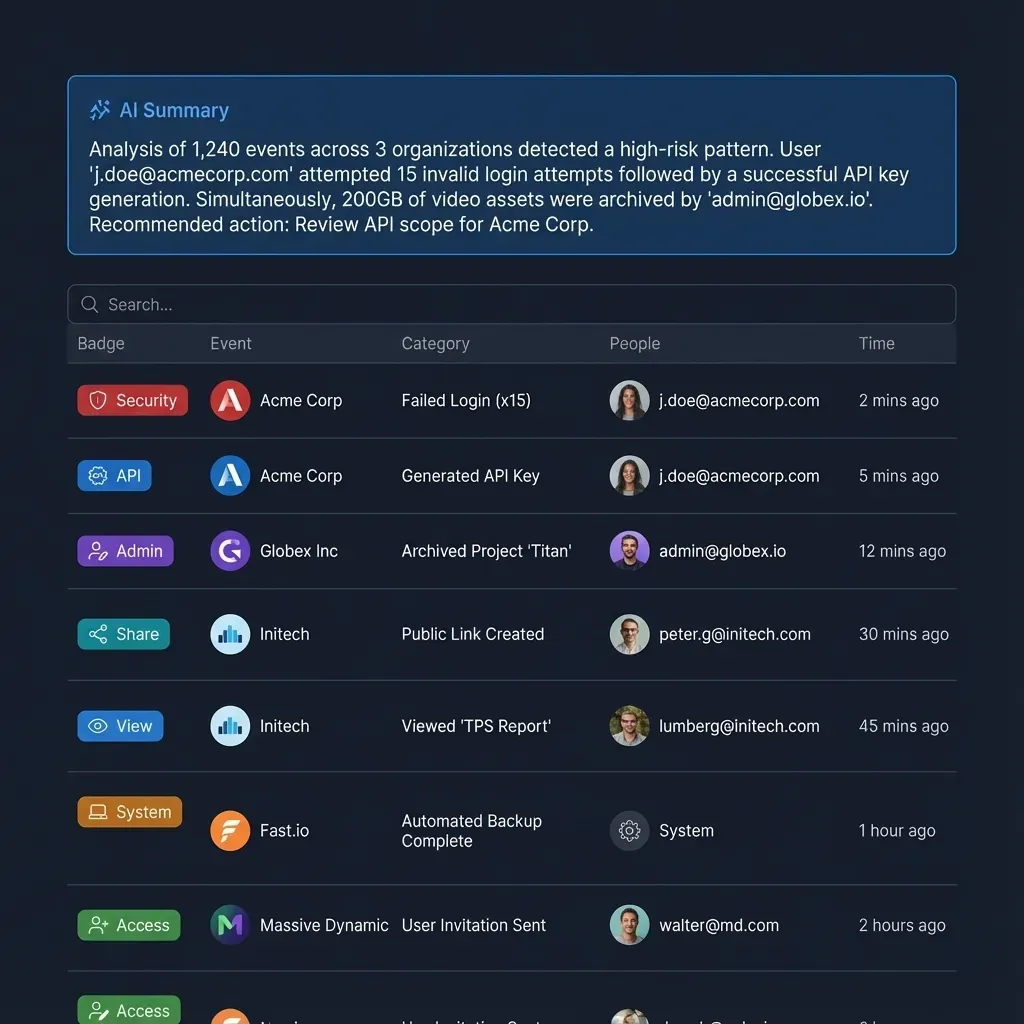
This integration means agents get audit logging without additional instrumentation. The activity feed in each workspace shows a chronological view of all actions, and the API provides programmatic access to audit data for compliance workflows.
For agents requiring persistent storage with built-in audit capabilities, Fast.io offers 50GB free storage with 5,000 monthly credits, no credit card required. This includes comprehensive activity tracking at the workspace, folder, and file levels.
Best Practices for AI Agent Audit Logging
Following established patterns ensures your audit logging system meets compliance requirements while remaining practical for day-to-day operations.
Design Principles
Log Everything by Default, Filter Later It is easier to filter verbose logs than to reconstruct missing data. Start comprehensive and refine based on storage constraints and query patterns. Never skip logging for "routine" operations, as those often contain the context needed to understand anomalies.
Use Standardized Schemas Define consistent field names, data types, and value formats across all agents and tools. Standardization enables cross-agent analysis and simplifies compliance reporting. Consider adopting existing standards like CEF (Common Event Format) or LEEF (Log Event Extended Format) where applicable.
Include Context, Not Just Actions A log entry stating "File deleted" is insufficient. Include which agent deleted it, from which workspace, at what time, with what authorization, and what the file contained (or a reference to its metadata).
Protect Sensitive Data Audit logs themselves become sensitive documents. Implement access controls limiting who can read logs, encrypt log data at rest and in transit, and redact or hash personally identifiable information (PII) where full values are not required for auditing.
Human Review Workflows
Audit logs serve human reviewers. Design for their needs:
- Timeline visualization: Show events in chronological order with clear markers for decision points
- Decision replay: Enable stepping through an agent's reasoning process one decision at a time
- Anomaly highlighting: Flag unusual patterns like permission escalations or repeated errors
- Export capabilities: Generate compliance reports in standard formats (PDF, CSV, JSON)
Integration with Compliance Frameworks
Map audit log fields to regulatory requirements:
While Fast.io provides encryption, SSO, granular permissions, and comprehensive audit logs, organizations requiring specific regulatory certifications should verify compliance mapping with their legal and security teams.
Common Pitfalls and How to Avoid Them
Teams implementing audit logging often encounter predictable challenges. Awareness of these pitfalls prevents costly rework.
Logging Too Little
The most common failure is incomplete logging. If an auditor asks "Why did the agent make this decision?" and your logs only show the final action without reasoning, you cannot answer. Capture the full decision chain, including rejected alternatives.
Inconsistent Time Handling
Agents may operate across time zones and distributed systems. Always use UTC timestamps with millisecond precision. Include timezone offsets where relevant, and ensure all system clocks are synchronized using NTP.
Neglecting Log Integrity
Logs that can be silently modified provide no accountability. Implement checksums or cryptographic signatures for log entries. Store logs in separate systems from the applications generating them to prevent attackers from covering their tracks.
Ignoring Query Performance
A petabyte of logs is useless if queries time out. Plan your indexing strategy around the questions you will actually ask: "What did this agent do last Tuesday?" "Which files were accessed by unauthorized users?" "Show me all instances where this error occurred."
Failing to Test Recovery
Audit logs are only valuable if you can access them when needed. Regularly test your log retrieval and analysis workflows. Simulate compliance audits to ensure you can produce required reports within regulatory timeframes.
Forgetting Agent Evolution
Agents change as models are updated and prompts refined. Log the agent's configuration version with every session. Without this context, you cannot explain why an agent behaved differently six months ago compared to today.
Frequently Asked Questions
What should AI agents log?
AI agents should log agent identity and session context, every tool call with parameters and results, file operations with checksums, decision rationale and reasoning chains, user interactions and feedback, errors and exceptions with full context, and state changes to memory or configuration. Each entry needs a timestamp, correlation ID, and severity level in a structured format like JSON for machine readability.
How do you audit AI agent behavior?
Audit AI agent behavior by implementing comprehensive logging that captures the full execution context, storing logs in immutable, append-only systems, using structured formats that enable efficient querying, maintaining logs for regulatory retention periods, and establishing workflows for human review of agent decisions. The audit process involves correlating events across time and agents, replaying decision sequences, and generating compliance reports that demonstrate accountability.
What is required for AI compliance logging?
AI compliance logging requires immutable storage that prevents tampering, structured data formats for automated analysis, retention periods matching regulatory requirements (often multi-year for high-risk applications), comprehensive coverage of all agent actions and decisions, user identification and authorization tracking, and mechanisms for generating compliance reports. The EU AI Act specifically requires traceability for high-risk AI systems, meaning organizations must be able to reconstruct why an agent made specific decisions and what data influenced those decisions.
How do you trace AI agent decisions?
Trace AI agent decisions by logging the complete reasoning chain including intermediate steps, alternative options considered, confidence scores, and final selections. Use correlation IDs to link related events across the decision sequence. Implement timeline visualization tools that show decisions in chronological order with full context. For complex multi-step workflows, maintain session state logs that capture the agent's evolving understanding and how each decision built upon previous ones.
What storage is best for AI agent audit logs?
The best storage for AI agent audit logs depends on query patterns and retention requirements. Hot storage (databases like PostgreSQL or Elasticsearch) works for thirty to ninety days of active investigation. Warm storage (object storage with indexing like S3 plus Athena) balances cost and accessibility for one to two years. Cold storage (glacier or archive tiers) minimizes cost for long-term legal retention of seven or more years. Append-only databases, write-ahead logging systems, and object storage with compliance locks provide the immutability required for audit integrity.
Related Resources

Need persistent storage with built-in audit logging?
Fast.io gives teams shared workspaces, MCP tools, and searchable file context to run ai agent audit logging workflows with reliable agent and human handoffs.