7 Top Tools for Building Marketing AI Agents in 2026
Building marketing AI agents requires more than a chatbot script. You need a complete stack: a brain to reason, a framework to organize tasks, and a workspace to store results. This guide covers the essential tools for developers and marketers building autonomous campaigns.
How to implement top tools for marketing ai agents reliably
Marketing automation has changed. We are moving from strict "if-this-then-that" workflows to autonomous agents that reason, plan, and execute complex campaigns.
To build these agents, you need a specialized technology stack. A simple script isn't enough when your agent needs to manage thousands of assets, coordinate with other agents, and get approval from human managers.
The 3 core components of a marketing agent stack:
- The Brain: The LLM that provides reasoning (e.g., OpenAI, Anthropic).
- The Body: The framework that connects the brain to tools (e.g., LangChain, CrewAI).
- The Home: The workspace where the agent lives, stores files, and collaborates (e.g., Fast.io).
Here are the top tools that cover these layers.
What to check before scaling top tools for marketing ai agents
Agents generate data: images, copy drafts, reports, and video clips. Most agent frameworks struggle with file persistence. Where do you put the files so humans can actually use them?
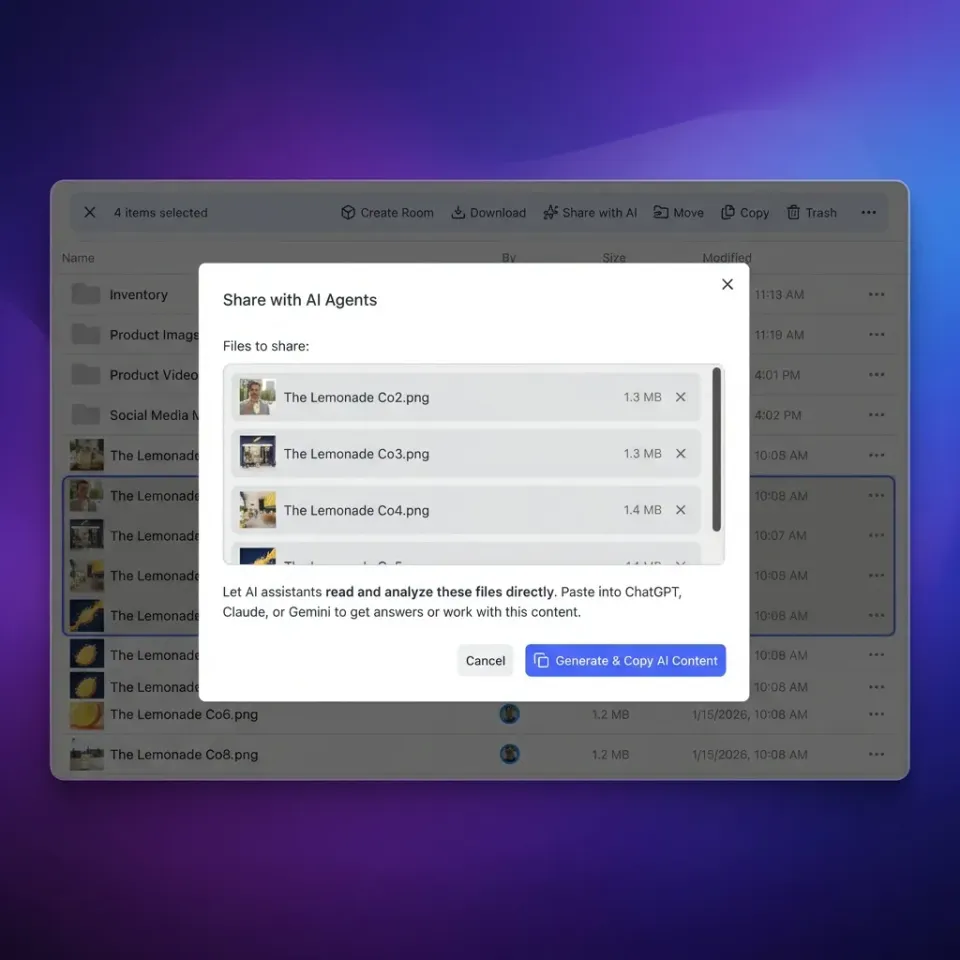
Fast.io solves this by providing a unified workspace for humans and agents. It is not just storage; it is a file system that agents can control via the Model Context Protocol (MCP).
Why it's essential for marketing agents:
- Universal File System: Agents can read/write files that instantly appear in a branded portal for human review.
- multiple MCP Tools: Your agent gets instant capabilities to manage files, search content, and organize folders without custom coding.
- Intelligence Mode: Any file uploaded is automatically indexed. Your agent can "read" a PDF brand guide or "watch" a video asset to understand context before creating content.
- Free Agent Tier: Developers can start with multiple of storage and multiple monthly credits for free.
For marketing specifically, Fast.io connects "agent generates content" and "client approves content."
2. LangChain: The Orchestration Framework
LangChain is a standard for building context-aware applications. It acts as the glue connecting LLMs to other data sources and tools.
For marketing agents, LangChain is useful because it handles the complexity of "chains," or sequences of actions. For example, a chain might be: Research topic -> Draft outline -> Write copy -> SEO optimize.
Key Features:
- Chains & Agents: Pre-built logic for common workflows.
- Document Loaders: Tools to ingest content from web pages or databases.
- Memory: Allows your agent to remember past interactions and campaign details.
Add one practical example, one implementation constraint, and one measurable outcome so the section is concrete and useful for execution.
3. CrewAI: For Multi-Agent Teams
Marketing is rarely a solo job. You have copywriters, designers, and strategists.
CrewAI uses this same structure for AI. It allows you to build a "crew" of specialized agents that collaborate to achieve a goal.
How it works for marketing: You can define a "Researcher Agent" that finds trends, a "Writer Agent" that drafts posts based on those trends, and a "Reviewer Agent" that checks for tone. CrewAI manages the hand-offs and communication between them.
Best For: Complex projects requiring distinct roles and specialized skills.
Define clear tool contracts and fallback behavior so agents fail safely when dependencies are unavailable. This improves reliability in production workflows.
4. OpenAI API: The Intelligence Layer
The OpenAI API (specifically the Assistants API) remains a popular choice for the "brain" of your agent. Models like GPT-4o provide the reasoning capabilities needed to understand nuance, humor, and brand voice.
Why developers choose it:
- Function Calling: The model can decide when to call external tools (like your CRM or CMS).
- Code Interpreter: Useful for analyzing marketing data and generating charts.
- Fine-tuning: You can train a model specifically on your brand's historical high-performing copy.
Add one practical example, one implementation constraint, and one measurable outcome so the section is concrete and useful for execution.
Teams should validate this approach in a small test path first, then standardize it across environments once metrics and outcomes are stable.
5. Gumloop: The No-Code Builder
Not every marketing team has a Python developer.
Gumloop (formerly partial.ly) allows you to build powerful AI workflows using a visual drag-and-drop interface.
The "Lego" approach: You connect blocks like "Scrape Website," "Summarize Text," or "Generate Image" to create a pipeline. It's powerful enough to build functional agents without writing a single line of code.
Best For: Growth marketers who want to prototype and deploy agents quickly.
Add one practical example, one implementation constraint, and one measurable outcome so the section is concrete and useful for execution.
Teams should validate this approach in a small test path first, then standardize it across environments once metrics and outcomes are stable.
6. Zapier: The Integration Layer
Zapier has moved from simple automation to AI-powered workflows. With "Zapier Central," you can teach bots how to behave across multiple+ apps.
For marketing agents, Zapier provides the connections. Your agent might need to post to LinkedIn, update a HubSpot contact, and send a Slack notification. Zapier handles the API connectivity so you don't have to build custom integrations for every platform.
Add one practical example, one implementation constraint, and one measurable outcome so the section is concrete and useful for execution.
Teams should validate this approach in a small test path first, then standardize it across environments once metrics and outcomes are stable.
7. HubSpot (Agentforce/Breeze): The Enterprise Platform
For enterprise teams, building from scratch isn't always the answer.
HubSpot (and Salesforce with Agentforce) are releasing native AI agents embedded directly in their platforms.
Breeze (HubSpot's AI): Includes agents specifically for content, social media, and prospecting. While less flexible than a custom LangChain build, these agents have the advantage of native access to your entire CRM database.
Best For: Teams deep in the HubSpot ecosystem who want "out of the box" agent capabilities.
Define clear tool contracts and fallback behavior so agents fail safely when dependencies are unavailable. This improves reliability in production workflows.
Teams should validate this approach in a small test path first, then standardize it across environments once metrics and outcomes are stable.
Comparison: Which Tool Is Right for You?
Choosing the right tool depends on your technical resources and customization needs.
| Tool | Best For | Coding Required?
| Key Strength | |------|----------|------------------|--------------| | Fast.io | Storage & Collaboration | Low (MCP) | Persistent workspace for agent outputs | | LangChain | Custom Applications | High | Maximum flexibility and control | | CrewAI | Team Simulations | High | Orchestrating multiple specialized agents | | Gumloop | Rapid Prototyping | No | Visual builder for non-technical users | | OpenAI | Core Reasoning | High | Leading language models |
Add one practical example, one implementation constraint, and one measurable outcome so the section is concrete and useful for execution.
Where to Start: Building Your First Agent
If you are building your first marketing agent, start simple.
- Pick a specific task: Don't build a "Marketing Manager." Build a "Tweet Drafter."
- Choose your brain: Start with OpenAI's GPT-4o for best results.
- Give it a home: Set up a Fast.io workspace so your agent has a place to read brand guides and save its drafts.
- Connect tools: Use the Fast.io MCP server to let your agent manage files, or Zapier to connect to social platforms.
Marketing is becoming more autonomous. The tools above give you everything you need to build it.
Define clear tool contracts and fallback behavior so agents fail safely when dependencies are unavailable. This improves reliability in production workflows.
Frequently Asked Questions
What is a marketing AI agent?
A marketing AI agent is an autonomous software program that uses artificial intelligence to perform marketing tasks. Unlike a chatbot, an agent can plan, use tools, and execute workflows, like researching a topic, writing an article, and publishing it, without constant human intervention.
Do I need to know Python to build an AI agent?
Not necessarily. Tools like Gumloop and Zapier allow you to build functional agents using visual interfaces. However, for advanced custom agents with complex reasoning and unique tool integrations, Python frameworks like LangChain are the standard.
How much does it cost to run a marketing agent?
Costs vary by usage. You typically pay for the LLM tokens (e.g., OpenAI API costs) and the hosting infrastructure. Fast.io offers a [free agent tier](/pricing/) with multiple of storage and multiple monthly credits, which is sufficient for many pilot projects.
Can AI agents replace marketing teams?
No. The most effective approach is keeping a human in the loop. Agents handle repetitive tasks like data analysis, drafting, and resizing images, freeing up human marketers to focus on strategy, creative direction, and final approval.
Related Resources

Give your marketing agents a home
Fast.io provides the secure, intelligent workspace your agents need to store files and collaborate with your team. Built for tools marketing agents workflows.