How to Build an AI Agent in Python
An AI agent is software that perceives its environment, makes decisions, and takes actions to achieve specific goals. While 80% of AI development happens in Python, most tutorials skip a critical component: persistent memory. This guide shows you how to build a functional AI agent in Python that doesn't lose its memory when you restart the script.

What Exactly is an AI Agent?
At its core, an AI agent is a loop. It's a software system that uses a Large Language Model (LLM) as its "brain" to reason about a task, decide on a course of action, and execute that action using tools. Unlike a passive chatbot that waits for your next prompt, an agent actively pursues a goal.
The Four Components of Agent Architecture
To build a working agent in Python, you need four key components:
Brain (LLM): The reasoning engine (e.g., GPT-4, Claude 3.5 Sonnet, Llama 3). 2.
Memory: The ability to store context, past interactions, and long-term knowledge. 3.
Tools: Capabilities (functions) the agent can call, like web search, file I/O, or API requests. 4.
Planning: The strategy layer where the agent breaks down complex goals into steps. Most developers get the "Brain" and "Tools" right but fail at "Memory." Without persistent storage, your agent has amnesia. It resets every time the session ends.

Step 1: Setting Up Your Python Environment
Before writing code, we need a clean environment. We'll use Python (version 3.10 or higher) and the official libraries for our chosen LLM. This tutorial stays framework-agnostic so you understand the raw logic, but you can adapt this to LangChain or CrewAI later.
Installation Checklist
Create a new directory and set up your virtual environment:
Create project folder: mkdir my-ai-agent && cd my-ai-agent
2.
Initialize environment: python -m venv venv
3.
Activate environment: source venv/bin/activate (or venv\Scripts\activate on Windows)
4.
Install dependencies:
bash pip install openai python-dotenv requests
You'll also need an API key from OpenAI, Anthropic, or a local LLM server. Create a .env file in your project root and add your key: OPENAI_API_KEY=sk-....
Step 2: Building the Agent Loop
The "heartbeat" of an AI agent is its execution loop. This is a while loop that continuously checks the current state, consults the LLM, and decides what to do next. Here is the simplest implementation of an agent loop in Python:
import os
from openai import OpenAI
from dotenv import load_dotenv

load_dotenv()
client = OpenAI()

messages = [
    {"role": "system", "content": "You are a helpful AI agent."}
]

while True:
    user_input = input("User: ")
    if user_input.lower() in ["exit", "quit"]:
        break

    messages.append({"role": "user", "content": user_input})

    response = client.chat.completions.create(
        model="gpt-4o",
        messages=messages
    )

    agent_reply = response.choices[0].message.content
    print(f"Agent: {agent_reply}")

    messages.append({"role": "assistant", "content": agent_reply})
This code works, but it has a major flaw: Ephemeral State. If you stop the script, the messages list is destroyed. Your agent forgets everything. For a production agent that runs for days or weeks, this won't work.
Step 3: Solving Amnesia with Persistent Storage
To make your agent work reliably, it needs a place to write long-term memories. While you could save to a local JSON file, that breaks if you move your agent to the cloud (like AWS Lambda or a container). The better solution is to use cloud-native storage that mimics a local filesystem. This allows your agent to read/write its state from anywhere without managing database servers.
Implementing Persistent State
By connecting your agent to a persistent storage layer, you make sure context survives restarts. This is important for agents that run on cron jobs or serverless functions.
Why File-Based Storage Works for Agents:
- Simplicity: Agents natively understand files (read/write). * Portability: JSON/Markdown files are readable by humans and other agents. * Cost: Much cheaper than managing a vector database for simple state. Fast.io provides an advantage here: it offers a standard filesystem interface that is actually cloud storage. Your agent can write to
memory.json, and that file is instantly replicated, secure, and accessible via API or MCP.
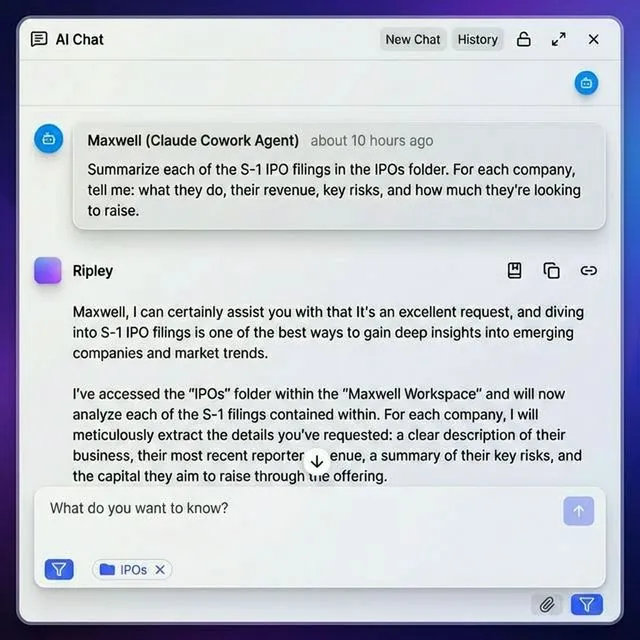
Step 4: Giving Your Agent Tools (MCP)
An agent that can only talk is just a chatbot. To make it an agent, we give it tools. In 2025, the standard for this is the Model Context Protocol (MCP). Instead of writing custom Python functions for every capability (like get_weather() or search_web()), you can connect your agent to an MCP server. This gives it instant access to dozens of pre-built tools.
Connecting to Tools via MCP
If you are using Fast.io, your agent automatically gets access to 251+ file operation tools. This allows it to:
- Read/Write: Edit code files, logs, or reports. * Search: Find documents using semantic search (RAG). * Organize: Move, rename, or archive project assets. This transforms your Python script from a conversationalist into a worker that can manage your entire digital workspace.
Why Most Python Agents Fail in Production
Building the prototype is easy (as seen in Step 2). Deploying a reliable agent is harder. The most common failure points are:
- Lack of Persistence: The agent crashes and loses its task list. * Context Window Overflow: The
messageslist gets too big and crashes the LLM call. * Hallucination: The agent tries to use tools it doesn't have. * Authentication Problems: Managing API keys for 20 different services. By using a dedicated agent platform or strong storage backend like Fast.io, you solve the Persistence and Authentication problems out of the box. You get a secure environment where your agent's state is safe, and file operations are authenticated automatically.
Frequently Asked Questions
What Python library is best for AI agents?
LangChain is the most popular framework for general-purpose agents due to its massive ecosystem. However, for specialized or lightweight agents, frameworks like CrewAI, AutoGen, or even raw Python with the OpenAI SDK are often preferred for their simplicity and control.
How long does it take to build an AI agent?
You can build a basic prototype in Python in under 15 minutes using the OpenAI API. However, building a production-grade agent with persistent memory, tool access, and strong error handling typically takes several days to weeks of development and testing.
Do AI agents need a database?
Yes, serious AI agents need persistent storage to maintain state between sessions. While you can use complex databases like PostgreSQL, many developers prefer file-based storage on platforms like Fast.io because it allows agents to interact with memory using natural file operations (read/write) rather than SQL queries.
Related Resources

Give your AI agent permanent memory
Stop building amnesic agents. Get 50GB of free, persistent cloud storage that your Python agents can read and write to like a local drive.